New York, June 24, 2026 – Israel’s rich history, which spans thousands of years, continues to be revealed through ongoing archaeological work led by the Israel Antiquities Authority (IAA), the University of Haifa, and independent researchers across the country. So far this year, there have been many groundbreaking discoveries, from 1,500-year-old bronze scales to ancient tunnels unearthed beneath the walls of Jerusalem. These discoveries highlight Israel’s storied and layered history.
“Few places in the world offer the opportunity to witness history being uncovered in real time, and these discoveries highlight the extraordinary depth of Israel’s cultural and historical heritage,” says Yoram Elgrabli, Tourism Commissioner for North America at the Israel Ministry of Tourism. “What makes these findings especially exciting is that they continue to reveal new chapters of a story that spans thousands of years, from the earliest evidence of human life to civilizations and faiths that have shaped our world. There is something truly remarkable about standing in a place where history is still emerging from the ground and helping us better understand our shared past. Whether exploring ancient archaeological sites, world-renowned museums, or the vibrant cities that blend the past with the present, visitors to Israel can experience a destination where every stone has a story to tell. These discoveries inspire curiosity and wonder, offering visitors a deeper connection to the people, cultures and events that have shaped human history.”
Some of the artifacts uncovered by archaeologists and the general public in Israel in 2026 include:
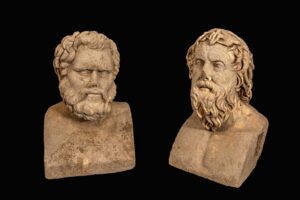
Two 1,700-year-old Roman Marble Statues Discovered Near Binyamina
Two marble statues dating back to the Roman Empire were discovered during an excavation led by the IAA as part of a coastal high-speed railway project. These two sculptures, which depict historical figures from the Greco-Roman world, were found buried in a wine collection pit of a Roman-Byzantine winepress. A Greek inscription bearing the name “Lycurgus” was preserved on one of the statues. These spectacular statues will be unveiled for the first time at the “Center VII -The Domestic House” annual archaeological conference at Tel Aviv’s MUZA – Eretz Israel Museum this month and will be on display to the public throughout the summer months.
________________________
Credit: Israel Antiquities Authority
________________________
Rare 1,500-Year-Old Scale Discovered in Susya
A rare bronze scale pan dating to the late Roman–Byzantine period was uncovered during a community archaeological excavation in the residential and commercial area of ancient Susya, led by the IAA in cooperation with regional partners. The discovery was made when a second-grade participant, together with his father, spotted the artifact during the dig. The object has been identified as part of a portable hanging balance scale (trutina). A system widely used in ancient Israel for commercial weighing, consisting of small bronze pans suspended from a balancing beam. The recovered pan features perforations along its rim used for attachment to suspension cords. Researchers say such scales were common tools in everyday trade, providing insight into the economic activity and measurement practices of the settlement during the period.
A 2,000-Year-Old Ancient Sling Bullet Discovered Near the Sea of Galilee
Archaeologists from the University of Haifa uncovered a rare Hellenistic-period sling bullet near the ancient city of Hippos, bearing the Greek inscription “Learn,” believed to be a taunting or sarcastic message directed at an enemy. Researchers note that during the Hellenistic period sling bullets were typically mass-produced by casting lead into simple stone molds, a method that allowed for rapid production even during military campaigns. The find offers insight into both the psychological aspects of ancient warfare and the use of slings as effective long-range weapons, likely employed by Hippos’ defenders during periods of conflict.
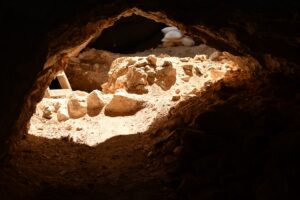
A Rare, Pre-Historic Cave Dating 400,000 Years Uncovered Near Haifa
A prehistoric cave dating back between 400,000 and 250,000 years was recently uncovered on the outskirts of the town of Fureidis, south of Haifa. The excavation of the cave depicts a time capsule that remained sealed for hundreds of thousands of years since the time of the Acheulo-Yabrudian culture, a time just before modern humans became dominant in the world. The site, among the most significant of its kind, offers new insight into early human life at a critical point in human evolution.
________________________
Credit: Israel Antiquities Authority
________________________
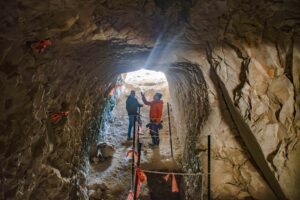
Ancient Tunnels Uncovered Beneath the Soil of Jerusalem
An excavation led by the IAA led to a monumental discovery of ancient tunnels near Kibbutz Ramat Rachel in Jerusalem. Researchers are still unsure about the purpose of this tunnel which measures approximately 16 by 10 feet, though they believe it was intended to reach a chalk layer suitable for quarrying building stones or producing lime. Possible evidence supporting this interpretation includes a shaft carved into the tunnel’s ceiling, which may have been used for ventilation, as well as quarrying debris discovered on the tunnel floor, although this interpretation, too, remains uncertain.
______________________
Credit: Israel Antiquities Authority
______________________
A 1,300-year-old Marble Bowl Found in the Golan Heights
Discovered in a cathedral in the Golan Heights, a 1,300-year-old marble bowl was found by a team of archaeologists from the University of Haifa. Experts suggest that this bowl was once used as an offering table for early Christian settlers in Israel.
_____________________________
For more information about Israel’s tourism offerings, visit israel.travel.
About the Israel Ministry of Tourism
The Israel Ministry of Tourism (IMOT) is Israel’s national tourism agency responsible for planning and implementing marketing and promotional initiatives to position Israel as a preferred travel destination. IMOT aims to increase tourism traffic to enhance and diversify the visiting experience. IMOT works to promote Israel’s impressive assortment of historical, cultural, culinary, and religious attractions – each the perfect blend of tradition and modernity. IMOT offices in North America are located in New York, Los Angeles, Atlanta, Chicago and Toronto. For details on upcoming events and attractions in Israel, visit IMOT’s website at israel.travel. Follow us on Facebook, X and Instagram to receive the latest updates.
_____________________________
Article Source: Israel Ministry of Tourism news release.
_____________________________
POPULAR ARCHAEOLOGY ON INSTAGRAM

_____________________________