When one thinks of great rivers of the world, waterways like the Nile, Mississippi, the Yangtze, Amazon, and Yellow usually come to mind. Not many think of the great Indus River, however. Among the longest rivers of the world, it stretches 2,000 miles, beginning at the Tibetan Plateau and piercing through the Indian subcontinent before finally emptying into the Arabian Sea. It is a vital economic and agricultural lifestream for hundreds of millions of people.
It also carries the name of one of the oldest and most expansive civilizations of the world — the Indus Valley Civilization.
Otherwise known as the Harappan, it was a Bronze Age civilization that dominated the northwestern regions of South Asia from 3300 BCE to 1300 BCE, reaching its greatest florescence from 2600 BCE to 1900 BCE. Of the three earliest civilizations of the Old World outside of China, the others being ancient Egypt and Mesopotamia, it was the most widespread geographically, spanning much of present-day Pakistan, northwestern India, and northeast Afghanistan. The Harrapan was noted for its sophisticated urban planning, baked brick houses, elaborate drainage systems, water supply systems, clusters of large non-residential buildings, and techniques of handicraft and metallurgy. Mohenjo-daro and Harappa, its two largest centers identified through archaeological investigations, grew to consist of between 30,000 and 60,000 individuals, with the whole of its geographic extent containing between one and five million individuals at its hight.
_____________________________
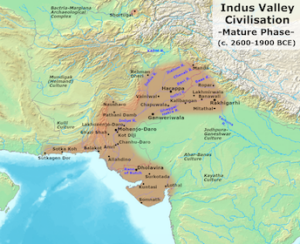
Map of Indus Valley Civilization, Mature Phase, c. 2600 – 1900 BCE. Avantiputra7, CC BY-SA 3.0, Wikimedia Commons
_____________________________
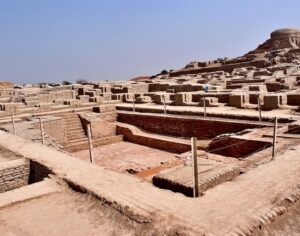
Excavated remains of Mohenjo-daro, with the Great Bath in the foreground and the granary mound in the background. Saqib Qayyum, CC BY-SA 3.0, Wikimedia Commons
_____________________________
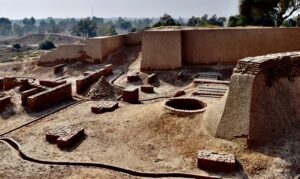
Archaeological Site of Harappa. Amanasad83, CC BY-SA 4.0, Wikimedia Commons
_____________________________
Much about this civilization has been revealed through archaeological excavations and studies. Compared to its contemporary Bronze Age civilization of Mesopotamia to its west and Egypt far to its south, however, less is known of its history and culture. That is at least in part because the script most scholars associate with this civilization, the Indus Script, remains frustratingly undeciphered. Most symbols found have been inscribed on seals, impressions of such seals and graffiti markings on pottery. Thus, most inscriptions are very short, making it difficult to determine if they constitute an actual writing system used to represent a Harappan language, which has not yet been identified. No scripts have yet been found on perishable organic materials such as papyrus, paper, textiles, leaves, wood, or bark. However, by 1977 at least 2,906 inscribed objects with legible inscriptions had been discovered and by 1992 about 4,000 inscribed objects have been identified. Moreover, in 2025 it was reported that around 5,000 inscriptions had been excavated since 1924.
____________________________
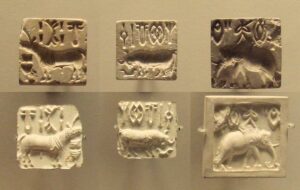
Seals showcasing Indus script. ALFGRN, CC BY-SA 2.0, Wikimedia Commons
____________________________
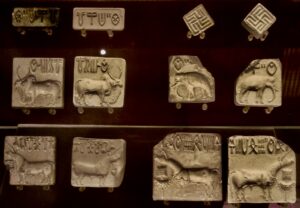
Stamp seals of the Indus Valley Civilization, some of them with Indus script; probably made of steatite; British Museum (London). World Imaging, CC BY-SA 3.0, Wikimedia Commons
____________________________
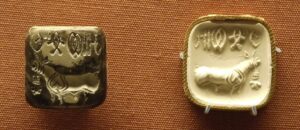
Indus stamp-seal 2500BC-2000BC. Geni, CC BY-SA 4.0, Wikimedia Commons
____________________________
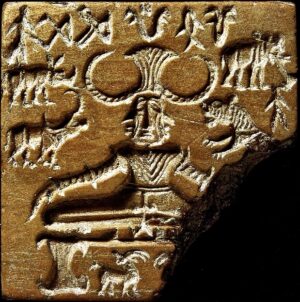
The Pashupati seal, showing a seated figure, surrounded by animals. 2600–1900 BCE. Public Domain, Wikimedia Commons
____________________________
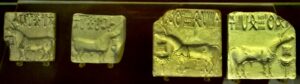
Seals showing unicorns. Mukerjee, CC BY-SA 3.0, Wikimedia Commons
____________________________
Professionals and amateurs alike have attempted to decipher the script over decades, and the nature of the script has been vigorously debated across several competing camps:
1. The Dravidian Hypothesis
Prominent scholars like Asko Parpola and Iravatham Mahadevan argue the script encodes an ancestral Proto-Dravidian language. They point to the structural syntax of the signs and remnants of Dravidian linguistic influences found in later regional texts.
2. The Indo-Aryan / Sanskrit Hypothesis
Alternative perspectives attempt to align the symbols with early Vedic Sanskrit and northern traditions. However, mainstream archeologists note that central Vedic elements, such as the domestic horse and spoke-wheeled chariots, are entirely absent from Harappan imagery.
3. The Non-Linguistic Token Theory
A sizable minority of modern researchers argue that the Indus script does not represent a spoken language at all. Instead, they believe it operated as a sophisticated proto-cuneiform accounting system—a code for weights, measures, political titles, and property tracking used to facilitate trade across the ancient world.
4. The Computational Search Methodology
Modern computer scientists use machine learning and AI-epigraphy tools to analyze symbol patterns and sign frequencies. Statistical analysis shows the script possesses conditional entropy—an organized structure that mimics the syntax of true spoken languages rather than random decorative symbols.
A New Breakthrough?
A promising new attempt has recently emerged to challenge all others. In the following brief interview, Popular Archaeology Magazine posed a number of questions to young computer scientist and engineer Bharath Rao (pictured below), a key player in this effort. The answers could shed new light on finally breaking the Indus Script ‘code’:
____________________________
1. What is your experiential/educational/professional background and how does it relate to the work you have done relating to the Indus Script?
A: I have a bachelors and masters in computer science and engineering. I have worked on cryptography as a part of my career. I realized that decipherment must be modeled as a cryptoanalysis problem to obtain the best results. If I have done anything innovative, it is that I have modeled the problem correctly.
__________________________

Bharath Rao. Image courtesy Bharath Rao.
__________________________
2. What led you to embark on this undertaking?
A: During covid I was in a year long lockdown and needed a long difficult problem to occupy myself. When I ran into the Indus decipherment problem, it seemed like something that could occupy me for years.
3. In your words, why is the Indus Script so important and what is the significance of your work as documented here on the decipherment of the Script?
A: The decipherment of the Indus script unlocks many unanswered and highly debated issues of pre-Iron age India and the Indo-European question. Everything about the Indus civilization is debated from the iconography to the language to their religious beliefs. Is Indian culture continuous since the neolithic? How were the religious beliefs developed? These are debated strongly into present day. Finally, we have some certainty in interpreting these.
4. In a summary that would be understandable to the general public, what are the key tools, concepts, and methodologies you used to decipher the script and how were they specifically applied to the current record of Script finds?
A: One of the key properties of language and scripts is redundancy, the fact that not all arrangements of letters are valid or likely. Cryptograms, crosswords and many word puzzles work because of this property. Without it, you could enter any letter in a crossword and it would make a valid word. The fact that a small set of values fits in a particular place means that when you have multiple places to test the same value, the set of possible values shrinks very quickly. This is essentially the decipherment done on a large scale. Using computers, thousands of possibilities can be scanned in seconds, which lets us proceed rapidly. The harder parts are resolving which glyphs represent the same signs, reconstructing the sign names, cross checking grammar and so on.
5. How does this approach differ from anything that has been done before and why do you think it is a more valid and effective means to deciphering the Script?
A: So far the Indus script decipherment approaches have been whimsical and ad-hoc. An “I think this sign looks like-” type of approach cannot read anything beyond a few short inscriptions meaningfully. This led to vastly different and incompatible results among various attempts. Indeed, the meaning of readings, if any was from the key that was proposed and not from the inscriptions. Scripts generally may be viewed as ciphers and deciphering a script is similar to solving a large cryptogram of the kind that are found in newspapers. With the help of computers, this effort can be speeded up. Once the values were deciphered using a small set of inscriptions, reading the entire corpus and finding that grammatical constraints such as subject verb agreement, adjective noun agreement, and consistent themes made it clear that the decipherment is correct. Because this is a mathematical decipherment, we can prove its correctness mathematically, showing that the language is natural speech.
6. What are the significant results of the decipherment as it relates to our new understanding of the Script?
A: The language of the Indus script is vedic Sanskrit. The orthography is similar to early Brahmi inscriptions. Analysis of the results show a Zipfian slope of -1, which indicates that the results reflect natural speech.
7. What have been the significant challenges of doing this work?
A: The decipherment, although algorithmic, was tedious and needed manual verification of the translations and grammar in Vedic Sanskrit. Many inscriptions are so degraded over time that it takes careful visual examination to read the glyphs. To a large extent, others have done this work already and created databases. Recently, due to the availability of a grammar library, the corpus translation and grammar is now machine verified.
8. Where will this paper be published (if not already published?) in terms of peer-reviewed journals?
A: The work needs a bit more polishing after which, it may be published in a suitable journal. As some scholars have pointed out, any work on the Indus script is essentially career suicide because academia seems to resist any and all claims to decipherment.
9. What are the implications of this decipherment for understanding the Indus civilization?
A: The content is similar to the content on seals in the region where the Indus sites that transitioned uninterrupted into the historical era. Even many names see a continuity into the historical era. This result is significant because it shows that Indian culture, history and language is uninterrupted from the era of the earliest settlements. This falsifies any late ingress of language into the Indian subcontinent. We are also able to identify the various deities in the iconography and correlate narrative iconography to lore from Indian texts.
10. What are your next steps/objectives related to this work?
A: There is a need on educating the public about the decipherment process, the contents of the corpus, the symbolism, new names and many interesting facts that have been uncovered. This needs detailed presentation plans and organizational effort. In addition, I plan to engage with cryptographers to get their input on the decipherment.
_________________________
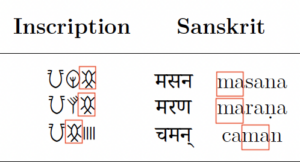
Example of one of the Indus scripts being resolved. Courtesy Bharath Rao. “….We decipher the Indus script by treating it as a large cryptogram as described by Claude Shannon…..Our decipherment can read every inscription and we translate 500+ inscriptions in- cluding the 50+ longest, 50+ shortest and 400+ medium-sized inscriptions including 100+ inscriptions with conjunct signs. We comfortably surpass Shannon’s criteria for a credible cryptogram decipherment. Brahmi glyphs are discovered to be stan- dardized Indus signs. We find significant continuation of Indus linguistic features and cultural elements in post-bronze age India.” —- From A Cryptanalytic Decipherment of the Indus script, by Bharath Rao.
_________________________

Claude Elwood Shannon (April 30, 1916 – February 24, 2001) was an American polymath who was a mathematician, electrical engineer, computer scientist, cryptographer, and inventor known as the “father of information theory”, and the man who laid the foundations of the Information Age. Shannon contributed to the field of cryptanalysis for national defense of the United States during World War II, including his fundamental work on codebreaking and secure telecommunications, writing a paper which is considered one of the foundational pieces of modern cryptography. Unknown author, CC BY 2.0, Wikimedia Commons
_________________________
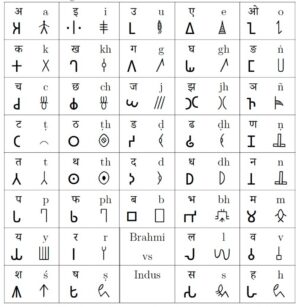
Indus/Brahmi table of scripts. Courtesy Bharath Rao.
____________________________
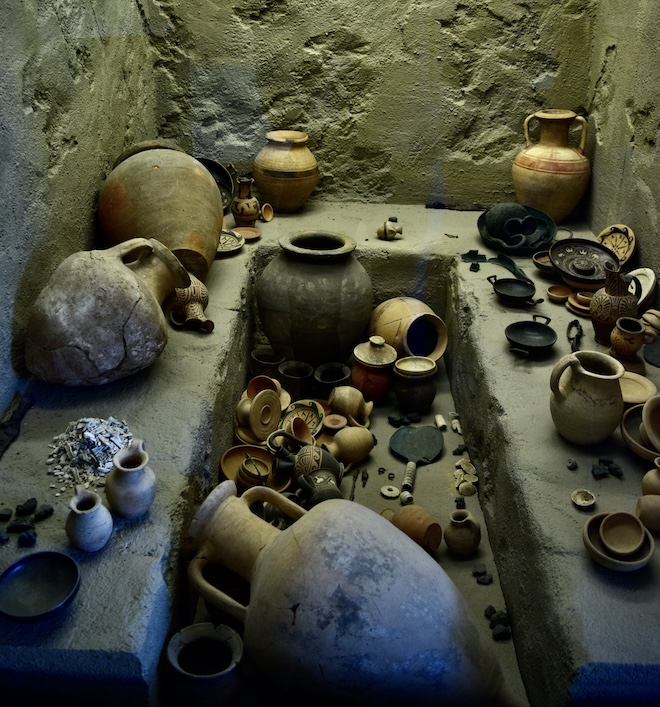
Cover Image, Top: Lajja Gauri Indus Valley artifacts. Eve whiter, CC0 1.0, Wikimedia Commons
_________________________