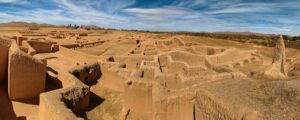
Proceedings of the National Academy of Sciences—Researchers re-characterized the precolonial population dynamics at a monumental archaeological site in the Chihuahuan Desert in Mexico. The Casas Grandes people lived in northwestern Mexico from 700 to 1450 CE and built Paquimé, the largest precolonial city in the region. The driving factors behind the population growth of the Casas Grandes people, which led to the construction of Paquimé in the 13th and 14th centuries, are not well-understood. Meradeth Snow and colleagues explored changes in the gene pool of the Casas Grandes population over 700 years by analyzing mitochondrial genetic data from 114 individuals interred at sites dated between 700 and 1450 CE. Casas Grandes was geographically located between other contemporary cultures in the southwestern United States and Mesoamerica and featured a blend of cultural traditions. Previous hypotheses suggested that large-scale immigration was the major driver of population growth in the region. The authors’ mitochondrial analysis detected genetic continuity across the studied time period and uncovered evidence of only low levels of immigration, which may have contributed to the hybridized cultural practices of the Casas Grandes people. Hence, the flourishing of the Casas Grandes tradition may have been driven by internal changes, rather than widespread population replacement. The findings provide insight into how migration has influenced human history and population dynamics, according to the authors.
____________________________
Ancient Mexican city of Paquimé. Michael T. Searcy
____________________________
Article Source: PNAS news release
*“A reanalysis of population dynamics in the Casas Grandes region of Northern Mexico using mitochondrial DNA,” by Meradeth Snow et al., Proceedings of the National Academy of Sciences, 15-Sep-2025. 10.1073/pnas.2506162122