
American Association for the Advancement of Science (AAAS)—The earliest human societies in the Americas likely hunted specific animals such as mammoths and giant ground sloths rather than general prey that was abundant at the time, according to new research. These findings could shed light on how early Paleoindians adapted their habits to expand across these continents successfully – a question that has been debated by experts in the field. The debate centers around two opposing ideas that suggest either that Paleoindians were megafauna specialists (i.e., they targeted specific large herbivores) or that they were dietary generalists (i.e., they exploited prey that were abundant within a specific habitat). Recent studies have produced conflicting results, highlighting the need for more comprehensive analyses of archaeological evidence. Here, Ben Potter and colleagues focused on records of the earliest continent-wide cultures in Eastern Beringia, the Clovis complex in North America, and the Fishtail Projectile Point (FPP) complex in South America. The researchers evaluated both the specialist and generalist models based on faunal records, estimated abundance, and Paleoindian technology use and behaviors. Analysis of animal remains at archeological sites revealed that Paleoindians showed a dietary preference for large herbivores such as mammoths and giant ground sloths over smaller mammals such as deer. Clovis and FPP technologies found at these sites included darts and throwing spears, as well as tools for butchering large animals. By contrast, there was no evidence of tools or implements that would be useful for trapping smaller prey or processing plants. In addition, kill sites and camps indicated that early Paleoindians were very mobile and frequently ranged over large distances. Potter et al. propose that these findings are consistent with specialist hunters who tracked their preferred prey into new regions, facilitating the population’s spread across the continent. The authors also speculate that this dietary preference may have contributed to the subsequent extinctions of megafauna during the Late Pleistocene era.
__________________________
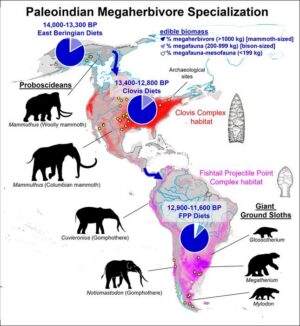
Time-transgressive Paleoindian focus on key megaherbivores in Beringia, North America and South America. Credit: Image created by Ben Potter from data in Potter et al. (2026).
__________________________
Article Source: AAAS news release.
*Hemisphere-wide evidence of Early Paleoindian megaherbivore specialization, Science Advances, 1-Jul-2026. 10.1126/sciadv.aef9628
Image Top: Mammoth at sunset. Kyraxys, Pixabay