The earliest dice ever discovered were found in Mesopotamia and date to around 3000 BCE. Even then, the principle was simple and familiar: correctly guess a number or combination and you win. Egypt, Greece, Rome, and China developed this tradition into dozens of distinct games, many of which made their way recognizably into modern backgammon, lotteries, board strategies, and sports betting practices.
How this overview is structured: games, bets, prohibitions, and modern heirs
For each civilization, the same pattern emerges: the context of the era, popular pastimes, bets and their consequences, the response of authorities and society, and what has survived to the present day. Ancient Egypt stands first in this sequence, its gambling history proving just as long as the civilization itself.
Egypt: gambling on the banks of the Nile, from Senet to proto-roulette
The independent history of Ancient Egypt spans more than three millennia, from approximately 3150 BCE to its annexation by Rome in 30 BCE. In the longest-lived state of antiquity, gambling was a mass phenomenon and, at the same time, a persistent headache for the pharaonic administration.
What the pharaohs and their subjects played
The list of Egyptian games is striking both in its variety and in its resemblance to modern equivalents:
- Mehen — a board with a spiral pattern in the shape of a serpent. According to one interpretation, players threw a ball and bet on where it would land (an obvious parallel with roulette); according to another, they moved along the spiral from “tail” to “head,” as in a classic race-style board game.
- Seneth and Tiau — board games with pieces and rectangular boards, resembling checkers or chess. Tiau was compact and portable, while Seneth was bulkier and more prestigious.
- Dice — the familiar multi-sided cubes, a universal game of prediction.
- Habem-Hau — throwing discs into a bowl for money, and Horse and Jackal— a board simulation of horse racing.
Bets and personal possessions at stake
Egyptians wagered money or personal property on the outcome of each match. This was no harmless pastime: a loss could mean the real forfeiture of valuable belongings, turning every game into a risky venture.
A quarrel between two Seneth players that took place around 4,300 years ago was recorded directly on the wall of the tomb of Pephi-Ankh in the necropolis of Meir. This is considered the earliest written evidence in history of gambling loosening tongues.
Laws against gambling and punishments
Gambling was regarded by Egyptian authorities as a serious social problem. Numerous surviving papyri contain laws against gambling, and habitual players were sent to forced labor, which effectively meant enslavement.
Mehen, with its element of chance, echoes the concept of roulette; Seneth and Tiau resemble board strategies; and dice remain an enduring symbol of gambling to this day. Those same dice and wagers connect Egypt to another great civilization — Ancient Greece.
Greece: when even the gods cast lots
In Greek mythology, Zeus, Poseidon, and Hades divided the heavens, the oceans, and the underworld among themselves by casting lots. The heroes of the Trojan War, Achilles and Ajax, played dice right beneath the walls of the besieged city. If gods and demigods did not shun gambling, it was nearly impossible for ordinary mortals to resist.
The main games: from backgammon floors to ancient tic-tac-toe
- Tilia — a forerunner of modern backgammon. The key difference: the board could be part of a stone floor rather than a separate wooden panel.
- Triassic — an equivalent of tic-tac-toe played on reusable compact boards.
- Guessing games — odds and evens, heads or tails, and other simple games of chance.
- Betting on athletic contests and horse racing, which drew large crowds of spectators.
Philosophers and scholars were fierce opponents of gambling, yet the celebrated Homer was, by contrast, known as a great enthusiast of it. An outright ban on gambling existed in only one city-state (polis) — the austere Sparta. The Romans borrowed much from the Greeks and gave it new names.
Rome: prohibitions on paper, gambling everywhere
Ancient Rome borrowed Greek gambling games almost wholesale, equipping them with new names:
- Mill Wheel replaced Trias.
- Duodecim and Tabula became local versions of backgammon.
- Dice, guessing games, and betting on gladiatorial combat and horse racing remained everyday pastimes.
Roman law formally prohibited gambling and punished violators. Yet the population’s love of gambling proved stronger than any prohibition.
Pompeii: a stone menu as a game board
In one Pompeii restaurant, the stone menu was laid out so that it could double as a board for Duodecim. Patrons played in plain sight without arousing suspicion, while the establishment gained a loyal clientele. Duodecim survived almost unchanged to the present day under the name backgammon, and dice became the foundation for dozens of games of throw and wager.
China: cards, dominoes, Mahjong, and bets that changed history
In modern China, most gambling games are strictly prohibited, yet it was here that dominoes and playing cards were invented. Some researchers have put forward the hypothesis that Chinese monks played a role in creating a prototype of roulette, though this theory remains contested.
Betting across all social strata
The nobility preferred horse racing, while common people placed wagers on dog racing and cockfighting. This social gradation of betting mirrored a pattern familiar from other civilizations as well.
Games that have survived to the present day
- Mahjong — according to legend, invented by Confucius himself. The objective: assemble a winning combination of 14 tiles before one’s opponents.
- Guo (weiqi) — a classic strategic board game.
- Sic bo — a Chinese variation of dice.
- Pai gow and Tian gou — variants of dominoes.
Keno as a state project
The lottery Keno emerged during a prolonged war and the construction of the Great Wall of China. Its popularity allowed the treasury to be replenished rapidly, financing the completion of the monumental construction project and securing military victory.
A loss that triggered a coup
In 926, a soldier named Huangfu Hui suffered heavy gambling losses and found himself deep in debt. In desperation, he took his own general hostage and forced him to launch a rebellion. The emperor’s adoptive brother joined the insurgents, seized the palace, and took the throne, while Huangfu received a high government position. A gambling debt became a political trigger and rewrote the history of an entire dynasty.
Ancient games today: what has remained unchanged across civilizations
Dice proved to be a universal format of chance, uniting all four civilizations. Backgammon under various names — Tilia, Duodecim, Tabula — demonstrates the durability of one and the same game principle across millennia. Lotteries such as Keno functioned from the very beginning as instruments of revenue collection, and betting on spectacles — from Egyptian horse racing to Roman gladiatorial combat — was a mass habit long before the advent of bookmakers. Prohibitions recurred in each of the civilizations examined, yet gambling invariably found ways around them, turning a stone menu into a game board and a monastic cell into a laboratory for new games.
From stone floors to digital platforms
The journey from Mesopotamian dice to the modern industry took roughly five thousand years, but the key shifts occurred within the last two centuries. In the seventeenth and eighteenth centuries, the first gambling houses appeared in Europe, and by the mid-twentieth century land-based casinos had become a fully-fledged economic sector with centers in Las Vegas, Monte Carlo, and Macau. With the spread of the internet in the 1990s, however, a significant share of players moved online. Today, iGaming is actively developing in dozens of countries, from the United Kingdom and Malta to Japan and Australia. Competition in mature markets compels operators to attract audiences with ever more generous terms. According to industry sources, australian online casino no deposit bonuses are being offered with increasing frequency, reflecting market saturation and the struggle for every new user.
The mechanics are essentially the same as thousands of years ago: give a person the chance to try a game without serious risk so that they return again. Ancient Egyptian dice and the Pompeii menu-board solved exactly the same problem, simply by different means.
Despite the fact that the mechanics of gambling have converged, its format has changed radically. The digital nature of these entertainments has made them a true mainstream phenomenon. It can therefore be said that gambling has never been as popular as it is today.
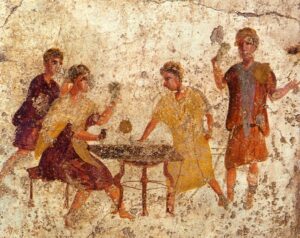
Cover Image, Top: Ancient Roman dice players. WolfgangRieger, Wikimedia Commons
__________________________