Anyone who has walked a survey transect, sifted a screen, or paused beside a coastal midden knows the feeling: a cobble or flake catches the light and seems to announce itself—chert, basalt, quartzite—before certainty dissolves. Was this piece brought from inland, collected from the beach below the site, or left by a later visitor? In archaeology, that hesitation is productive. Lithic raw materials sit at the intersection of geology, technology, and human choice, and careful looking at stone helps us read the past without overclaiming what one specimen can prove.
Why raw material still matters on site
Flaked and ground stone tools are among the most durable traces of human activity. Unlike organics, they survive where other evidence vanishes. But durability does not equal self-explanation. The same glassy fracture that made a material attractive for blades can appear in several geological families; heat treatment, patina, and residual cortex can all shift how a piece looks under field light. Provenance studies—sourcing obsidian to a flow, matching chert to a formation—rely on petrography, geochemistry, and comparative collections. What the trench or beach walk offers first is more modest: a disciplined description of color, texture, inclusions, and fracture, and a clear line between observation and inference.
That discipline matters beyond typology. Exchange networks, mobility, and craft specialization are often argued from raw-material patterns. If “exotic” stone is misidentified as local beach cobble—or the reverse—those arguments weaken. Readings of ritual deposits, caches, and unfinished blanks likewise depend on knowing whether a stone was chosen for workability, color, or origin. None of that starts with a label; it starts with looking.
Beach finds, garden stones, and the informal record
Not every stone that raises a question sits in a labeled bag. Walkers near shell middens often pick up water-rolled pieces that resemble debitage. Gardeners turn up “arrowheads” that may be natural fractures, folk reproductions, or genuine surface finds with no context. Museums receive trays of such objects with sincere questions and almost no provenience. The ethical response is not to invent a culture or a date from a photograph alone. It is to describe the object, compare it to known lithologies from the region, and say plainly when the evidence stops.
Context remains king. A biface without findspot cannot support a settlement model. Still, comparative identification of the rock itself—igneous versus sedimentary, fine-grained versus coarse, phenocrysts or fossils—narrows the conversation. It helps a landowner decide whether to contact a heritage office.
Looking with method, not with certainty
Field manuals emphasize the same sequence: note the setting; photograph scale and both faces; describe cortex, flake scars, and use-wear separately from the rock type; then compare. Hand lenses and teaching-lab reference collections remain the gold standard for tactile learning. When those resources are far away, digital comparison can support the early descriptive stage, provided its limits are understood.
A free browser-based aid such as Rock Identify lets you identify rocks from a photo by uploading one to three images, optionally with location or notes, and receiving a suggested match with category and explanation for side-by-side comparison. It does not require an app download or an account for basic use, and public use is capped at about three free identifications per day. Critically, a suggested match is not a certified laboratory identification, not a chemical assay, and not proof of archaeological provenance or cultural affiliation. Treat it as a field-notebook prompt: a hypothesis to check against local geology maps, comparative collections, and specialist advice before any stronger claim is made.
From comparison to responsible interpretation
Archaeology’s public face often meets stone first—at open days, in classroom kits, and among surface finds reported by the public. Teaching people to slow down around rock identification protects both science and heritage. Overconfident labels travel farther than careful uncertainty; underconfident silence can leave genuine sites unrecognized. The middle path is comparative literacy: know the common lithologies of your region, know which materials were preferred for tools and ornaments, and know when to ask a curator.
Art history and anthropology add further stakes. Jade, turquoise, and other valued stones move through ritual and prestige economies; misnaming them flattens meaning. Even ordinary cobbles used as hammerstones or temper in ceramics repay close looking. The goal is not to turn every walker into a petrographer. It is to keep description honest, comparison explicit, and cultural conclusions provisional until context and specialist methods catch up.
Stone will keep outlasting us. What we owe it—and the people who shaped it—is patience: look twice, compare once more, and leave room for later analysis to revise the first guess.
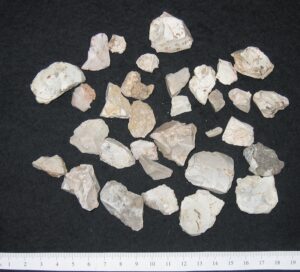
Cover Image, Top: Thirty five Prehistoric Fire damaged flints. Bristol City Council, Kurt Adams, 2005-12-02, CC BY-SA 2.0, Wikimedia Commons
____________________________
Advertisement