The history of coins began in Lydia, in what is now western Turkey, in the late seventh century BC, about 2,600 years ago. Before that, people paid with weighed lumps of silver and grain. Since then, coinage has been a long experiment in getting strangers to trust a piece of metal, and most of what we know about it comes out of excavation trenches and lab benches.
The Monterey Company, a coin maker in Bend, Oregon, that has struck custom coins since 1989, has written up the object at the start of the story: the Lydian Lion, often called the oldest coin in the world. This article picks up there and follows coinage forward, from Lydia to the US Mint’s last penny, using the digs and lab studies that date each step.
How Did People Pay Before Coins?
Before coins, people paid in metal by weight. In Mesopotamia the shekel coin started as a unit of weight, roughly 8 grams of silver, and the Code of Hammurabi (c. 1750 BC) sets fines and fees in silver. Across the Near East, archaeologists keep finding hacksilber: chopped rings, bars and scraps of silver cut to make up a payment.
Weighed silver worked, but every deal needed scales and a guess about purity. A coin fixed both problems. Its weight was set in advance, and the stamp told you who stood behind it.
Who Made the First Coins?
The Lydians made the first coins, and the best evidence came out of the ground at Ephesus. In 1904-05, British Museum archaeologists digging beneath the Temple of Artemis recovered 93 electrum coins left as offerings in the late seventh century BC, according to the Sardis Expedition. Nine were blank “proto-coins,” lumps of fixed weight with only a punch mark. Most of the rest showed the head of a lion.
Six of the Ephesus lion coins carry the Lydian inscription WALWET. Many scholars read it as the name of King Alyattes, which ties the coinage to the royal house at Sardis, the Lydian capital on the electrum-bearing Pactolus River.
The Ephesus coins also killed an old assumption: that early coins were only for big payments. Half of them weigh less than 1.2 grams. The smallest Lydian fraction, a 1/96 stater stamped with a lion’s paw, weighs 0.15 grams and measures 4 millimeters across.
Lydian electrum came with a catch. Natural electrum varies in its mix of gold and silver, and lab analysis shows the lion coins were debased to about 54% gold, 44% silver and 1-2% copper. The Lydian state ran the mint, set the face value and kept the difference.
What Were the First Gold Coins?
The first pure gold coins were issued by Croesus, the last king of Lydia, who ruled from about 560 to 546 BC. His mint at Sardis dropped electrum and struck separate coins in refined gold and refined silver. Greeks called them Croeseids, after the king.
Croesus’s split is where the history of gold coins starts. A pure-metal coin could be judged by weight alone, and a fixed ratio between the gold and silver pieces created the first bimetallic system. Herodotus, writing about a century later, credited the Lydians as the first people to mint gold and silver coin (Histories 1.94).
Cyrus of Persia took Sardis in 546 BC, but the Croeseids outlived their king. The Persians kept striking them, then replaced them around 500 BC with the gold daric and the silver siglos.
How Did Coinage Spread to Greece, India and China?
Coinage spread across the Greek world within a few decades of Lydia. Aegina’s silver “turtles” circulated widely in the sixth century BC. Athens followed with the owl tetradrachm, struck from Laurion silver, which became the trade coin of the fifth-century Aegean.
India came to coinage on its own. Punch-marked silver coins, stamped with several small symbols instead of a single design, appear in the Gangetic plain somewhere between the sixth and fourth centuries BC. The start date is still argued, and most scholars treat the Indian tradition as independent.
China took a different route again. Zhou-era states cast bronze money shaped like tools: spades and knives. After the Qin dynasty unified China in 221 BC, the round bronze ban liang with a square hole became the single standard, according to the American Numismatic Association. Chinese coins kept that shape into the early twentieth century, roughly 2,000 years.
When Was the Roman Denarius Introduced?
Rome introduced the silver denarius around 211 BC, in the middle of the Second Punic War against Hannibal. Rome came to coinage late compared with the Greeks, and it got its defining coin in wartime.
The silver in the denarius explains the timing. In a 2016 study in Geochemical Perspectives Letters, Francis Albarède and colleagues measured silver and lead isotopes in 26 Roman coins struck before and after the 211 BC reform. Pre-reform silver matched Spanish ore that Carthage had paid Rome as a war indemnity. Post-reform silver had a different signature, most likely plunder from Syracuse and Capua.
Albarède’s team concludes the reform was built to absorb a flood of war booty rather than to survive a shortage. Rome cut coin weights so the new silver would not set off inflation. Few ancient budgets can be read straight off the coins. This one can.
Roman coins went on to carry emperors’ portraits and slogans across the empire for centuries. That made them propaganda as much as payment, and it makes Roman coins one of archaeology’s most useful dating tools today.
When Did Coins Start Being Made by Machine?
Coins were made by hand for about 2,000 years. A worker set a metal blank between two engraved dies and struck it with a hammer, the same basic method the Lydians used. Hammered coins are rarely round, and their thin, uneven edges invited clipping: shaving slivers of precious metal off a coin before spending it.
Machine minting started in Paris, where the mint began using a mill and screw press in the 1550s. England’s Royal Mint began machine production in February 1662, starting with gold, according to the Royal Mint Museum. Machine-struck coins came out round, with milled edges that made clipping obvious at a glance. The English guinea, first struck in 1663, came off the new presses.
Steam reached the mint in 1788, at Matthew Boulton’s Soho Mint near Birmingham. The Soho Mint’s 1797 “cartwheel” penny showed how fast a mint could now turn out identical coins. Across the Atlantic, the Coinage Act of 1792 had already created the United States Mint in Philadelphia.
What Is the Most Valuable Coin in the World?
The most valuable coin in the world is a 1933 Saint-Gaudens Double Eagle, a $20 gold piece that sold at Sotheby’s in June 2021 for $18.9 million, a world auction record. The US pulled gold coins from circulation in 1933, and the Double Eagles struck that year were ordered melted before release. A handful escaped. The 2021 coin is the only 1933 Double Eagle known to be legal to own privately, per Smithsonian.
Coinage is still changing. On November 12, 2025, the US Mint in Philadelphia struck its final circulating one-cent coin, ending 232 years of penny production. Philadelphia also struck the country’s first circulating coins, in 1793.
History of Coins Timeline
| Date | Milestone |
|---|---|
| c. 1750 BC | The Code of Hammurabi sets fines and fees in weighed silver |
| Late 7th c. BC | First coins: Lydian electrum, later deposited at the Temple of Artemis, Ephesus |
| c. 560-546 BC | Croesus issues the first pure gold and silver coins |
| 6th-5th c. BC | Greek city coinages spread; Athenian owls dominate Aegean trade |
| c. 6th-4th c. BC | Punch-marked silver coins appear in India |
| 221 BC | The Qin standardize China’s round, square-holed bronze coin |
| c. 211 BC | Rome introduces the silver denarius |
| 1550s | The Paris mint adopts the mill and screw press |
| 1662 | England’s Royal Mint begins machine-struck coinage |
| 1788 | Boulton’s Soho Mint strikes coins with steam power |
| 1792 | The US Coinage Act creates the United States Mint |
| 1933 | US Double Eagle gold coins ordered melted |
| 2021 | A 1933 Double Eagle sells for $18.9 million |
| 2025 | The US Mint strikes its last circulating penny |
Read down the timeline and the constant is the stamp: a mark from someone who answers for the metal. WALWET on a Lydian lion and the date on a modern quarter do the same job. The method outlived circulation too. Commemorative medals and custom-struck coins are still made the way the Lydians made theirs, by pressing an engraved die into metal.
__________________________
Sources
Sardis Expedition (Harvard Art Museums / Cornell), “The Coins of Sardis”. https://sardisexpedition.org/en/essays/latw-kroll-coins-of-sardis
Albarède, F., Blichert-Toft, J., Rivoal, M. and Telouk, P. (2016), “A glimpse into the Roman finances of the Second Punic War through silver isotopes,” Geochemical Perspectives Letters 2. https://www.geochemicalperspectivesletters.org/article1613/
American Numismatic Association, “Chinese Coinage” (Money Museum virtual exhibit). https://www.money.org/money-museum/virtual-exhibits-hom-case5/
The Royal Mint Museum, “Charles II”. https://www.royalmintmuseum.org.uk/journal/british-monarchs/charles-ii/
Reuters, “Double Eagle gold coin sells for record-setting $18.9 million” (June 8, 2021). https://www.reuters.com/world/us/double-eagle-coin-sells-record-setting-195-million-2021-06-08/
Smithsonian Magazine, “The World’s Most Valuable Coin Sells at Auction for $18.9 Million”. https://www.smithsonianmag.com/smart-news/1933-double-eagle-sells-189-million-sets-world-record-most-valuable-coin-180977965/
United States Mint, final circulating one-cent coin press release (November 12, 2025). https://www.usmint.gov/news/press-releases/united-states-mint-hosts-historic-ceremonial-strike-for-final-production-of-the-circulating-one-cent-coin
The Monterey Company, “The Oldest Coin in the World”. https://montereycompany.com/blog/the-oldest-coin-in-the-world/
__________________________
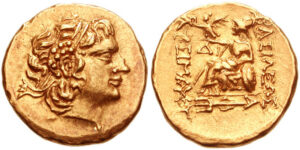
Cover Image, Top: KINGS of PONTOS. Mithradates VI Eupator. Circa 120-63 BC. AV Stater (20mm, 8.21 g, 12h). First Mithradatic War issue. LouisAragon, CC BY-SA 2.5, Wikimedia Commons
__________________________
Advertisement