The Puglia Tableland in Time: A Corridor of Battles
Across the broad, wheat-gilded plateau of Puglia Tableland (Tavoliere di Puglia), between the Gargano promontory and the Ofanto River, armies have collided for two thousand years. Hannibal annihilated Rome at the Battle of Cannae on the Canosa di Puglia’s Ofanto’s banks in 216 BCE. Frederick II hunted with falcons from Torre Alemanna, the Templar-like grange that still dominates the plain 18 kilometers from Cerignola. On April 28, 1503, the same corridor decided the future of gunpowder warfare.
Cerignola sits at 120 meters above sea level on the southern rim of Puglia Tableland, a city that in 1503 was, in the words of its own municipal register, a rural village of just 350 families. In 1532, only twenty-nine years after the battle, Giustiniani recorded 277 fuochi — hearths — roughly 1,200 souls. This was not a city but a market town guarding the Mena della Dogana delle Pecore, the great transhumance customs system whose revenues funded the Kingdom of Naples. Its control was the reason the battle was fought here. Matteo Stuppiello’s Cerignola-based Centro Studi e Ricerche Torre Alemanna has documented this linkage: the battlefield of 1503 was fought explicitly ‘for the possession of Mena della Dogana delle Pecore’.
It is a landscape whose memory is tenacious and Italian toponomastics has repeatedly shown that peasant communities encode history into field names: the nineteenth-century municipal register for Cerignola, held in the local provincial capital, Foggia’s State Archive, has never been systematically searched for archaeological and historical reasons.
__________________________

The municipal banner of the city of Cerignola. (CREDITS: COMUNE DI CERIGNOLA – AMMINISTRAZIONE COMUNALE ).
__________________________
The Last Charge
He was thirty years old, handsomely armored, and certain he would win. Louis d’Armagnac, Duke of Nemours and Viceroy of Naples for Louis XII, looked at the low ridge outside Cerignola at dusk on April 28, 1503, and saw a tired Spanish army dug in behind a ditch, outnumbered in cavalry and artillery, commanded by a general who had been avoiding battle for months. The French gendarmes — the armored elite of Europe, the last heirs of the medieval knight — lowered their lances.
They never reached the line. From behind a hastily cut earthwork reinforced with vineyard stakes, more than 1,000 Spanish arquebusiers opened fire. The volley that killed Nemours — almost certainly the first European army commander to die by small-arms fire — also killed the cavalry charge as a dominant tactic. What no English-language history has asked is where those men fell, what the ditch looked like, and why contemporary witnesses thought its location worth carving into a church wall.
A Battlefield without a Map: The Scandal
No seventeenth- or eighteenth-century cartographer mapped the field. No memorial marks it. The site is not protected under the Codice dei Beni Culturali as a cultural landscape. Its perimeter is described in modern scholarship as ‘uncertain’. The consequence is practical: every season of deep plowing on Puglia Tableland— standard since the Bourbon land reforms — destroys near-surface archaeology that has never been recorded.
That uncertainty is solvable: Spanish military commander Gonzalo Fernández de Córdoba, marching from Barletta on April 27-28, 1503, with about 9,000 men, recognized the ridge as a natural glacis commanding the approaches from the south and west, with a reverse slope to shelter reserves and access to the Via Traiana corridor. Cross-referenced with sixteenth-century descriptions of ‘vineyard-covered slopes’ fifteen miles north of Ofanto river, the probable engagement zone is a rectangle of three to four square kilometers northeast of the modern town. With LiDAR, now available via ISPRA’s national Digital terrain Model (DTM) 1m, would reveal linear depressions inconsistent with natural topography. The lower fill of a ditch two to three meters deep would lie below plow damage, accessible to magnetometry and ground-penetrating radar.
The Sources No One Has Put in English
The reason Cerignola remained localist is not lack of sources, but lack of translation: the Comune of Cerignola and the Torre Alemanna research center have digitized a corpus that has never appeared in Anglophone scholarship: excluding the well-known local syntheses, these are the foundations for any future archaeology.
The Letter that still Smells of Gunpowder
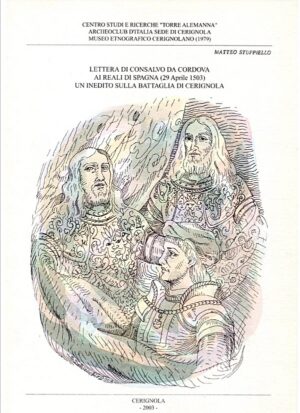
Lettera di Consalvo da Cordova ai reali di Spagna (29 aprile 1503) – Un inedito sulla battaglia di Cerignola, curated by Matteo Stuppiello, published 2003, digital edition updated 07/03/2025 on comune.cerignola.fg.it/biblioteche-digitali, is a single manuscript page: Gonzalo’s own report to Ferdinand and Isabella, written in Cerignola the day after the battle. Stuppiello describes it as ‘ricca di bagliori, luci crepuscolari e spari’ — rich with twilight glows and gunshots.
Unlike the polished chronicles of Paolo Giovio or Francesco Guicciardini, it retains tactical detail: the fatigue of the night march from Barletta, the decision to entrench on arrival, the recovery and honorable burial of Nemours, the capture of the French artillery train intact.
For Popular Archaeology readers, this is the equivalent of finding a field dispatch from Bosworth — a primary source never cited in Black, Mallett & Shaw, or Montgomery, now available for download from the local municipal library.
_______________________
_______________________
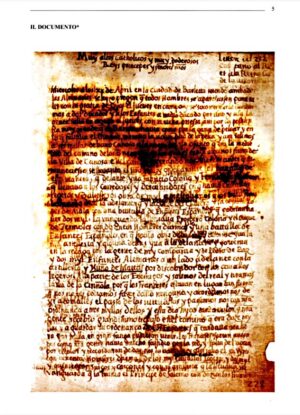
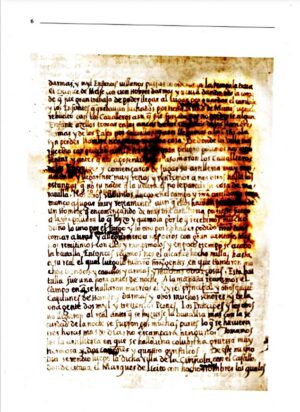
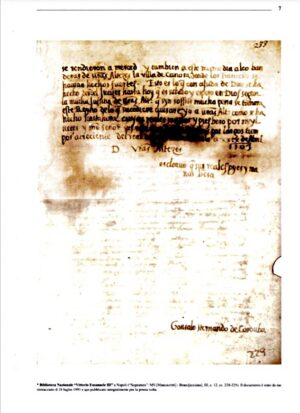
Gonzalo’s letter screenshots of 29 April 1503 — the only eyewitness account written on the battlefield. (CREDITS: COMUNE OF CERIGNOLA – CENTRO STUDI E RICERCHE TORRE ALEMANNA).
_______________________
The Graffito: A Monument Inside a Monument
In the tiny fourteenth-century church of Cerignola’s Santa Maria delle Grazie, known locally as the Incoronatella, on the old road to Trinitapoli (Via Trinitapoli Vecchia), three graffiti survive. One, dated 1503, is defined by the Comune of Cerignola as a ‘unique testimony of our territory about 28 aprile 1503 Battle [of Cerignola]’ and ‘monument inside a monument’.
The graffito was carved by an unknown hand on the right wall of the triumphal arch, in the very church where, according to both the church’s own tradition and Chiesa di Santa Maria delle Grazie entry, the lifeless body of Louis d’Armagnac was brought after the battle. The text gives, in almost notarial form, chronological elements that refer precisely to April 28, 1503, VI indiction, Friday at hour XXIII-XXIIII — a detail confirmed by the perpetual calendar of Adriano Cappelli, where 28 April 1503 indeed fell on a Friday.
Its full decipherment was accomplished by Prof. Francesco Magistrale, Professor of Latin Paleography at the University of Bari, thanks to the initiative of Matteo Stuppiello. Magistrale’s reading, published in R. Licinio – F. Magistrale – G. Specchio, La Battaglia di Cerignola (28 aprile 1503) riflessi storici e artistici (1993) and in the Comune of Cerignola monograph S.M. delle Grazie (1999, financed for the 20th anniversary of the Museo Etnografico Cerignolano), provides numbers of combatants, protagonists, and even the hour of the French defeat. The monograph warns that ‘the only, unique testimony of the Battle of Cerignola… has lost, in a couple of years, its peculiar details of reading’ due to humidity and neglect.
As part of their work on the Battle of Cerignola, Centro Studi e Ricerche Torre Alemanna, the local chapter of Archeoclub d’Italia of Cerignola, and the Museo Etnografico Cerignolano Stuppiello —founded by local historian Matteo Struppiello— revisited the scientific reading of the historic graffito preserved inside the Church of Santa Maria delle Grazie, especially as described on Matteo Stuppiello’s Letter from Gonzalo de Cordova to the King and Queen of Spain, April 29, 1503 – An Unpublished Document on the Battle of Cerignola, San Ferdinando di Puglia, 2003.
The scientific transcription and translation of the graffito was carried out in 1995 by the late Prof. Franco Magistrale, Professor of Latin Paleography, Department of Historical and Social Sciences, University of Bari.
_________________________
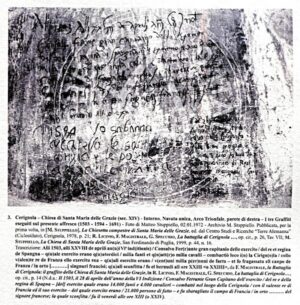
The graffito in Santa Maria delle Grazie, with raking light. Inset: Magistrale’s transcription. (CREDITS: MATTEO STUPPIELLO’S PRIVATE ARCHIVE – COMUNE OF CERIGNOLA).
_________________________
The Land Registry that Explains the Ditch
Why could Córdoba dig an effective anti-cavalry ditch in an afternoon? The answer is in the Archivio di Stato of Naples, fondo Pignatelli Aragona Cortes, Scanzia 63, fasc. 1, excerpted in the Comune of Cerignola’s 1672 Apprezzo. Here, two data points are decisive for battlefield archaeology.
First, the agricultural description: ‘Al tempo della battaglia, folti vigneti coprivano la collina arrivando fino al piano, ed erano nettamente separati dal resto della campagna da una fossa non molto profonda’. In English: ‘At the time of the battle, dense vineyards covered the hill down to the plain, separated by a not very deep shallow ditch’. In other words, Córdoba did not invent a trench ex nihilo, but he deepened and weaponized an existing agrarian feature, reinforcing it with vineyard stakes — exactly as the chronicles describe.
Second, the demographic context: the Giustiniani catasto cited by Vincenzo Buonassisi notes 277 fuochi in 1532 and 699 fuochi in 1595, falling to 288 fuochi in 1648. The shallow, intensively worked landscape of 1503 is therefore not the deep-plowed cereal monoculture of today. The lower fills of the 1503 ditch likely survive below modern plowsoil.
This linkage between archival agronomy and military engineering has never been made in English-language histories, which treat the ditch as improvised. It was adaptive reuse.
The Forgotten Historiography: Buonassisi and Pieri
Two local works, both digitized by the Comune, anchor the European significance: Vincenzo Buonassisi, La Battaglia di Cerignola, Cerignola, Scienza e Diletto, 1908, reprinted by the Cerignola’s Amministrazione Comunale in 1995 as La battaglia di Cerignola: in occasione della Festa al Borgo antico, 28-29-30 aprile 1995.
Buonassisi, who died in Via Fanfulla 10 on 27 June 1928, published the first monographic study of the battle. He established that Cerignola was occupied by the French before the battle and that the Spanish approached from the Ofanto river via Cannae, a route still traceable through Via Traiana. His description of the borgo as ‘in an advantageous situation’ remains the best contemporary topography.
__________________________

The cover of Vincenzo Buonassisi’s reprinted book ‘La Battaglia di Cerignola’. (CREDITS: COMUNE OF CERIGNOLA – 1995 AMMINISTRAZIONE COMUNALE).
__________________________
Also Brindisi-based Puglia regional archive stored Piero Pieri’s Consalvo di Cordova e la battaglia di Cerignola (28 aprile 1503)’, Archivio Storico Pugliese, Anno V, Fasc. I-IV, December 1952, pp. 265-283. Pieri’s paper, presented at the Secondo Congresso Storico Pugliese in 1952, is the first modern military analysis of Cerignola, arguing that it was not a chance encounter but a deliberately engineered killing ground: that predated by 30 years the Anglophone rediscovery of pike-and-shot. In addition, that historically valuable Piero Pieri’s document is cited in every Centro Studi e Ricerche Torre Alemanna pdf-formatted documents but never translated.
Additional context comes from the Dominican foundation: ‘The Dominican Fathers were already settled in 1501 Cerignola when they founded their convent and Church of San Domenico’ — explaining why Cerignola-based Church of Santa Maria delle Grazie was already a recognized sacred refuge in 1503.
__________________________

The cover of Piero Pieri’s document ‘Consalvo from Cordoba and the Battle ofCerignola’. (CREDITS: ARCHIVIO STORICO PUGLIESE, BRINDISI, SECONDO CONGRESSO STORICO PUGLIESE, 1952).
__________________________
What Spain still Remembers — and Amsterdam Preserves
While Cerignola forgot, Spain remembered institutionally. The Regimiento de Infantería Cerinola n. 42, later Fuerteventura n. 56. On 30 April 1986, prot. n. 4565/509, the Spanish Servicio Histórico Militar in Madrid officially transmitted to the Centro Studi e Ricerche Torre Alemanna ‘notizie sulla Divisione Militare Cirignola e sulla Battaglia di Cerignola,’ first published in S. Delvecchio – M. Occhionero – G. Specchio – M. Stuppiello, Schede didattiche sul territorio di Cerignola, 1987.
It details the coat of arms: ‘En campo de plata un cisne blanco terrazado, muriendo y apresado a una siepe… inscripción, en sable, Cerignola’. The blazon is formally described in Heraldica e Historiales del Ejercito, Tomo V – Infanteria, Madrid, 1981, pp. 46-47, 58-60. The text states: ‘Su nombre lo recibió en conmemoracion de la gloriosa batalla ganada, el 28 de abril de 1503, por las armas españolas en Italia mandadas por el Gran Capitan’. A Spanish infantry regiment bore Cerignola’s name until the 20th century.
In addition, Matteo Stuppiello’s Centro Studi e Ricerche Torre Alemanna dedicated a re-reading of it in its article The Regimiento de Infanteria CERINôLA of the Spanish Army: it explained why they chose to publish the coat of arms of the Spanish Army’s 56th Infantry Regiment Fuerteventura. It was a public thank you to Col. Alessio Antonutti, Italian Military and Air Attaché in Madrid, and Gen. José Cifuentes, Director of the Spanish Military Historical Service, who on April 30, 1986, provided them with official records on the “CIRIGNOLA” Military Division and the Battle of Cerignola.
The coat of arms itself has a long history: it originally belonged to the 42nd Peninsular Infantry Regiment Canarias. In 1899 that unit was renamed the 42nd Infantry Regiment Cerinola in honor of the battle. After several reorganizations, in 1956 it was merged with the 52nd Independent Infantry Battalion Fuerteventura and the 54th Lanzarote to form the current 56th Fuerteventura.
The official blazon, quoted from Heraldica e Historiales del Ejercito, Vol. V – Infanteria, Madrid, 1981, is striking: on a silver field, a white swan on a terrace, dying and caught in a hedge, topped with a gold mural crown, all encircled by two laurel branches tied with a pink ribbon and a scroll bearing the name Cerignola in black.
The text notes that these are the arms of the city of Cerignola itself, and the regiment took the name to commemorate the glorious victory won on April 28, 1503, in Italy by Spanish forces under the Great Captain, Gonzalo de Cordova, during the conquest of Naples against the Duke of Nemours.
__________________________
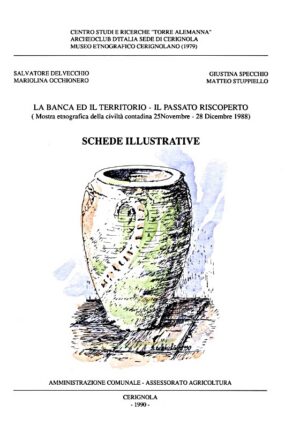
The cover of the book “La Banca ed il Territorio — Il Passato Riscoperto – Schede Illustrative”. (CREDITS: 1990 AMMINISTRAZIONE COMUNALE – ASSESSORATO AGRICOLTURA OF CERIGNOLA – CENTRO STUDI E RICERCHE TORRE ALEMANNA).
__________________________
The second object is located at the Rijksmuseum, the national museum of Amsterdam: a stunning example is the bronze medal celebrating the Battle of Cerignola, recently made available online by the Rijksmuseum: created by an anonymous artist to celebrate the victory of the Spanish, led by Gonzalo Fernandez de Cordova, over the French, the medal shows on the obverse Hercules with his lion skin and club and Janus with his bunch of keys: the two figures stand beside a coat of arms crowned by an eagle’s head, between the inscriptions ‘Consalvus Agidarius Tur. Gal. Dei R. Q. C. D. Dictator III. Parta Italiae Pace Janum clausit’. On the reverse, a battle scene appears inside the inscription ‘Consalvi Agidari Victoria de Gallis ad Cannas’.
The reference to Cannae/Cannas is a recognized historical mistake by the artist as the battle took place at Cerignola, and the site of Cannae on the Ofanto river played only a marginal role in the events. The example now in the Rijksmuseum belonged to Mrs. J.M. van Gelder-Nijhoff, who donated it to the Dutch Museum in 1885.
___________________________
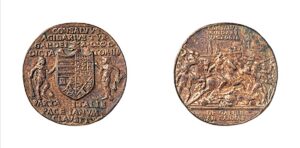
The two sides of the bronze medal celebrating the Battle of Cerignola led by Gonzalo Fernandez de Cordova. (CREDITS: RIJKSMUSEUM, NATIONAL MUSEUM OF AMSTERDAM, NETHERLANDS).
___________________________
The Battle of Cerignola took place on April 28, 1503, and it was the turning point that shifted the war that had pitted the Spanish against the French since 1499 decisively in favor of Spain. At stake was control of the Province of Foggia, a major source of revenue for the state thanks to rents from the pastures used by the great Abruzzo flocks. The French believed it should be administered from the Abruzzi region, while the Spanish had established it as an autonomous province.
After freeing Barletta from the French siege, Gonzalo, known as the “Great Captain,” decided to meet the enemy army in the open field. He spent the night with his troops at Cannae, then marched toward Cerignola, where he lured the army led by Louis d’Armagnac, Duke of Nemours, into a fatal trap. The Spanish, heavily outnumbered, took position on a hill, digging a ditch around it and defending it with palisades.
The Great Captain placed his infantry in the center and light cavalry on the flanks. He then provoked the French with an attack by his light cavalry. The enemy counterattacked with heavy cavalry, which proved slow and cumbersome in its movements. When they reached the ditch and the palisade, the French realized they had fallen into a trap: they were suddenly hit by the flanking assault of the light cavalry Gonzalo had positioned on the sides and by the deadly fire of the arquebusiers, a weapon that had seen little use until then.
In the clash, almost all the French commanders lost their lives, including Armagnac himself, whose body Gonzalo ordered to be recovered and buried in Barletta. The victory at Cerignola reversed the course of the war, turning it in favor of the Spanish. And this commemorative medal is not the only treasure related to Cerignola held by the Dutch National Museum and now available to the public in high-resolution digital form.
Towards Recovery: Why it Has Not Been Done
The local community of Cerignola is not unaware: the Centro Studi e Ricerche Torre Alemanna, founded by Matteo Stuppiello — who obtained the first monumental possession for Torre Alemanna in 1978 under Law 1089/1939 — has lobbied for decades. The Museo Etnografico Cerignolano (1979) and Archeoclub d’Italia Sede of Cerignola preserve 2,000 catalogued artifacts of rural civilization, but no battlefield finds, because no survey has been authorized.
_________________________
The logos and siege of President Matteo Stuppiello’s local cultural associations and cultural centers. (CREDITS: MATTEO STUPPIELLO – MUSEO ETNOGRAFICO CERIGNOLANO – CENTRO E STUDI RICERCHE TORRE ALEMANNA , ARCHEOCLUB D’ITALIA SEDE DI CERIGNOLA).
_________________________
The ditch that Gonzalo Fernández de Córdoba ordered dug on the afternoon of April 28, 1503, is the most consequential earthwork in European warfare: it ended mounted chivalry, inaugurated the infantryman with a firearm, and shaped the Mediterranean for 160 years. It may still be there — filled, plowed over, invisible to the naked eye but accessible to a magnetometer.
Medieval Archaeology is not the question: its value is beyond doubt. The real question is why we are allowing one of Italy’s great early modern battlefields to disappear under the plow while we debate its importance from a podium. For Cerignola, public scholarship is now the front line. It is how we finally reclaim this history.
____________________________
Acknowledgements
This article would not have been possible without the open-access archival policy of the Comune of Cerignola and the decades of research carried out by the “Centro Studi e Ricerche ‘Torre Alemanna”, “Archeoclub d’Italia Sede di Cerignola”, and the “Museo Etnografico Cerignolano (1979)”. The author wishes to thank the “Comune of Cerignola (Sindaco, Giunta Comunale, and the entire Amministrazione Comunale)” and the “Assessorato alla Cultura” for making available its digital libraries, including the unpublished Lettera di Consalvo da Cordova (29 aprile 1503), the Apprezzo del 1672, the S.M. delle Grazie monograph (1999), and the C.S.R. Torre Alemanna dossiers.
Special gratitude is due to Prof. Matteo Stuppiello founder and President of the “Centro Studi e Ricerche Torre Alemanna”, whose lifelong work secured the monumental possession for “Torre Alemanna (1978)” and the “Piano delle Fosse Granarie”, and who curated the transcription of Gonzalo’s letter, the Graffito, and the Spanish Army dossier.
The decipherment of the “Graffito of Santa Maria delle Grazie” – the ‘monument inside the monument’, the only contemporary epigraphic testimony of the Battle – is owed to Prof. Francesco Magistrale, University of Bari.
Special thanks for archival sources to “Archivio di Stato of Naples, Fondo Pignatelli Aragona Cortes”, “Servicio Histórico Militar of Madrid”, the “Rijksmuseum National Museum” of Amsterdam, and “Museo del Prado” of Madrid.
____________________________
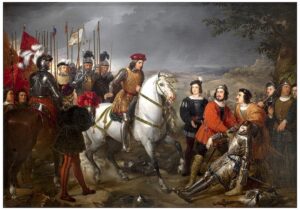
Cover Image, Top: Gonzalo Fernández de Córdoba at the Battle of Cerignola. (CREDITS: FEDERICO DE MADRAZO Y KUNTZ- COPYRIGHT © – MUSEO NACIONAL DEL PRADO, MADRID).
____________________________