American Association for the Advancement of Science (AAAS)—Extinct megafauna that once roamed southern South America were staples in the diet of early human hunters, according to a new chronological analysis* of faunal remains. “Our results undermine one of the most widely cited objections to the hypothesis that humans are the principal cause of megafaunal extinctions and put human foragers again at the heart of the debate,” Luciano Prates and colleagues write. The late Pleistocene extinction devastated the planet’s existing megafauna, wiping out majestic giants ranging from mammoths to giant sloths and saber-toothed tigers. Scientists generally agree that climate change at the end of the last glacial period was a chief driver of ecological stress and extinctions worldwide. However, the role of humans in this extinction is debated, especially in North America. Some researchers posit that humans played a negligible role in the decline of megafauna, while others argue that predation by early hunter-gatherers was the chief driver of extinctions. In contrast, most archaeologists suspected that humans played a less prominent role in the extinction of megafauna in South America, in part due to a lack of sites containing faunal and human remains. However, Prates et al. now show that megafauna in South America were leading prey items for early hunters and foragers in the late Pleistocene, ranging from 13,000 to 11,600 years ago. The team identified and examined 20 archaeological assemblages of faunal remains in the Southern Cone of South America, comprising modern-day Argentina, Uruguay, and Chile. By comparing bone remains of megafauna with small- and medium-sized animals, the scientists calculated that extinct megafauna dominated 15 of the 20 assemblages. These extinct taxa included two species of giant sloths, giant armadillos, and horses, which the authors determined likely ranked at the top of choice prey items because they offered higher returns than smaller species. Prates et al. conclude that extinct megafauna were thus the main targets of hunters in the Pampas, Patagonia, and central Chile, noting that the human diet only broadened to include smaller extant species such as guanaco once megafauna had largely disappeared 11,600 years ago.
_______________________________
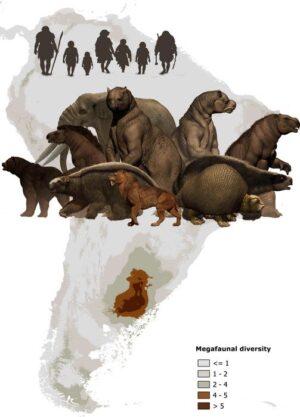
Megafaunal species were preferred prey for humans in Southern South America. Luciano Prates et al. Megafaunal reconstructions in the figure were provided and authorized by Megafauna 3D Project (https://www.megafauna3d.org)
_______________________________

Location of sites with preextinction faunal assemblages. Top: Summed
probabilities of radiocarbon dates on megafauna showing the limit (11,600 cal
years B.P.) for a substantial coexistence with humans. Bottom: Map of Southern
South America with location of sites with preextinction faunal assemblages studied
in this work: Monte Verde II (1), Tagua Tagua 1 to 3 (2 to 4), Campo Laborde (5),
Cerro La China 1 (6), Santa Julia (7), Paso Otero 5 (8), Infieles-1
(9), El Trébol (10),
Cueva Fell (11), Cueva Lago Sofía 1 (12), Piedra Museo 1 (13), Cueva Tunel (14), Casa
del Minero 1 (15), Cueva del Medio (16), Cueva Tixi (17), Tres Arroyos (18), Cerro Tres
Tetas (19), and Pay Paso 1 (20). Summed Probability Distribution (SPD) curve and
species diversity map were plotted using data provided by Prates and Perez (5).
Credit
Prates et al., Sci. Adv. 11, eadx2615
_______________________________

Frequency of animal occurrence by site in preextinction bone assemblages,
grouped by class and body size of prey. Columns show the occurrence
of physical (light gray) or behavioral (dark gray) association with humans. Prates et al., Sci. Adv. 11, eadx2615
_______________________________
Article Source: AAAS news release.
*Extinct megafauna dominated human subsistence in Southern South America before 11,600 years ago, Science Advances, 1-Oct-2025. 10.1126/sciadv.adx2615