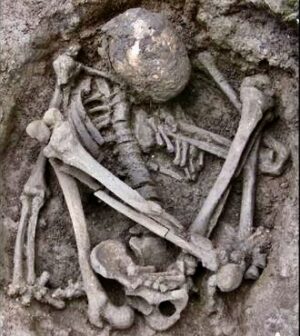
Proceedings of the National Academy of Sciences—A study* uncovers the oldest known evidence of human mummification. From 12,000 to 4,000 years ago, hunter-gatherer societies in southeastern Asia predominantly buried their dead in flexed, tightly crouched, or squatting postures, often with traces of burning. Such burial practices contrast with subsequent Neolithic burials in extended supine postures. Hsiao-chun Hung, Zhenhua Deng, Hirofumi Matsumura, and colleagues analyzed bone samples from 95 archaeological sites across southeastern Asia to explore pre-Neolithic burial practices in the region. The tightly compacted postures and lack of bone disarticulation typically associated with decomposition in some burials suggest that the bodies were buried in a desiccated state, rather than as fresh cadavers. X-ray diffraction and Fourier-transform infrared spectroscopy analyses of the internal microstructures of selected bone samples identified evidence of exposure to heat, typically at relatively low intensities. Together, the findings suggest that many of the bodies were treated to an extended period of smoke-drying over a fire prior to burial, a form of mummification that resembles contemporary burial practices ethnographically recorded in some Indigenous Australian and Highland New Guinea societies. According to the authors, the findings identify mummification practices in southeastern Asia that persisted for more than 10,000 years and predate mummification practices associated with Ancient Egypt and the Chinchorro culture in Chile.
________________________________

Middle-aged woman at the Liyupo site in southern China who was smoke-dried prior to burial. Note: Bone fragments belonging to a second individual have been digitally removed from the lower left corner. Zhen Li
________________________________

Young male individual in a hyper-flexed position (left) from the Liyupo site in Guangxi, China, dating to around 7,000 years ago, with a partially burned skull (right). Zhen Li and Hirofumi Matsumura
________________________________

Middle-aged male individual excavated from Huiyaotian in Guangxi, China, found in a hyper-flexed position, and dated to more than 9,000 years ago. Yousuke Kaifu and Hirofumi Matsumura
________________________________
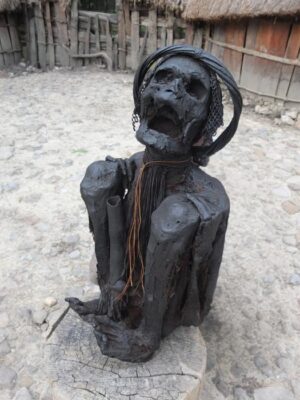
Modern hyper-flexed, smoke-dried mummy of the Dani people, kept in a private household in the Baliem Valley of Wamena, Jayawijaya Regency, Papua (Indonesia). Hirofumi Matsumura and Hsiao-chun Hung
________________________________
Article Source: PNAS news release.
*“Earliest evidence of smoke-dried mummification: More than 10,000 years ago in southern China and Southeast Asia,” by Hsiao-chun Hung, Zhenhua Deng, Hirofumi Matsumura et al., Proceedings of the National Academy of Sciences, 15-Sep-2025. 10.1073/pnas.2515103122