Five researchers from Kent State University, Southern Methodist University (SMU), the Smithsonian, the University of Michigan, and the University of Utah explored whether Clovis foragers hunted, scavenged, or did both, and whether it was possible to tell the difference archaeologically. The new research* is now published in the Journal of Archaeological Science: Reports.
To set a broad foundation for considering the question, they began their study showing the near ubiquity of scavenging among non-human animals. They document the fact that the paleoanthropological, ethnohistoric, and ethnographic records showed that scavenging was also quite common among human groups past and present. Following that, they consider the many opportunities scavengers have – and Clovis foragers might have had – in exploiting proboscidean carrion. Lastly, they assess the proposed archaeological evidence for Clovis hunting and scavenging and show that Clovis foragers likely practiced both.
“Researchers cannot currently distinguish the two archaeologically and thus cannot reliably show how many Clovis proboscidean sites represent hunting versus scavenging events,” said Kent State’s Metin I. Eren.
“While Clovis foragers likely hunted mammoths, it would be odd indeed if Clovis foragers – alone among ethnohistoric and ethnographic human groups and nearly all omnivores and carnivores – did not scavenge,” said SMU’s David J. Meltzer. Meltzer added that “scavenging also could possibly explain the high δ15N values recently reported for the Anzick child, which could readily result from his mother eating maggots and not mammoth meat.” The researchers concluded that given the present state of knowledge, the Clovis archaeological record cannot be used to argue that Clovis groups routinely hunted proboscideans, or that there are sufficient “kill sites” to support a human role in proboscidean extinctions.
The Smithsonian’s Briana Pobiner, the University of Utah’s James O’Connell, and the University of Michigan’s John D. Speth were the other contributing authors to the study.
“If we cannot definitively conclude that proboscidean killing took place at any single Clovis site because there is archaeological equifinality with scavenging, then proboscidean overkilling is not supported either,” Eren said. “Despite some archaeologists’ and other scientists’ long-standing beliefs, there is just no definitive scientific evidence for a human role in the North American Late Pleistocene extinction of proboscideans.”
______________________
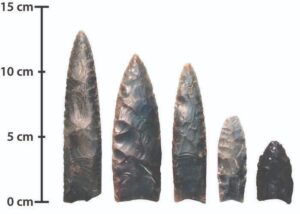
Clovis fluted points from Blackwater Draw, New Mexico. Credit: Journal of Archaeological Science: Reports
______________________
Article Source: Kent State University news release.
Image, Top: Mammoth. Kyraxys, Pixabay
_______________________