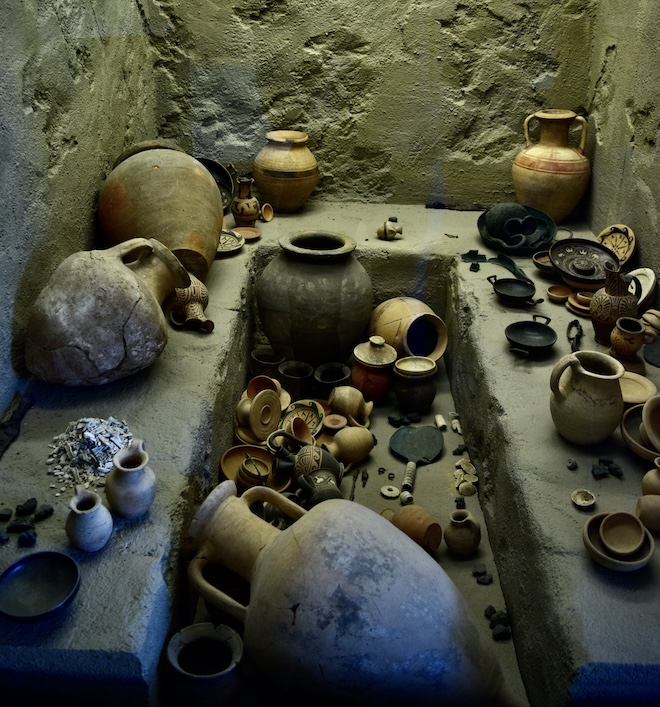
University of Bonn—What culinary practices prevailed in the South Caucasus during the Bronze Age? The cuisine was remarkably diverse. This is what an international research team from the Universities of Bonn and Bari, along with other scientific institutions such as the Centre National de la Recherche Scientifique (CNRS) and the Azerbaijan National Academy of Sciences report. The new evidence highlights a multi-ingredient cuisine alongside the central role of dairy products, fruit, and grape-based beverages in Kura-Araxes communities. The findings have now been published in the journal PNAS*.
The Kura-Araxes culture is named after the two main rivers of the South Caucasus, the Kura and the Araxes, which flow into the Caspian Sea. This prehistoric cultural tradition emerged in the South Caucasus around the mid-4th millennium BCE and expanded to become the most widespread cultural phenomenon in Southwest Asia by the early to mid-3rd millennium BCE. It developed within small-scale, household-based communities, in sharp contrast to the contemporaneous urban trajectories of early state and hierarchical societies of Mesopotamia.
“By combining technological, morphological, use-wear, and biomolecular analyses of 52 ceramic vessels from the Kura-Araxes settlement of Qaraçinar (Azerbaijan), dated to ca. 2800–2600 BCE, and integrating these results with botanical and faunal data, we explored a wide range of material evidence to reconstruct Kura-Araxes foodways and culinary practices,” explains Maxime Rageot, biomolecular archaeologist at the University of Bonn. The scientist is also a member of the transdisciplinary research areas “Present Pasts” and “Life & Health” at the University of Bonn.
Characteristic Pottery
“Pottery, central to this research, was one of the most distinctive expressions of the Kura-Araxes tradition and a key marker of its expansion. It played a crucial role in processes of social integration and in the cultural reproduction of Kura-Araxes communities across space and time,” adds Giulio Palumbi, prehistoric archaeologist at the University of Bari and the CNRS, who leads the excavation project. Qaraçinar, located on the eastern piedmont of the Lesser Caucasus, was excavated between 2019 and 2024 in collaboration with Muzaffar Huseynov and Bakhtiyar Jalilov from the Institute of Archaeology and Anthropology of the Azerbaijan National Academy of Sciences.
Residues in Ceramic Vessels as a Starting Point
Exceptionally well-preserved organic residues in pottery provided robust biomolecular evidence for the preparation and consumption of fruit and grape products, plant oils and waxes, conifer resins, dairy products, and other ruminant fats. The researchers also identified markers of thermal processing, consistent with repeated cooking activities. These findings demonstrate the prominent role of dairy products and ruminant fats in Kura-Araxes dietary and culinary practices, including the transformation of milk into secondary products.
The results also shed new light on the role and significance of grape-based beverages and their modes of consumption within Kura-Araxes communities. Wine may have been consumed, sometimes flavored with conifer resins. Within the non-hierarchical structure of Kura-Araxes society, this locally available product (potentially even collected from wild grapevines) does not appear to have been associated with elite or prestige consumption, in contrast to contemporaneous Mesopotamian contexts.
Diverse Uses of Grapes and Fruits
Grapes and other fruit products (fermented and non-fermented) were not only identified in drinking/serving vessels but also in numerous cooking pots as well as in some large storage jars, suggesting multiple culinary purposes, such as flavoring or sweetening dishes, and possibly acting as catalysts in biochemical processes like cheesemaking. In addition, Pinaceae resins may have been used both as flavoring agents and as preservatives for food and drink.
The identification of millet-based food or drink in Kura-Araxes pottery at Qaraçinar suggests long-distance connections with eastern regions, as millet was cultivated in Central Asia during this period but had not previously been documented so early and so far to the west. Furthermore, this research reveals for the first time a functional distinction between pottery types: Monochrome wares appear to have been used mainly for cooking, whereas Red-Black Burnished vessels were likely dedicated to the consumption of raw dairy products and fruit- or grape-based beverages, including wine.
Together, these findings provide new insights into the daily life and culinary traditions of the Kura-Araxes communities. “The diversity of the cuisine was accessible to all, as the society was characterized by low levels of social stratification,” says Rageot. The results also open new perspectives for future research, suggesting that the expansion of the Kura-Araxes tradition may have also involved the spread of distinctive culinary practices originating in the South Caucasus.
___________________________
Bottom: Red-black and black-polished vessels from Qaraçinar, Azerbaijan. Photos: A. Decaix, ANR SWEED and the Mission “Boyuk Kesik” & ANR KUR(A)GAN
___________________________
Funding and Participating Institutions
In addition to the Universities of Bonn and Bari, the international research team included the Institute of Archaeology and Anthropology of the Azerbaijan National Academy of Sciences, the Austrian Archaeological Institute (ÖAW), the Muséum national d’Histoire Naturelle in Paris (MNHN), and the Centre National de la Recherche Scientifique (CNRS, Lab. CEPAM, Nice). The study was funded by the Agence Nationale de la Recherche (ANR) and the German Research Foundation (DFG) as part of the ANR-DFG KUR(A)GAN (directed by Giulio Palumbi and Svend Hansen, ANR-DFG -0006-01) and by the Ministère de l’Europe et des Affaires Étrangères (Mission Boyuk Kesik).
___________________________
Article Source: University of Bonn news release.
*Maxime Rageot, Maria Bianca D’Anna, Muzaffar Huseynov, Bakhtiyar Jalilov, Alexia Decaix, Rémi Berthon, Qi Zeng, Jeremy Perez, Farhad Guliyev, Léa Drieu, Arnaud Mazuy, Martine Regert & Giulio Palumbi: Biomolecular analyses reveal grape-based beverages, dairy processing, and pottery function in Kura-Araxes culinary practices, PNAS, DOI: 10.1073/pnas.2529600123, URL: https://www.pnas.org/doi/epdf/10.1073/pnas.2529600123
___________________________