American Association for the Advancement of Science (AAAS)—Scientists have uncovered the earliest known elephant bone tool in Europe – found in a site in the United Kingdom where Pleistocene elephant remains are scarce. The discovery* spotlights the local Paleolithic society’s resourcefulness in acquiring materials and their mastery of tool manufacturing. “This find marks the earliest known instance of elephant bone being utilized as a raw material in Europe, as well as the earliest unambiguous reported use of elephant bone as a knapping percussor,” Simon Parfitt and Silvia Bello write. Paleolithic bone, wood, and antler tools for knapping – the process of chipping away at stones to create sharp edges – are rare artifacts, because their organic nature makes them prone to disintegrating. Here, Parfitt and Bello present a 480,000-year-old knapping tool made from elephant bone found in Boxgrove, in southern England. Their archaeological examination revealed that people shaped and flaked the cortical bone fragment into a “retoucher,” which they used to thin, resharpen, and lightly hammer stone tools. Based on the paucity of elephant bones found in the UK, Parfitt and Bello intuited that this tool – which most likely came from the straight-tusked elephant (Palaeoloxodon antiquus) – came from raw material sourced elsewhere. “This find provides further evidence of the strategic selection and curation of organic tools among early hominins, implying a high level of resourcefulness, adaptability, and a nuanced understanding of their environment and available materials,” the authors write.
________________________
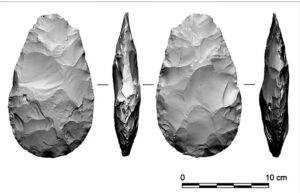
Handaxe from the Boxgrove paleosol horizon (locality Q2/GTP 17). Credit: Parfitt et al., Sci. Adv. 12, eady1390
________________________

Location maps. (A) Location of Boxgrove in relation to the Goodwood-Slindon (40 m) Raised Beach. (B) Extent of quarrying at Boxgrove and the principal archeological sites (red). Credit: Parfitt et al., Sci. Adv. 12, eady1390
________________________
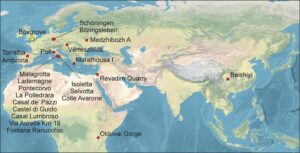
Map of Lower Paleolithic sites with published elephant-bone tools. Credit: Parfitt et al., Sci. Adv. 12, eady1390
________________________
Article Source: AAAS news release.
*The earliest elephant-bone tool from Europe: An unexpected raw material for precision knapping of Acheulean handaxes, Science Advances, 21-Jan-2026. 10.1126/sciadv.ady1390
________________________