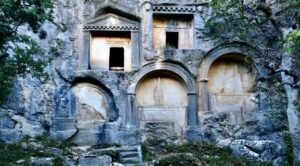
In the rugged heights of the Taurus Mountains, where the ancient city of Termessos clings to the cliffs of Mount Güllük—a city so defiant it once turned back Alexander the Great—history is usually told through monumental theatres and heroic resistance. Yet, among the grand tombs of warriors and kings, there lies a much smaller, humbler limestone sarcophagus. It tells a story far more profound than conquest; it is a story of a broken heart, proving that the bond between human and animal is a language far older than empires.
This is the eternal resting place of Stephanos—a dog whose name means “Crown” or “Gift”—and the memory of the woman who refused to let his soul fade into the dust of Pisidia: Aurelia Rhodope.
“Buried Like a Human”
When archaeologists first unearthed this small-scale sarcophagus, they assumed it belonged to a beloved infant or a child of the nobility. However, as the 11-line Greek epigram on its side was deciphered, a startling and touching truth emerged. This was a grave commissioned by a wealthy, likely solitary woman for her canine companion.
In the 3rd century CE, an era where animals were largely viewed through the lens of utility—as hunters, guards, or shepherds—Rhodope defied every social norm. As explicitly stated in the inscription, she buried Stephanos “just like a human.” This was not merely a disposal of remains; it was a sacred rite of passage, a final act of dignity for a being she considered an equal.
_________________________
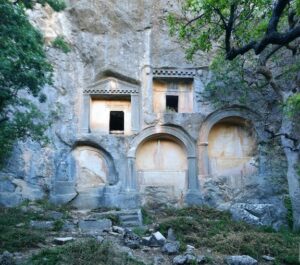
Rock-cut tombs in Termessos. Ingo Mehling, CC BY-SA 3.0, Wikimedia Commons
_________________________
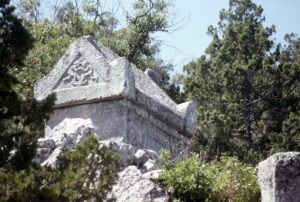
Sarcophagus in the Termessos necropolis. Dosseman, CC BY-SA 4.0, Wikimedia Commons
_________________________
The Lament on the Stone
Rhodope’s grief did not end with the commission of a tomb; she had the following lines carved onto the stone using hexameter, the most prestigious poetic meter of the ancient world:
“Those who played with him called him ‘Lovely Stephanos,’ The joy of Rhodope. But death took him suddenly; Now this tomb hides him, the one who vanished away. I am the dog Stephanos; Rhodope built this tomb for me. She wept for him and buried him just like a human.”
Stephanos’s departure left a void that Rhodope chose to fill with art. At the end of the poem, following a poignant ancient tradition, Stephanos “speaks” from within the grave to greet passersby: “I am the dog Stephanos; Rhodope built this tomb for me.”
Two Tombs, One Eternal Bond
The story becomes even more haunting when we look at Rhodope’s own fate. In the necropolis of Termessos, her own sarcophagus stands with a solitary inscription: “Aurelia Rhodope built this tomb for herself alone.” This line suggests a woman who lived her final years without a spouse or children, leaving Stephanos as perhaps her most significant emotional tether.
While Rhodope’s own tomb still overlooks the vast canyons of Termessos, Stephanos’s sarcophagus now finds its home in the Hall of Sarcophagi at the Antalya Museum. This small stone chest serves as a “lesson in humanity” from 1,800 years ago; it shows how, even in the hardened, martial world of the Roman frontier, there was room for pure mercy and unconditional love.
From the wind-swept paths of Termessos to the silent corridors of the Antalya Museum, this story whispers that archaeology is not just about stones and wars. Though the tears shed by Rhodope 1,800 years ago have long since dried, that small tomb remains—a sentinel of a loyalty that time could not erode. If you ever find yourself before that small sarcophagus, look closely at the verses; you will see not just the name of a dog, but the purest and most ancient reflection of the human soul.
___________________________
POPULAR ARCHAEOLOGY ON INSTAGRAM
___________________________