American Association for the Advancement of Science (AAAS)—The ancient Maya center Aguada Fénix was built to represent the society’s understanding of the cosmos, forming the shape of a cosmogram, according to new research. Takeshi Inomata and colleagues suggest that Aguada Fénix’s meaningful site plan motivated people to participate willingly in its construction before the emergence of social hierarchies that enforced compulsory labor. Earlier research attributed the creation of Maya city centers, such as Tikal and Copan, to the existence of a strict class structure in which laborers and lower classes obeyed elites’ orders to construct buildings and infrastructure. However, recent research has uncovered large city centers built earlier than the Late and Terminal Preclassic period (350 BC to 250 BCE), which is when ancient Maya hierarchy began to emerge. For example, no signs of social hierarchy have been found in Aguada Fénix, which was active during the early Middle Preclassic period. From 2020 to 2024, Inomata et al. conducted lidar surveys and tested soil samples in Aguada Fénix. They dated the site to between 1050 BCE and 700 BCE, and discovered that it formed a cosmogram with north-south and east-west axes formed by corridors and canals. The team also uncovered a central cross-shaped cache that held what may be the earliest known directional color symbols found in Mesoamerica. They argue that Aguada Fénix’s special site plan likely motivated communal participation without the need for coercive force. They note, though, that the site probably housed some calendar specialists prized for their knowledge and ability to glean cosmological insights. “[The specialists] probably did not have coercive power, but their esoteric knowledge may have earned them respect, enabling them to persuade large numbers of people to participate in constructions and rituals,” the authors speculate. “These community leaders may have formed an emergent elite, providing a prototype for later Maya rulers.”
___________________________

Cruciform cache found in the E Group Plaza. (A) Locations of the excavation units in the E Group on the Main Plateau. (B) Cruciform cache viewed from the east. (C) Axe-shaped clay objects found at the bottom of the large cruciform pit (Cache NR10). (D) Pigments and shells found at the bottom of the small cruciform pit (Cache NR11). Inomata et al., Sci. Adv. 11, eaea2037
___________________________
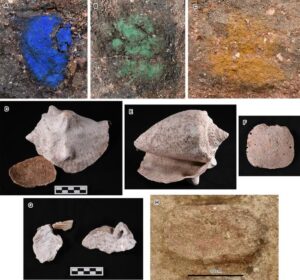
Cache NR10/11 found in the cruciform pit. (A) Blue pigment (azurite) found in the northern part of Cache NR11. (B) Green pigment (malachite) found in the eastern part. (C) Yellow pigment (ochre containing goethite) found in the southern part. (D) Atlantic milk conch (M. costatus) and a valve of the marine spiny oyster (Spondylus sp.) found in the western part. The outer lip of the conch was partially cut clean, and the exterior surface of the spiny oyster was smoothed. The edges of the spiny oyster were also removed to form a square shape, and the valve contained at least two purposefully drilled holes, perhaps for use as a pendant. (E) Atlantic milk conch underside. (F) Marine spiny oyster exterior. (G) Valve of a marine pearl oyster (Pinctada sp.) found in the southern part. The exterior surface of this oyster was also smoothed. (H) Close-up view of one of the axe-shaped clay objects with red pigment found in Cache NR10. Inomata et al., Sci. Adv. 11, eaea2037
___________________________

Greenstone objects found in Caches NR6-9. (A) Cache NR6. The large incised object probably depicts a crocodile. (B) Cache NR8. It contained five greenstone axes and an ornament arranged in a flower-petal form but probably had more objects before it was cut by Cache NR9. (C) All objects found in Cache NR7. The cache contained 18 stone objects placed in a cruciform pattern. (D) Front and side view of a thin jade plaque found in the central part of Cache NR9. It may have been used as a plaque hanging from a belt or as a pendant. It probably represents a female in a birthing position. It appears to have broken when the upper right notch was being made. (E) Two sides of the jade objects, each with two transverse perforations, found in Cache NR9. They may have been used together as a headband or necklace. (F) Side view of the first object from the left in (E). (G) Side view of the third object from the left in (E). (H) Pectoral probably representing a bird found in the central part of Cache NR9. Inomata et al., Sci. Adv. 11, eaea2037
___________________________

Cache NR7 with jade objects. Takeshi Inomata
___________________________

Excavation of Cruciform cache (Cache NR10-11). Takeshi Inomata
___________________________
Article Source: AAAS news release.
*Landscape-wide cosmogram built by the early community of Aguada Fénix in southeastern Mesoamerica, Science Advances, 5-Nov-2025. www.science.org/doi/10.1126/sciadv.aea2037
Cover Image, Top Left: Cruciform cache after excavation (Cache NR10-11). Takeshi Inomata