PHILADELPHIA—Spotlighting century-old watercolor paintingsby Egyptian artist Ahmed Yousef, Ancient Egypt in Watercolors: Paintings and Artifacts from Dra Abu el-Naga will go on view at the Penn Museum starting Saturday, February 28, 2026.
Last exhibited in Cairo during the 1920s, the watercolor paintings have been carefully preserved in the Penn Museum’s Archives for more than 100 years. They have never been on display in the United States.
Ancient Egypt in Watercolors reveals the often under-appreciated, but critical function of art in archaeology. The 1,500 sq. ft. exhibition highlights elaborately decorated tomb chapels during the New Kingdom (approximately 1550 BCE-1070 BCE), a “golden age” that marked the height of Egypt’s power and wealth. Many affluent officials built their tombs at Dra Abu el-Naga—a key part of the larger Theban Necropolis. Their tomb paintings show scenes from everyday life and imagery depicting the journey to the netherworld—illuminating how much the ancient Egyptians valued family bonds, honoring their ancestors, and continuing one’s identity into the next life.
“The watercolors are copies of important tomb paintings of high officials and their families interred at Thebes and provide a rich record of the vitality of Egyptian funerary art of the New Kingdom,” says Penn Museum Egyptologist Dr. Josef Wegner, Lead Curator of Ancient Egypt in Watercolors. “Together with select artifacts on display for the first time, the exhibition reveals a society at the zenith of its power and creativity.”
Between 1921-1923, Penn Museum archaeologist Clarence Fisher excavated at Dra Abu el-Naga—taking photographs and commissioning these watercolor paintings. Yousef, a gifted young artist, was among the 200 local workmen who helped with the excavation.
“Archaeology requires more than digging. There is a value of collaboration in archaeological research, and the role an artist can play alongside the archaeologist in documenting and preserving ancient sites. Art, both ancient and modern, has an important role in maintaining memory and interpreting the past,” Dr. Wegner adds. “We are still learning more about the people of the New Kingdom by studying these watercolor paintings, the Penn Museum’s extensive collections, and field notes that archaeologists left behind.”
Many of the tombs recorded in the watercolor paintings are still standing today. Other tombs, however, were more vulnerable. Some original works in the tombs themselves have been lost to time—destroyed by the elements. One of the deteriorated tombs in Dra Abu el Naga’s Lower Cemetery (Tomb 306) belonged to the Doorkeeper of Amun (Temple), Irdjanen, and his wife, the Chantress of Amun, Mutemipet. Dating to the 19th Dynasty (ca. 1295-1186 BCE), the tomb’s interior artworks have been preserved through Yousef’s watercolors and Fisher’s archival photographs—the only documentation that still exists.
“Ahmed Yousef’s paintings are artworks in their own right,” Dr. Wegner adds.
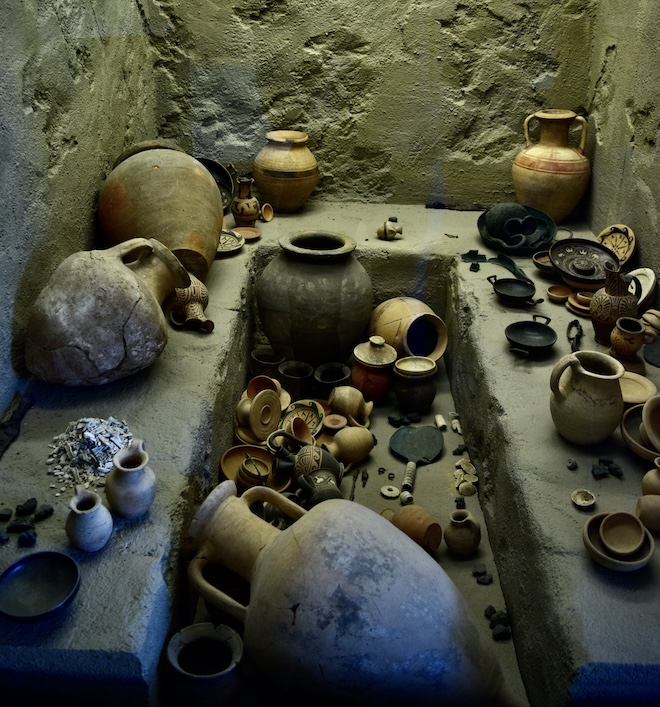
Ancient Egypt in Watercolors draws attention to one of the most important archaeological sites in Egypt excavated by the Penn Museum during the first half of the 20th century, as well as the prominence of the Museum’s Egyptian Collections of more than 50,000 artifacts—with nearly 3,000 objects from Dra Abu el-Naga. Of those, a selection of nearly 60 rarely-seen artifacts complement the paintings, including 3,500-year-old bread loaves, statuary of high officials and New Kingdom royalty, funerary stelae, shabti figurines (which ensured comfort for deceased individuals in the Afterlife), amulets, ostraca (informal notes), canopic jars, among others.
The eight-month exhibition will feature multimedia elements and two rotations of watercolor paintings: The first group will be on display through June while the second will be on view beginning July 1.
Ancient Egypt in Watercolors will close in November—just ahead of the grand opening for the Penn Museum’s Egypt Galleries: Life and Afterlife on December 12, 2026. Following extensive conservation across nearly three decades, its centerpiece will be the 4,300-year-old Tomb Chapel of Kaipure—a high-ranking treasury official of Egypt’s Old Kingdom (ca. 2350 BCE). This architectural marvel, excavated more than a century ago at Saqqara, features a massive 5-ton “false door” with nearly 100 carved and painted limestone blocks. Visitors will be able to enter and move through the space to experience what it feels like to be inside an ancient tomb chapel.
Life and Afterlife represents the first phase of the Penn Museum’s bi-level, 14,000 sq. ft. Ancient Egypt and Nubia Galleries. The second phase is the Egypt and Nubia Galleries: Royalty and Religion—showcasing the monumental 3,000-year-old palace of Pharaoh Merenptah, whose towering 30-ft. columns will be displayed at their full height for the first time since their excavation more than 100 years ago. These galleries are scheduled for completion in 2029.
Here is a timelapse video documenting the installation of the 5-ton tomb chapel. For more information on the Ancient Egypt and Nubia Galleries, watch the video here.
_____________________________

The Theban Mountain by Ahmed Yousef, a watercolor documenting original ancient Egyptian art painted on tomb chapel walls at Dra Abu el-Naga near Thebes, uncovered during excavations in the early 1920s. Image: Penn Museum
_____________________________
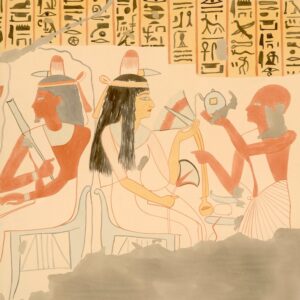
Doorkeeper of Amun (Temple), Irdjanen, and his wife, Mutemipet, are shown being taken care of in the Afterlife. Ahmed Yosef’s watercolor paintings documented the art inside the tombs at Dra Abu el-Naga. Image: Penn Museum
_____________________________

Husband and wife are together through eternity, as depicted in paintings inside Tomb 306 at Dra Abu el-Naga and recorded in Ahmed Yousef’s watercolors. Image: Penn Museum
_____________________________

Tomb 306 in the Lower Cemetery. Coxe Expedition Dra Abu el-Naga (Thebes), Egypt 1922-1923. Image: Penn Museum Archives
_____________________________
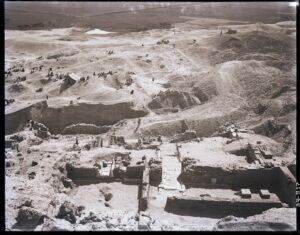
Upper Cemetery. Upper Terrace: courtyards of tombs 35 & 160 looking down from pyramid. Looking south. Coxe Expedition Dra Abu el-Naga (Thebes), Egypt 1922-1923. Image: Penn Museum Archives
_____________________________
Frequently Asked Questions
What is Dra Abu el-Naga?
Dra Abu el-Naga was one of the most important archaeological sites in Egypt excavated by the Penn Museum during the first half of the 20th century. It is located on the west bank of the Nile River at Thebes—near the modern city of Luxor—opposite the temple of Amun at Karnak. Many of the tombs at Dra Abu el-Naga belonged to rich, powerful officials connected with the Amun temple. Close to the Valley of the Kings, it was as a key part of the larger Theban Necropolis.
When was the New Kingdom in Ancient Egypt?
The New Kingdom (approximately 1550 BCE-1070 BCE) marked the height of Egypt’s wealth.
What was depicted on the walls of ancient Egyptian tombs during the New Kingdom?
During the New Kingdom (approximately 1550 BCE-1070 BCE), paintings that decorated the tombs at Dra Abu el-Naga showed scenes from everyday life and the journey to the netherworld—illuminating how much the ancient Egyptians valued family bonds, honoring their ancestors, and continuing one’s identity into the next life.
Who is the artist Ahmed Yousef?
Egyptian painter Ahmed Yousef worked as a draftsman and an artist for Penn Museum archaeologist Clarence Fisher in 1922. Yousef painted watercolors depicting elaborately decorated tomb chapels. He went on to have a long career with major art institutions—making him a key figure in the development of modern Egyptian applied arts and design education.
Where were Ahmed Yousef’s watercolor paintings for the last 100 years?
For the last 100 years, Ahmed Yousef’s watercolor paintings have been safely stewarded and carefully preserved by the Penn Museum Archives in its temperature-controlled storage facilities.
____________________________
ABOUT THE PENN MUSEUM
The Penn Museum’s mission is to be a center for inquiry and the ongoing exploration of humanity for our University of Pennsylvania, regional, national, and global communities, following ethical standards and practices.
Through conducting research, stewarding collections, creating learning opportunities, sharing stories, and creating experiences that expand access to archaeology and anthropology, the Museum builds empathy and connections across diverse cultures.
The Penn Museum is open Tuesday–Sunday, 10:00 am–5:00 pm. The Café is open Tuesday–Thursday, 9:00 am–3:00 pm and Friday and Saturday, 10:00 am–2:00 pm. On Sundays, the Café is open 10:30 am–2:30 pm. For information, visit www.penn.museum, call 215.898.4000, or follow @PennMuseum on social media.
_______________________________
Article Source: Penn Museum news release.
Cover Image, Top Left: A century-old watercolor painting from Egyptian artist Ahmed Yousef (#28) depicts artwork inside the tomb of Irdjanen, the Doorkeeper of Amun, and his wife, Mutemipet, being taken care of in the Afterlife. Image: Penn Museum
____________________________