Proceedings of the National Academy of Sciences—A study* suggests that pre-Columbian peoples and European colonists influenced the abundance of tree species within Amazon forests. For thousands of years before the arrival of Europeans in the Americas, around the year 1550, pre-Columbian Indigenous peoples were growing crops and modifying forests through activities such as burning. Crystal N. H. McMichael and colleagues examined the ecological legacy of colonization. The authors explored how pre-Columbian and colonial-period activity may have influenced the abundance of tree species in present-day forests. Using archaeological records, historical accounts, and climate data, the authors constructed models to predict the likely locations of pre-Columbian settlements prior to 1550 as well as colonial settlements from 1600 to 1920. The authors compared the models with the occurrence of 262 tree species surveyed in 1,521 plots throughout the Amazon basin. Trees considered useful, such as species used in the construction industry, tended to be more abundant in plots in which the probability of pre-Columbian and colonial settlements was higher. Some species were enriched in the pre-Columbian era but less abundant in areas with predicted colonial settlements. The findings could provide insights into the extent to which forests were shaped by past human activity. Such insights could help determine whether forests are mature or recovering and gauge the extent of their ability to contribute to carbon sequestration, according to the authors.
__________________________
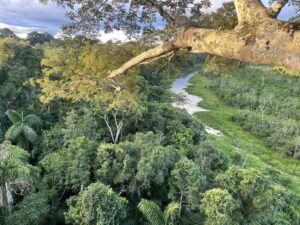
The Ecuadorian Amazon taken from a canopy tower at the top of a Ceiba pentandra tree. Credit: Mark Bush
__________________________
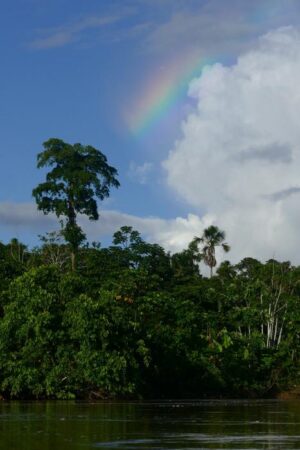
Amazonian forest. Credit: Crystal McMichael
__________________________
Article Source: PNAS news release.
*“Centuries of compounding human influence on Amazonian forests,” by Crystal N.H. McMichael et al., Proceedings of the National Academy of Sciences, 17-Nov-2025. https://www.pnas.org/cgi/doi/10.1073/pnas.2514040122