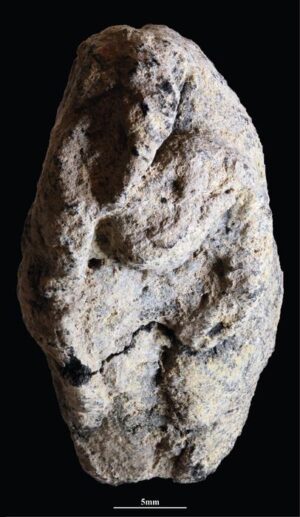
Proceedings of the National Academy of Sciences—Researchers report* a clay figurine from around 12,000 years ago, showing early advances in symbolic representation. Despite being rare, depictions of human–animal interactions in Paleolithic artwork can provide insights into the role of animals in human mythology and economy. Laurent Davin and colleagues report the discovery of a figurine from around 12,000 years ago—during the Late Paleolithic Period—that depicts a woman and a goose. The figurine comes from an archaeological site in northern Israel that also contained remains of geese, with evidence of hunting, butchering, and feather use. Through technological, archaeometric, and dermatoglyphic analyses, the authors found that the figurine was meticulously modeled from clay by a young adult who used innovative techniques. Notably, the use of volume and light to create perspective appear earlier in the figurine than in other examples. The figurine also represents the earliest known depiction of a woman in Southwestern Asian artwork, represented naturalistically rather than in a stylized fashion. Further, the figurine depicts a mythological scene rather than a hunting scene, suggesting an animistic belief system and an advance in symbolic representation in cultural objects. According to the authors, the figurine pushes back in time artistic innovations that came to define the subsequent Neolithic Period.
___________________________
The 12,000-year-old Natufian clay figurine from Nahal Ein Gev II, depicting a woman and a goose. Credit: Laurent Davin
___________________________

Artistic reconstruction of the 12,000-year-old Natufian clay figurine from Nahal Ein Gev II, depicting a woman and a goose. Credit: Laurent Davin and Vic Oh
___________________________
Article Source: PNAS news release.
*“A 12,000-year-old clay figurine of a woman and a goose marks symbolic innovations in Southwest Asia,” by Laurent Davin, Natalie D. Munro, and Leore Grosman, Proceedings of the National Academy of Sciences, 17-Nov-2025. https://www.pnas.org/cgi/doi/10.1073/pnas.2517509122