Proceedings of the National Academy of Sciences—A study* uncovers early evidence of wild barley and pistachio consumption in the foothills of Central Asia. Triticeae grasses, including wheat and barley, began evolving the earliest traits of domestication by around 10,000 years ago. Precisely when humans began to forage for Triticeae grass seeds or to use sickles for harvesting remain unclear. Xinying Zhou, Robert Spengler, and colleagues documented the use of stone sickles to harvest wild hulled and naked barley (Hordeum vulgare spp.) at Toda-1 Cave in the Surkhan Darya Valley of southern Uzbekistan that was dated to around 9,200 years ago. Surface wear patterns on stone blades and flakes excavated at the site suggested that they were used to cut siliceous plant material and may have been hafted into composite tools. Analysis of preserved plant remains indicated that nuts and fruits were processed at the site, in addition to wild barley, including wild progenitors of pistachios and apples or a close apple relative. Although the Surkhan Darya Valley is exceptionally arid in present times, analysis of wood charcoal and cave sediments suggested that the surrounding foothills would have been covered in shrubby woodland and seasonal fields of wild grasses. According to the authors, the findings expand the known geographic area where wild cereals were harvested and provide insights into the early Holocene foraging economy of Central Asia.
____________________________
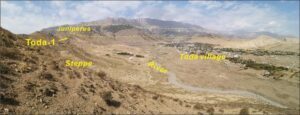
Landscape and vegetation zone around Toda-1 Cave in Uzbekistan. Xinying Zhou
____________________________
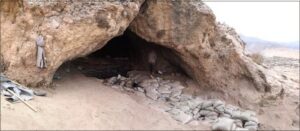
Entrance of Toda-1 Cave in Uzbekistan. Xinying Zhou
____________________________
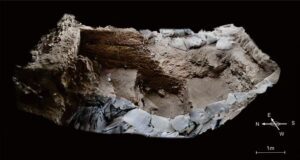
Toda-1 Cave excavation trench in 2019. Xinying Zhou
____________________________
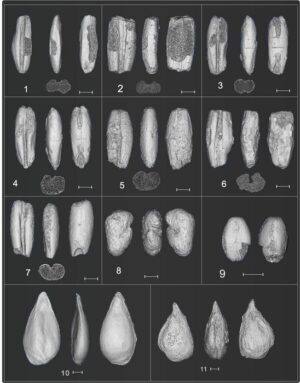
Carbonized seeds from Toda-1 Cave in Uzbekistan. Xinying Zhou
____________________________
Article Source: PNAS news release.
*“9,000-year-old barley consumption in the foothills of central Asia,” by Xinying Zhou et al., Proceedings of the National Academy of Sciences, 25-Aug-2025. https://www.pnas.org/cgi/doi/10.1073/pnas.2424093122