Archaeology used to mean brushes, trowels, and years of slow digging. Not anymore. Today, researchers find buried cities without moving a single grain of soil. The transformation is dramatic — and it’s accelerating fast.
Modern archaeology now blends science, computing, and field intuition in ways nobody predicted even twenty years ago.
Seeing Through the Ground: LiDAR
LiDAR stands for Light Detection and Ranging. It fires laser pulses from aircraft and measures how they bounce back. Dense jungle? No problem — the lasers pierce through the canopy.
In 2018, researchers used LiDAR to reveal a network of Maya cities in Guatemala spanning over 2,100 square kilometers. More than 60,000 hidden structures appeared in a single scan.
Drones Are Changing Everything
Small, cheap, fast. Drones now map archaeological sites in hours rather than weeks. They carry cameras, thermal sensors, and even ground-penetrating radar.
A drone survey costs a fraction of traditional aerial photography. Some teams operate entire excavation seasons using footage gathered by drones costing under $1,000.
Satellites Watch From Above
Satellite imagery has revealed lost cities beneath desert sands in Egypt, Saudi Arabia, and Central Asia. Dr. Sarah Parcak — sometimes called a “space archaeologist” — used NASA satellite data to identify over 3,000 ancient settlements.
The method works because buried structures affect soil moisture and plant growth differently. Satellites detect those subtle color and texture differences.
Ground-Penetrating Radar: X-Ray for the Earth
GPR sends radio waves into the ground and records reflections. It’s non-invasive. Nothing gets disturbed. Archaeologists essentially see underground before deciding where — or whether — to dig.
In 2022, GPR surveys near Stonehenge revealed 17 previously unknown ritual monuments. Nobody dug a single hole to find them.
DNA Analysis Rewrites Human History
Ancient DNA recovered from bones and teeth now tells stories no artifact ever could. Where did people migrate? Who were their relatives? What diseases did they carry?
A 2019 study analyzing DNA from over 800 ancient Europeans rewrote understanding of the Bronze Age migration patterns entirely. Results changed textbooks.
3D Scanning and Printing: Touching the Past
Fragile artifacts can now be scanned and reproduced with extraordinary precision. Museums share 3D models online. Researchers collaborate across continents without shipping anything.
The Smithsonian Institution has digitized over 4.8 million objects and specimens. A student in Kyiv can study a Roman coin held in Washington — in full three-dimensional detail.
Artificial Intelligence Sorts the Noise
AI doesn’t get bored. It doesn’t overlook patterns in repetitive data. Machine learning algorithms now process satellite images, identify anomalies, and flag potential sites — scanning in minutes what would take humans months.
At Pompeii, AI helped decipher carbonized scrolls too fragile to unroll physically. Characters hidden for 2,000 years finally became readable.
Digital Collaboration and Secure Research Access
Researchers today constantly work across borders. They share datasets, images, and findings through secure digital channels.
Protecting sensitive location data is genuinely important—revealing the precise GPS coordinates of unexcavated sites publicly can attract looters within days. Many fieldwork teams now use a free VPN service to encrypt their data transmissions. A free VPN from a proven provider like VeePN is an essential tool for self-protection in the digital environment, especially when working from remote locations with unsecured networks. It’s a simple but critical layer of protection for irreplaceable research.
Photogrammetry: Building Worlds From Photos
Take hundreds of overlapping photos. Feed them into software. Get a precise 3D model. That’s photogrammetry — now standard on serious excavations.
Teams used it extensively at Çatalhöyük in Turkey, one of the world’s oldest known cities. Every excavated layer was digitally preserved before removal. Nothing is truly lost anymore.
Underwater Archaeology Goes Deeper
Remotely operated vehicles (ROVs) explore shipwrecks and submerged settlements at depths no human diver could reach. They carry cameras, robotic arms, and sonar systems.
The ancient Greek shipwreck Antikythera — source of the famous “first computer” mechanism — was revisited using ROVs in 2016. New fragments of the mechanism were recovered. It changed everything scholars believed about ancient Greek engineering.
Isotope Analysis: Reading Bones Like Passports
The food and water a person consumes during childhood leaves a chemical signature in their bones. Scientists measure isotope ratios and determine where someone grew up — sometimes to a specific region.
This technique proved that many people buried at Stonehenge weren’t local. They came from Wales, hundreds of kilometers away. A stone circle suddenly became a story about movement and community.
Citizen Science and Open Data
Technology hasn’t just helped professionals. Platforms like MicroPasts crowdsource artifact identification to thousands of volunteers worldwide.
Regular people classify pottery types, transcribe documents, and tag photographs. VeePN supports the kind of secure, borderless digital collaboration that makes these global research networks possible. Connectivity matters when your team spans twelve countries.
What the Numbers Say
The scale of change is measurable. According to UNESCO estimates, the adoption of remote sensing technologies has increased the discovery rate of archaeological sites by approximately 30–40% over the past decade. Meanwhile, ancient DNA studies published annually jumped from roughly 50 papers in 2015 to over 500 by 2023.
These aren’t incremental improvements. They’re a revolution.
What Comes Next
Quantum computing may soon crack patterns in archaeological datasets far too complex for current machines. Hyperspectral imaging — which captures light beyond the visible spectrum — is already finding invisible pigments on ancient paintings.
The past isn’t static. Every year, technology lets us see it more clearly.
Final Thought
Modern archaeology is no longer just about digging. It’s about listening — to signals in the soil, in satellite data, in ancient DNA, in carbonized scrolls. The tools change constantly.
What doesn’t change is the question underneath all of it: Who were we, and how did we get here? Technology just keeps getting better at helping us answer it.
__________________________
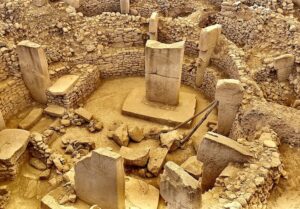
Cover Image, Top: Gobekli Tepe. Immanuelle, CC BY-SA 4.0, Wikimedia Commons
__________________________