Proceedings of the National Academy of Sciences—A study* explores foraging behavior in early humans. High-quality foods, particularly meat, were key to the cognitive and social development of early humans of the genus Homo. To explore food acquisition strategies among early humans, Frances Forrest and colleagues analyzed a 1.6-million-year-old fossil assemblage from the Koobi Fora Formation in Kenya. The assemblage, from the KBS geological layer, covers the period preceding the Okote geological layer and includes butchered animal remains associated with early Homo. Antelope remains were highly frequent in the assemblage. The remains in the assemblage were consistent with behaviors documented in the Okote layer. Such behaviors include hunting or aggressive scavenging, transporting carcass limbs to processing sites, and systematically extracting marrow. In the KBS assemblage, bones showed few carnivore tooth marks, suggesting that early Homo was able to obtain carcasses with limited carnivore competition. Transport of limbs revealed prioritization of high-reward, low-effort carcass sections. The geologic formation tied to the assemblage showed that the foraging behaviors occurred in a river-adjacent environment. The KBS assemblage also showed behavior consistent with 1.84-million-year-old sites in Tanzania and 2-million-year-old sites in Kenya. According to the authors, foraging behavior in early Homo was stable over time and may have contributed to the success and evolution of hominins.
_____________________________
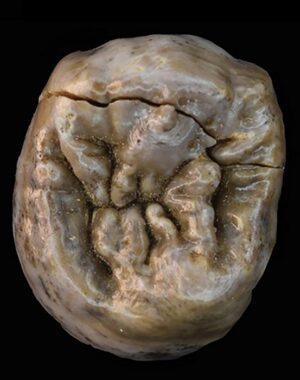
Hominin tooth from the Koobi Fora Formation in Kenya associated with the study assemblage. Credit Sharon Kuo.
_____________________________

Fossil bone from Koobi Fora, showing cut marks linked to butchering by early Homo. Credit Sharon Kuo.
_____________________________
Article Source: PNAS news release.
*“Early evidence for a stable and flexible foraging niche in the evolution of Homo,” by Frances Forrest et al., Proceedings of the National Academy of Sciences, 4-May-2026. 10.1073/pnas.2537631123
_____________________________