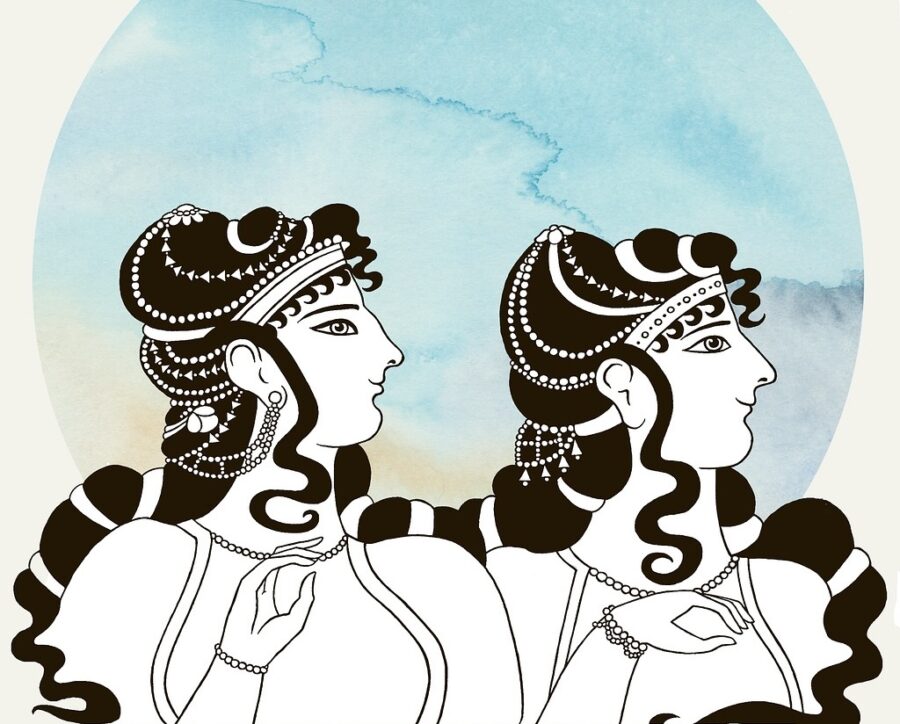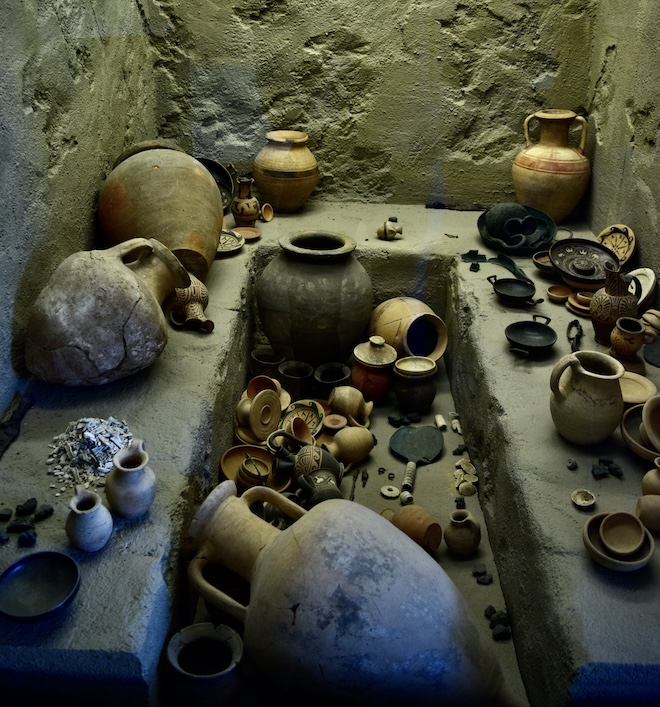
The story of Joseph in Egypt has long been one of the most enduring narratives in religious consciousness and collective human memory. Yet rereading it in light of historical and archaeological evidence opens the door to a more complex and deeper understanding, beyond strictly literal interpretations .
This article attempts to reconstruct the possible historical context of these narratives while taking their religious dimension into account, through a critical reading based on archaeological evidence and historical reasoning.
Between History and Memory
The difference between history and memory can be summarized simply as follows:
- History records what happened materially.
- Memory interprets what happened and gives it meaning.
Modern historical analysis does not deny the essence of the religious narrative. Rather than searching for a literal correspondence between scripture and archaeological traces, the story of Joseph can be understood as the result of a long interaction between history, memory, and identity.
Joseph between Religious Narrative and Historical Context
Exploring the relationship between religious narratives and ancient Egyptian history represents one of the most complex areas of historical research, due to the intersection between collective memory and archaeological evidence, and between religious symbolism and political reality.
Among the most debated questions is the place of the story of Joseph within the historical context of ancient Egypt, and whether it may be connected to actual events dating to the late New Kingdom.
According to religious texts, Joseph is described as a foreign individual who rose to a high administrative position in Egypt and managed a major economic crisis with great wisdom.
Historically, the presence of foreigners in high positions within the Egyptian state is well documented, particularly during periods of stability and political openness such as that in the New Kingdom. The rise of individuals like Yuya, who held prominent offices and appears to have had non-Egyptian origins, demonstrates that the Egyptian administrative system was capable of integrating non-Egyptian individuals into the highest ranks of government.
From this perspective, the present article explores who Yuya was and what possible relationship he might have had to the story of Joseph.
Yuya between History and Religious Narrative
Yuya is one of the most intriguing figures in ancient Egyptian history, not only because of his exceptional status but also because of the context in which he appeared.
Although he did not belong to the royal family, he rose to an unprecedented position as one of the most influential figures of the late Eighteenth Dynasty, particularly during the reign of Amenhotep III. His close connection to the royal family came through the marriage of his daughter Tiye to Amenhotep III. Queen Tiye later became the mother of Akhenaten, making Yuya effectively Akhenaten’s grandfather.
Yuya held several high offices, including Overseer of the Cattle of the God and Master of the Horse. He was also buried in a richly furnished tomb, an honor rarely granted except to members of the highest elite.
What distinguishes Yuya is not only his social rise but also the strong indications of his non-Egyptian origins, whether suggested by his name, his physical features, or his family connections. This opens the door to legitimate questions about the nature of the role he played within the Egyptian state, especially during a period marked by important political and administrative changes in the late Eighteenth Dynasty.
The context in which Yuya emerged is particularly significant. When examining the broader context of the reign of Thutmose IV, the predecessor of Amenhotep III, we find a transitional period characterized by a relative decline in external military activity and an increasing emphasis on internal stability and administrative reorganization. This shift may have been connected to certain climatic or economic disruptions and to the growing need for effective management of economic and social crises.
In such an environment, competence and administrative skill could become more valuable than purely royal lineage. This may help explain the rise of a figure like Yuya, and it also resonates with the religious narrative concerning the years of famine that led to the rise of Joseph.
In the same context, the famous Dream Stele of Thutmose IV is an important symbolic indicator of this transformation. The granite stele, located between the paws of the Great Sphinx at Giza, records a dream experienced by the prince before he became king. In the dream, the Sphinx promised him kingship if he cleared the sand surrounding it.
____________________________

Frontal view of the great Sphinx of Giza with the Dream stela. Chanel Wheeler, CC BY-SA 2.0, Wikimedia Commons
____________________________

Dream Stele as recorded by Lepsius. Carl Richard Lepsius, Public Domain, Wikimedia Commons
____________________________
This inscription is often interpreted as an attempt to legitimize royal authority during a sensitive political transition. But when compared with the religious narrative, it becomes strikingly reminiscent of the story of the ruler’s dream interpreted by Joseph. Where dreams always held an important place in ancient Egyptian culture and Egyptians often recorded significant dreams on monuments to preserve their memory.
This broader historical environment of seeking stability allows us to imagine the rise of capable administrators—even those of foreign origin—provided they demonstrated the ability to manage resources and control crises.
Within this framework, it becomes reasonable to suggest the hypothesis that Yuya may represent a historical example of a capable economic expert who emerged during a period when the Egyptian state required careful management of resources.
From this perspective, the story of Joseph may be interpreted as a symbolic echo of an earlier historical memory rather than a literal record of events. Such a reading opens the possibility of understanding how collective memory can develop from real historical experiences transmitted across generations.
Thus, the story of Joseph may be viewed not as a precise historical chronicle but as a scriptural narrative reinterpretation of an earlier historical experience, allowing for a deeper understanding of the relationship between religious narrative and political history.
From Yuya to Akhenaten: The Roots of Religious Transformation in the Late New Kingdom
The religious transformation that occurred during the reign of Akhenaten remains one of the most controversial phenomena in the history of the ancient Near East.
The emergence of the worship of the single god Aten, the decline of the power of the priests of Amun, and the abrupt separation from deeply rooted religious traditions are difficult to explain to be the result of an isolated personal decision.
Instead, examining the political, social, and intellectual context preceding this period allows for a deeper understanding of its motivations and perhaps its earlier roots.
It is worth noting that the God Aten, represented as the solar disk, had existed since the Old Kingdom as one manifestation of the god Ra, although the peak of Aten’s worship occurred during the Eighteenth Dynasty.
Within this broader context, Yuya emerges as a figure worthy of consideration—not as the direct cause of religious transformation but as a possible intermediary between two intellectual worlds.
Possible Intellectual and Religious Background
Although there are no explicit texts attributing alternative religious ideas to Yuya, his presence at the center of the ruling elite and his close relationship with the royal family may have positioned him as a channel through which unconventional religious ideas could have circulated.
The religious transformation of Akhenaten did not appear suddenly. It was preceded by lots of intellectual accumulations reflected in the following :
- The increasing centrality of the worship of the Sun in Egyptian doctrines, which began to appear clearly during the reign of Thutmose IV.
- A gradual shift from religious plurality toward a more concentrated concept of divine authority.
- The growing role of the king as the sole intermediary between the divine and the world.
All of these elements may have developed within the ruling elite before being formally expressed.
From Administrative Reform to Religious Transformation
The reforms initiated by Akhenaten may therefore represent the continuation of an earlier intellectual and administrative trajectory rather than the result of a sudden revelation.
During the reign of Thutmose IV, Yuya began to emerge as an influential figure within the royal court. Thutmose IV arranged the marriage of his son Amenhotep III to Yuya’s daughter Tiye, who later became the mother of Akhenaten.
During this same period, early signs of a transformation in the relationship between political authority and religion began to appear. These developments included the growing symbolic importance of the God of the sun Aten and the gradual weakening of the absolute dominance of the priesthood of the God Amun. This process became more evident during the reign of Amenhotep III.
Importantly, this transformation was not an abrupt religious revolution but a cumulative process extending over generations. This makes it plausible that the intellectual roots of Akhenaten’s reforms had begun developing long before his reign.
Within this framework, it is possible that earlier members of the elite—including Yuya—contributed to redefining the relationship between political authority and the divine God. Yuya may therefore be understood not as the founder of a new religious doctrine but as a cultural and administrative intermediary who helped reshape the structure of authority.
His exceptional status within the court and his influence on the next generation of rulers strengthen this possibility, particularly since Akhenaten grew up in a political and intellectual environment different from that of earlier periods.
From this perspective, Akhenaten’s religious transformation should not be seen as a sudden religious shift but rather as the culmination of a gradual historical process that began decades earlier.
____________________________
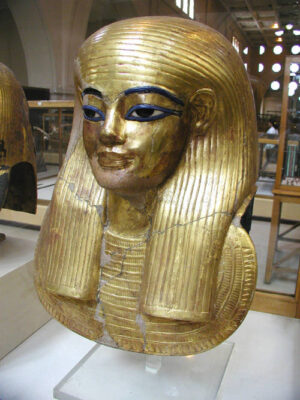
The gilded cartonnage mummy mask of Yuya, the father of Queen Tiye. Yuya was the father-in-law of pharaoh Amenhotep III, one of the the most powerful kings of Egypt’s 18th dynasty. Credit Jon Bodsworth, Wikimedia Commons
____________________________
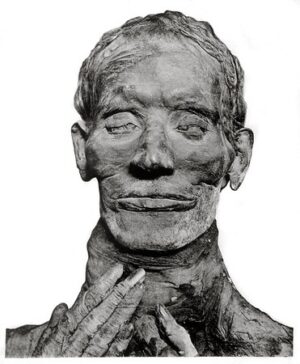
Photo image of the mummy of Yuya. Public Domain, Wikimedia Commons
____________________________
The Time of the Event and the Time of Writing: Divine Revelation as a Bridge between History and Memory
The chronological gap between the historical events that took place and the time when they were written down represents one of the central methodological challenges in the study of religious narratives.
For example, the Torah was not written at the time of the events it describes, nor during the lifetime of Moses. Instead, it was composed and compiled over several centuries, roughly between the tenth and fifth centuries BCE.
This means that several centuries separate the time of the events from the time of writing—a gap normally sufficient for historical memory to change or even disappear.
The issue becomes even more complex when we consider the civilizational context from which these narratives emerged. Ancient Egyptian civilization—within which stories such as those of Joseph and Moses are believed to have taken place—had already entered a long period of decline.
Its religious institutions weakened, knowledge of its language and symbols disappeared, and the historical records that preserved its memory were lost. Ancient Egyptian civilization itself eventually became a forgotten civilization, rediscovered only in the eighteenth century with the discovery of the Rosetta stone.
Despite this, the narratives themselves survived and remained strongly present within later religious traditions either in the Jewish, Christian, and Islamic religious traditions , even though more than a thousand years separated the emergence of each of those traditions and its predecessor .
This raises a fundamental question: how did these narratives survive while an entire civilization disappeared?
In other words, these stories were written in a period when there was no longer any living knowledge of the civilization in which the events supposedly occurred. Yet the narratives themselves remained remarkably coherent and preserved their core structure.
This persistence is difficult to explain purely through random cultural transmission or oral memory, particularly given the absence of direct knowledge of ancient Egyptian civilization at the time of the emergence of those religious narratives.
Here the concept of Divine revelation offers a possible explanation. In this analytical framework, revelation is not understood merely as the literal dictation of text, but as a mechanism through which meaning is preserved across time.
The concept of Divine Revelation preserves the essence of human experience even when historical details are lost. In this sense, Divine revelation does not transmit history in its precise chronological form; rather, it transmits the experiential truth of events—their meaning, significance, and ethical function that are the main essence of shaping Humanity.
From this perspective, the survival of narratives such as the story of Joseph becomes more understandable despite the disappearance of the civilization in which they supposedly took place.
Thus the gap between the time of events and the time of writing becomes not a weakness but rather a supporting element to the concept of Divine revelation. If the narratives were merely reflections of contemporary human knowledge, they would likely have disappeared along with the civilization that produced them.
Instead, their persistence across different religions and historical contexts suggests a deeper source of memory that transcends both written records and oral tradition.
In this sense, religion itself may be understood as a vessel for historical memory when material archeological evidence fails to preserve it.
____________________________
References
- Assmann, Jan. The Mind of Egypt: History and Meaning in the Time of the Pharaohs. Harvard University Press.
- Dodson, Aidan. Amarna Sunset: Nefertiti, Tutankhamun, Ay, Horemheb, and the Egyptian Counter-Reformation. American University in Cairo Press.
- Hornung, Erik. Akhenaten and the Religion of Light. Cornell University Press.
- Lichtheim, Miriam. Ancient Egyptian Literature, Volume II: The New Kingdom. University of California Press.
- Redford, Donald B. Akhenaten: The Heretic King. Princeton University Press.
- Wilkinson, Toby. The Rise and Fall of Ancient Egypt. Random House.
____________________________