Archaeologists from the Archaeological Centre Olomouc discovered a Bronze Age fragment hoard associated with the Urnfield culture during ongoing archaeological monitoring of Section 5 of the Brno–Přerov railway modernization project. Use-wear analysis has shown that most of the bronze objects had been used before their deposition and that some were deliberately damaged. Archaeologists believe the objects may subsequently have been deposited in a wetland near the river as part of a ritual practice.
The Archaeological Centre Olomouc has been carrying out archaeological monitoring for Správa železnic, the Czech railway infrastructure manager, since September 2025. The work is scheduled to continue until 2029. It follows a rescue excavation conducted at the same site from September to the end of December 2025, during which archaeologists uncovered an extensive prehistoric settlement.
“We knew that our work was continuing in an area occupied by an extensive prehistoric settlement, so we also used metal-detecting survey during the archaeological monitoring. It was this method that led to the discovery of the bronze hoard,” says Vít Záhorák, the archaeologist leading the archaeological monitoring.
Archaeologists discovered the hoard at the end of May in an area that had still been flooded shortly beforehand. The depositional setting is one of the most important aspects of the discovery. According to the preliminary assessment, the assemblage does not appear to represent a stock of bronze concealed for later recovery. The current interpretation instead suggests that the objects were deliberately deposited in a former wetland and that their deposition may have formed part of a ritual practice.
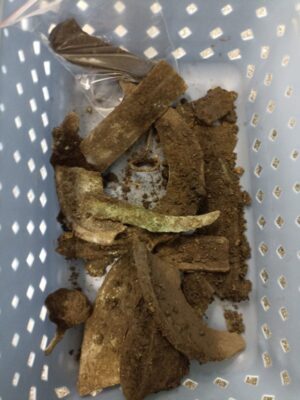
The hoard consists mainly of fragments of bronze tools. It includes eight deformed sickles, one complete sickle, part of a sword blade, fragments of ornaments and other bronze objects. Three ingots and two unfinished objects were also recovered. Archaeologists classify the assemblage as a mixed fragment hoard dominated by worn parts of tools.
Use-wear analysis, which examines traces of use preserved on the surfaces of artifacts, has provided crucial evidence. It confirmed that the bronze tools had been used before their deposition and also showed that some had been deliberately damaged. The sword fragment was separated by a single powerful blow, probably delivered with a chisel or an axe, while several of the sickles were intentionally deformed.
“We recorded traces of ordinary use as well as deliberate damage on the artifacts. These modifications were not caused during their practical use but appear to be connected with their deposition,” explains use-wear specialist Michael Kamarád.
The newly discovered Bronze Age hoard is not the only assemblage of metal objects found at the site. During the earlier rescue excavation, archaeologists uncovered an Early Medieval iron hoard deposited within a structure associated with craft production. According to the preliminary assessment, that assemblage was connected with the practical activities of an inhabitant of the settlement. The bronze hoard dates from an earlier period, and its deposition in a wet environment suggests a different motivation.
Deposits of bronze objects in watery or waterlogged settings are also known from other Bronze Age sites. In some of these cases, archaeologists have considered a possible connection with ritual practices. Further specialist analyses will help determine whether the Kojetín hoard had a comparable significance.
The bronze hoard is now undergoing conservation and specialist documentation. The results of further analyses will help clarify the circumstances of its deposition and its significance for understanding the lives of Bronze Age communities in central Moravia.
_______________________
The Bronze Age hoard from Kojetín after its recovery from the site and before conservation and specialist examination. The assemblage consists of several bronze objects and their fragments. Photo: Archaeological Centre Olomouc.
_______________________
Article Source: Archaeological Centre Olomouc news release.
_______________________
POPULAR ARCHAEOLOGY ON INSTAGRAM

_______________________