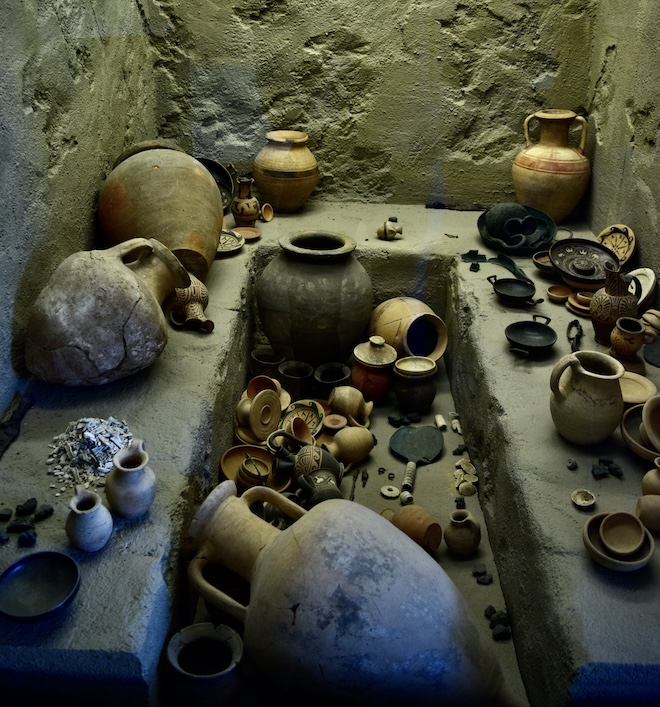
Long before anyone built a house meant to last a lifetime, people were building for eternity. The earliest large stone structures humans left behind were not homes or halls but tombs, raised to carry the dead into whatever came next. It is a strange twist of history that the buildings meant for the afterlife are the ones that taught the living how to build.
The instinct might be to treat ancient tomb construction as a curiosity, something for museums rather than modern job sites. Yet the methods worked out by those early builders (how to stack stone so it holds, how to bind it, how to keep water out) are the same problems every mason still solves today. The tools have changed far more than the principles.
What Ancient Tomb Construction Actually Involved
Before the arch, before the cathedral, the tomb was the proving ground. When early civilisations decided a burial deserved something permanent, they were forced to answer questions no one had answered at scale before: how to move heavy stone, how to make it stand, and how to make it endure for centuries rather than seasons.
Why were tombs the first great test of masonry?
A tomb had one demanding requirement that an ordinary dwelling did not: it had to outlast everyone who built it. That single goal pushed early masons toward heavier materials, more careful joints, and structures designed around permanence rather than convenience. The result was a range of forms that still define what people picture when they imagine ancient building:
- Mastabas, the flat-roofed, sloping-walled tombs of early Egypt, built first in mud brick and later in stone.
- Pyramids, which scaled the mastaba idea into vast stepped and smooth-sided monuments.
- Rock-cut tombs, carved directly into cliff faces rather than assembled from blocks.
- Mausoleums, above-ground tombs that turned burial into architecture.
- Catacombs, underground networks lined and reinforced with masonry.
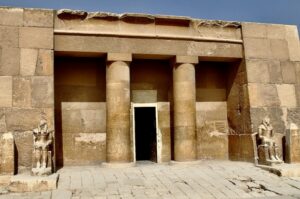
The earliest of these, such as the ancient Egyptian mastaba, show masonry already being used with intent rather than guesswork, with sloping walls to shed load and shaped stone laid in deliberate courses. These were experiments in permanence, and the ones still standing are the experiments that worked.
Why Those Early Builders Still Matter to Masonry Today
It would be easy to assume that thousands of years of progress left ancient methods behind. In practice, the opposite is closer to the truth. The fundamentals settled in the age of the tomb were so sound that they became the baseline the trade never really moved away from.
What did tomb construction prove that still holds true?
Three ideas, above all, carried forward. First, that weight must be distributed, not simply piled, which is why courses are laid level and load is spread across a base. Second, that a structure is only as durable as the material between the stones, which made mortar and jointing a craft in itself. Third, that shaped, well-fitted units outlast rough ones, because tight joints leave water and weather less to work with.
These are not historical footnotes; they are the daily logic the trade still runs on. Picture the earliest builders arguing over how to set a single stone so it would hold for a thousand years, then picture a reputable masonry contractor today weighing the same call before laying the first course of a wall, and the distance between them all but disappears. A modern wall and an ancient tomb are separated by millennia and united by the same rules, which is part of why the craft rewards patience and precision over shortcuts.
Ancient Techniques Compared With Modern Masonry Methods
Setting the two eras side by side is the clearest way to see what endured and what evolved. The comparison is less a story of replacement than of refinement, with old principles carried forward inside better tools and materials.
How much has actually changed in thousands of years?
Run through the core elements of the craft, and each one shows the same trend: the idea stayed, the execution improved.
- Main materials. Ancient builders worked in mud brick and quarried, dressed stone; modern masons use fired brick, concrete block, and cut or manufactured stone.
- Binder. Early mortars were lime, gypsum, or mud-based; today’s are engineered cement and lime mixes matched to the specific job.
- Tools. Copper and stone tools, ramps, and levers have given way to powered saws, mixers, and precision measuring tools.
- Load handling. Both eras spread weight through mass and careful stacking, though modern work adds engineered supports and reinforcement.
- Finishing. Hand-dressed faces and fitted joints have become machine-cut units with hand-finished detailing.
- Goal. The ancient aim was permanence for a single monument; the modern one adds safety, function, and appearance to that same durability.
Tomb-Era Techniques Modern Masons Still Rely On
Some methods have survived not because of tradition but because nothing better replaced them. A handful of techniques worked out in the age of monumental tombs remain in daily use, often unchanged in principle.
Which ancient methods never went out of use?
- Coursed, level stacking. Laying units in even horizontal rows to distribute load is as standard now as it was on the first stone tomb.
- Dressed, fitted stone. Shaping a stone so it sits tightly against its neighbours reduces the gaps water can exploit, a lesson learned early and never unlearned.
- Mortar and repointing. Filling and later refilling the joints between units keeps water out and structures sound, and it remains one of the most common repair jobs in the trade.
- Corbelling and the arch. Bridging a gap by stepping stones inward, and later by turning an arch, both trace back to early monumental building.
- Weather and water management. Sloping surfaces and drainage to keep moisture moving away from the structure are ancient ideas that still decide how long masonry lasts.
That fourth point, in particular, explains why old structures need ongoing care. Mortar is designed to weather before the stone or brick does, which is why understanding how chimney repair works and handles failing joints echoes the very oldest maintenance problem in the craft, which is to renew the material between the units before the units themselves are lost
Where That Ancient Craft Shows Up in Homes Now
The line from tomb to modern home is not as long as it looks. The same techniques that raised burial monuments now sit, quietly and unremarked, in ordinary properties.
How does tomb-era masonry reach an everyday backyard?
Every fireplace, garden wall, stone façade, and outdoor oven is a descendant of that early work. A hearth built to hold heat relies on the same instincts as an ancient kiln or a stone-lined chamber. A patio or a retaining wall borrows the coursing and drainage logic first tested on monuments. Even the decision to face a structure in stone for both strength and appearance is an inheritance from tombs that were meant to impress as much as endure. The craft did not trickle down so much as continue, passed from one generation of hands to the next with the core methods intact.
FAQs
Did ancient tombs really use techniques still used today?
Yes. Coursed stacking, dressed stone, mortar joints, and drainage were all in use on early tombs and remain standard in modern masonry, refined by better tools and materials.
What was the earliest form of monumental tomb?
The mastaba, a flat-roofed tomb with sloping walls, is among the earliest, and its ideas later scaled up into the pyramid.
Why has masonry changed so little in principle?
Because the core problems, spreading load, binding units, and keeping water out, were solved early and solved well. Later progress improved the materials and tools rather than the underlying logic.
What is the most common ancient technique still used in repairs?
Repointing, the renewal of mortar between units, is a direct continuation of an ancient maintenance practice and one of the most frequent masonry repairs today.
Is old masonry stronger than modern masonry?
Not necessarily. Ancient work that survives is often the best of its era, while modern methods add engineering, safety, and consistency that ancient builders lacked.
Final Thoughts
The story of masonry is, in large part, the story of the tomb. The drive to build something that would outlast its makers forced early civilisations to work out how stone holds, how mortar binds, and how weather is kept at bay, and those answers proved so durable that the trade still runs on them. Modern materials and tools have sharpened the craft without rewriting its rules. Looked at that way, every wall, hearth, and chimney standing today carries a little of the same logic first tested on structures built for eternity.
Cover Image, Top: Ancient Egyptian Mastaba. Djehouty, CC BY-SA 4.0, Wikimdia Commons
_____________________________