Tel-Hai University of Kiryat Shmona in the Galilee—A remarkably preserved elephant tooth previously recovered from Gesher Benot Ya’aqov (GBY-NBA) — a prehistoric site in northern Israel, where early humans made stone tools some 700,000 years ago — has now enabled researchers to reconstruct a lush landscape of woodlands, wetlands, and waterways from the Pleistocene. The findings provide a rare glimpse into the environment shared by giant elephants and some of the region’s earliest human populations.
The elephant remains were discovered alongside basalt handaxes and cleavers, hallmark tools of the Acheulian tradition, one of the earliest and most widespread stone-tool technologies in human history. Researchers combined multiple analytical techniques to reconstruct a resource-rich environment of woodlands, grasslands, wetlands, and waterways that helped sustain both large mammals and early humans along the Levantine land bridge connecting Africa and Eurasia.
Published in Quaternary Science Reviews, the study led by Hannah Farrell (a PhD candidate at Haifa University) focuses on findings from the excavation site of GBY-NBA by Prof. Gonen Sharon of Tel-Hai University of Kiryat Shmona in the Galilee and his colleagues. The research focuses on a giant elephant molar and tusk fragments discovered alongside Acheulian stone tools at Gesher Benot Ya’aqov (Daughters of Jacob Bridge), located in the Jordan Rift Valley, south of today’s Hula Valley in northern Israel. The remains belonged to Palaeoloxodon antiquus, the straight-tusked elephant, one of the largest land mammals of the Pleistocene. Rather than studying the elephant alone, researchers used the tooth as a biological archive to reconstruct the broader ecosystem shared by large mammals and early human toolmakers.
What an Ancient Ecosystem Reveals About Human Origins
According to Prof. Sharon, “understanding how humans and animals responded to environmental change hundreds of thousands of years ago helps us better understand the forces that shaped our species.”
Using CT scanning, 3D reconstruction, microscopic wear analysis, isotope geochemistry, and pollen studies, the team found evidence for a long-lasting landscape of woodlands, grasslands, marshes, rivers, and shallow-water habitats. Carbon isotope values suggest the elephant lived in a consistently well-watered environment, while pollen recovered from sediments revealed abundant wetland vegetation, including reeds, sedges, willow, tamarisk, and aquatic plants.
The findings indicate that the Hula Valley region formed part of a stable ecological refuge within the Levantine Corridor, the land bridge connecting Africa and Eurasia. Such environments likely provided reliable water and biological resources for wildlife and human groups moving through the region during the Pleistocene.
“The availability of water, vegetation, and animal resources shaped where humans and wildlife could survive,” Sharon says. “The wetlands, rivers, and woodlands of the Hula Valley helped sustain life along one of the world’s earliest migration corridors, offering a rare opportunity to understand the ecological conditions that supported both animals and human populations nearly 700,000 years ago.”
The study was conducted by PhD candidate Hannah Farrell of the University of Haifa at a site excavated by Prof. Gonen Sharon of Tel-Hai University of Kiryat Shmona in the Galilee, in collaboration with Cheryl A. Makarewicz (isotope studies) and Nimrod Marom (archaeozoology) from the University of Haifa, along with Minji Jin and Dafna Langgut (pollen studies) from Tel Aviv University.
About Tel-Hai University of Kiryat Shmona in the Galilee
Tel-Hai University of Kiryat Shmona in the Galilee is a rapidly growing research university addressing challenges in food security, sustainable agriculture, engineering, artificial intelligence (AI), and more.
Through interdisciplinary applied research, academic excellence in a host of disciplines – including humanities, social sciences, and education – as well as close collaboration with industry and communities, Tel-Hai University of Kiryat Shmona in the Galilee is tackling some of the most pressing challenges of the 21st century, while positioning the Galilee as a global hub for innovation.
_________________________
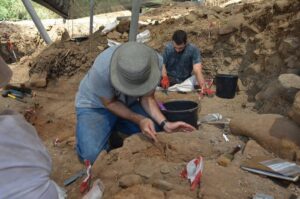
The study was conducted by PhD candidate Hannah Farrell of the University of Haifa at a site excavated by Prof. Gonen Sharon of Tel-Hai University of Kiryat Shmona in the Galilee. Credit: Photos and illustrations courtesy of Tel-Hai University of Kiryat Shmona in the Galilee and Hannah Farrell, University of Haifa
_________________________
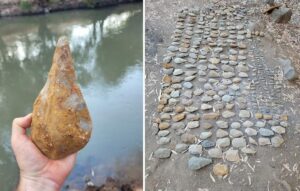
The elephant remains were discovered alongside basalt handaxes and cleavers, hallmark tools of the Acheulian tradition, one of the earliest and most widespread stone-tool technologies in human history. Credit: Photos and illustrations courtesy of Tel-Hai University of Kiryat Shmona in the Galilee and Hannah Farrell, University of Haifa
_________________________
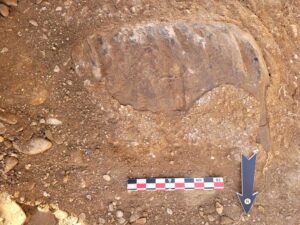
A remarkably preserved elephant tooth previously recovered from Gesher Benot Ya’aqov (GBY-NBA) — a prehistoric site in northern Israel, where early humans made stone tools some 700,000 years ago — has now enabled researchers to reconstruct a lush landscape of woodlands, wetlands, and waterways from the Pleistocene. The findings provide a rare glimpse into the environment shared by giant elephants and some of the region’s earliest human populations. Credit: Photos and illustrations courtesy of Tel-Hai University of Kiryat Shmona in the Galilee and Hannah Farrell, University of Haifa
_________________________
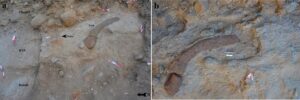
The research focuses on a giant elephant molar and tusk fragments discovered alongside Acheulian stone tools at Gesher Benot Ya’aqov in northern Israel. The remains belonged to Palaeoloxodon antiquus, the straight-tusked elephant, one of the largest land mammals of the Pleistocene. Credit: Photos and illustrations courtesy of Tel-Hai University of Kiryat Shmona in the Galilee and Hannah Farrell, University of Haifa
_________________________
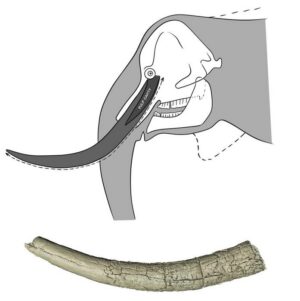
The remains belong to Palaeoloxodon antiquus, the straight-tusked elephant, one of the largest land mammals of the Pleistocene. Credit: Photos and illustrations courtesy of Tel-Hai University of Kiryat Shmona in the Galilee and Hannah Farrell, University of Haifa
_________________________
Article Source: Tel-Hai University of Kiryat Shmona in the Galilee news release.
*Elephant dental remains from the Acheulian site at North Bridge Acheulian–Gesher Benot Ya’aqov: hominin behavior and environmental implications, Quaternary Science Reviews, 10.1016/j.quascirev.2026.110277
_________________________
POPULAR ARCHAEOLOGY ON INSTAGRAM

_________________________