Two compelling prehistoric sites in what is present-day Morocco are leading to new, revolutionary insights on the nature, direction, and geography of human evolution on the African continent. Here are the stories that have developed from the excavations and research.
The Casablanca Horizon
Casablanca is best known in general popular imagery as the exotic setting for the iconic 1942 film, Casablanca, starring Humphrey Bogart and Ingrid Bergman, and as Morocco’s coastal economic powerhouse gem boasting a unique blend of Berber, Arab, and European cultures with historic Art Deco architecture, the massive Hassan II Mosque, and vibrant traditional crafts.
Much less known to most, but nonetheless equally significant, is the fact that it also lies adjacent to internationally renowned Plio-Pleistocene palaeo-shorelines, cave systems and coastal dunes. This region has offered ideal conditions over geologic time for fossil formation and archaeological preservation — one of Africa’s best locations for investigating and researching Pleistocene palaeontology and archaeology. For scientists exploring the remains of prehistoric fauna, prehistoric humans, and their context of environmental change, it has therefore now emerged as one of the world’s most remarkable hotspots for uncovering traces of humanity’s human evolutionary journey.
The Grotte à Hominidés
Here, since the early 1990’s, an international team of scientists consisting of archaeologists and other specialists led by Jean-Jacques Hublin (Collège de France & Max Planck Institute for Evolutionary Anthropology), David Lefèvre (Université de Montpellier Paul Valéry), Giovanni Muttoni (Università degli Studi di Milano) and Abderrahim Mohib (Moroccan Institut National des Sciences de l’Archéologie et du Patrimoine, INSAP) have conducted a 3-decade long excavation and investigation of Thomas Quarry I, slicing into the Oulad Hamida Formation, a ~1 Ma to Early/Middle Pleistocene stratigraphic unit featuring prehistoric fauna and clear signs of a hominin (or early human) presence based on rich Acheulean stone tool manufacturing, such as bifaces and cleavers, alongside evidence of butchery and fauna. It has thus far yielded a long-term record of early human habitation.
The finds recovered at Thomas Quarry I were remarkable by themselves. But it was the discovery made in one section of the Quarry, a cave system called Grotte à Hominidés, that yielded fossils that began to open up new questions and revelations about human evolution on the African continent.
It was in 1969 when Philippe Beriro, a collecting hobbyist, discovered what turned out to be the partial mandible of a hominin on a sloping surface below the cave, in addition to lithic and other mammal fossils. But it wasn’t until 1994 when controlled excavations, carried out over a period of more than two decades, uncovered stone artifacts of the Acheulean industry, more mammal fossils and, most significantly, additional hominin fossils within a well-defined stratigraphic context. Abundant carnivore remains, coprolites and other unmodified mammal bones, along with the scarcity of lithic artifacts, all indicated a carnivore den context. The hominin fossil assemblage included an adult mandible, eight hominin vertebrae and a hominin mandible fragment that forensic analysis showed to be a 1.5 year-old child. Finds also included a partial hominin femora that investigators determined to have been scavenged by a large carnivore, likely a hyena.
________________________________
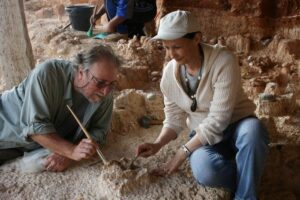
ean-Paul Raynal and Fatima Zohra Sihi-Alaoui, co-directors of the program “Préhistoire de Casablanca” throughout the excavation that led to the discovery of the mandible ThI-GH-10717, in May 2008. Credit © R. Gallotti, Programme Préhistoire de Casablanca
________________________________
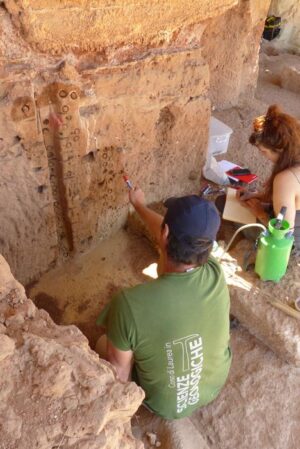
Serena Perini and Giovanni Muttoni during the sampling for magnetostratigraphy in the Grotte à Hominidés deposits at the Thomas Quarry I. Credit © D. Lefèvre, Programme Préhistoire de Casablanca
________________________________

Thomas Quarry I, Grotte à Hominidés: Mandible ThI-GH-10717 during the excavation. Credit © J.P. Raynal, Programme Préhistoire de Casablanca
________________________________
What Kind of Hominin?
As would be the case for any archaeological team, among the first priorities was to identify the genus and species of hominin these fossil remains represented.
Researchers applied high-resolution micro-CT imaging and geometric morphometric analysis of the Grotte à Hominidés specimens, including comparative anatomical analysis, drawing upon hominin fossil remains from other sites. The comparative fossil samples consisted of Early, Middle and Late Pleistocene hominins from Africa, Europe and Asia. The range of hominin species included specimens of H. erectus, Homo floresiensis, Homo naledi, H. neanderthalensis, H. sapiens and Denisovan. Analysis revealed that these fossils featured a mosaic of archaic and derived traits.
Examining teeth was a particularly revealing operation. Says Matthew Skinner of the Max Planck Institute for Evolutionary Anthropology, Leipzig, Germany, and co-author of the associated study, “Using microCT imaging we were able to study a hidden internal structure of the teeth, referred to as the enamel-dentine junction, which is known to be taxonomically informative and which is preserved in teeth where the enamel surface is worn away. Analysis of this structure consistently shows the Grotte à Hominidés hominins to be distinct from both Homo erectus and Homo antecessor, identifying them as representative of populations that could be basal to Homo sapiens and archaic Eurasian lineages.”*
_____________________________
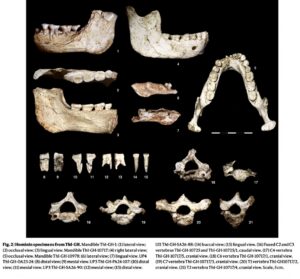
From Hublin, JJ., Lefèvre, D., Perini, S. et al. Early hominins from Morocco basal to the Homo sapiens lineage. Nature 649, 902–908 (2026). https://doi.org/10.1038/s41586-025-09914-y. CC BY 4.0
_____________________________
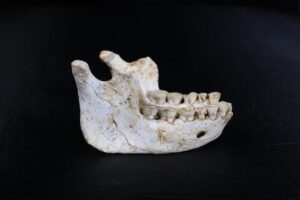
773,000-year-old mandible ThI-GH-10717 from Thomas Quarry in Morocco. Credit © Hamza Mehimdate, Programme Préhistoire de Casablanca
_____________________________
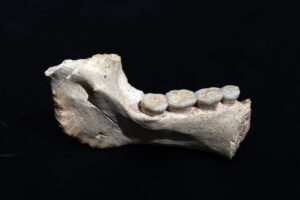
773,000-year-old mandible ThI-GH-1 from Thomas Quarry in Morocco. Credit © Hamza Mehimdate, Programme Préhistoire de Casablanca
_____________________________

Lower jaws (mandibles) from North Africa, illustrating variation among fossil hominins and modern humans. The fossils shown are Tighennif 3 from Algeria (upper left), ThI-GH-10717 from Thomas Quarry in Morocco (upper right), and Jebel Irhoud 11 from Morocco (lower left), compared with a mandible from a recent modern human (lower right). All specimens are shown at the same scale, allowing direct comparison of their size and shape. Credit © Philipp Gunz, MPI for Evolutionary Anthropology
_____________________________
How Old?
Key to understanding the significance of the finds was the determination of their age within the geologic chronology. To obtain the age of the fossils, scientists sampled the sediments in which the fossils were found to create a high-resolution magnetostratigraphic record of the sediments. The key deposits, in contrast to what could be studied at most sites, were fortunately originally created during a reversal in the Earth’s magnetic field polarity, a phenomenon that can be detected in sedimentary deposits. In this case, the deposits were laid down at the end of what is known as the Matuyama Chron (reverse polarity), and the onset of the Brunhes Chron (normal polarity). By taking and testing 180 samples from this horizon, the research team was able to establish the precise position of the polarity switch, dated at 773,000 years ago. The nature of the faunal finds (37 species of mammals) found at the site also independently supported this age, a finding that led to another important implication, as reported in the study paper published in the journal Nature:
“Resemblances with East and South African faunas attest to easy latitudinal exchanges, demonstrating that the Sahara was not a permanent barrier in EP times owing to the recurrent expansion of savanna landscapes across North Africa in response to short-lived, astronomically driven periods of enhanced monsoon rainfall.”**
These fossils were 773,000 years old. They were hominins that ancestrally may have had connections in geologic time with other hominins, in other parts of the greater African landscape, facilitated by a greener Sahara.
What Does It Mean?
Given the age of the fossils, scientists determined that the hominins these fossils represented were nearly contemporary with the Homo antecessor hominins of the Gran Dolina site much further north in Spain at Atapuerca, though featuring a few differing morphologies, but older than Middle Pleistocene fossils thought to be ancestral to Neanderthals and Denisovans, and about 500,000 years older than the early Homo sapiens fossils found at Jebel Irhoud, also located in present-day Morrocco. The research team for Grotte à Hominidés thus suggest that these new finds could provide some clues relating to the last common ancestor of Homo sapiens, Neanderthals, and Denisovans, an ancestor that is estimated from genetic findings to have lived somewhere between 765,000 and 550,000 years ago.
Says Jean-Jacques Hublin,“the fossils from the Grotte à Hominidés may be the best candidates we currently have for African populations lying near the root of this shared ancestry, thus reinforcing the view of a deep African origin for our species.“*
____________________________
The First Homo sapiens
About 80 miles southeast of Casablanca lies a site called Jebel Irhoud. The location means nothing to most people. It is what the locals have named it — a mountain-like karstic limestone outcrop situated southeast of the coastal city of Safi. Collectively with all other hilly outcrops in the region, there is nothing distinguishable about it — except for a distinctive, massive cut-away a little over halfway down its ridge line on its east side. Today this cut-away looks very much like a rock shelter. But at one time, several hundred thousand years ago, it was a complete cave.
Jebel Irhoud is filled with 8 meters of deposits from the Pleistocene epoch, and thus it has a story to tell — about a slightly greener, wetter Sahara over 300,000 years ago — a steppe-like environment where equids, bovids, gazelles, rhinoceros and various other predators roamed the landscape — including humans, who lived in this cave and hunted and fed on the gazelles and other animals that made the region their home. We know there were humans here because archaeologists and other scientists have discovered what they left behind here, including their bones — bones that looked startlingly like those of modern humans.
Lost and forgotten for millennia, evidence of ancient human presence within the cave came to light in 1960, when miners stumbled across what appeared to be the remains of a human skull within its wall. The skull was eventually consigned to the University of Rabat, sparking a joint French-Moroccan expedition to explore and study the site in 1961. Under the leadership of the French scientist Émile Ennouchi, this excavation team discovered several fossil bone specimens identified as human — a skull, part of another skull, and a lower mandible — along with the remains of about 30 species of mammals, some of which were dated to the Middle Pleistocene. The finds stirred the scientific world with the suggestion that some form of humans occupied the site perhaps tens of thousands of years ago. Further excavations conducted by a team under Jacques Tixier and Roger de Bayle des Hermens in 1967 and 1969 deepened the story, with the recovery of additional fossils, including a human-like humerus and an apparent human pelvic (hip) bone. A plethora of stone artifacts were discovered, as well.
_____________________________

The Jebel Irhoud (Morocco). Credit: Shannon McPherron, MPI EVA Leipzig, License: CC-BY-SA 2.0
_____________________________

View looking south of the Jebel Irhoud site. The remaining deposits and several people excavating them are visible in the center. At the time the site was occupied by early hominins, it would have been a cave, but the covering rock and much sediment were removed by work at the site in the 1960s. Credit: Shannon McPherron, MPI EVA Leipzig, License: CC-BY-SA 2.0.
_____________________________
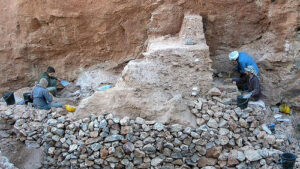
Excavators working on the remaining deposits at Jebel Irhoud. The new fossils were found in the sediments in front of where the two excavators on the left are working. Credit Shannon McPherron, MPI EVA Leipzig, License: CC-BY-SA 2.0.
_____________________________
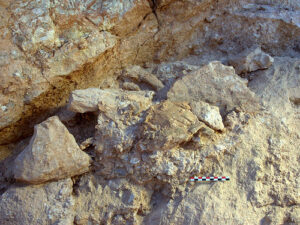
Two of the new Jebel Irhoud fossils in situ as they were discovered during excavation. In the center of the image, in a slightly more yellow brown tone, is the crushed top of a human skull (Irhoud 10) and visible just above this is a partial femur (Irhoud 13) resting against the back wall. Not visible behind the pointed rock (between the femur and the skull) is the mandible (Irhoud 11). The scale is in centimeters. Credit: Steffen Schatz, MPI EVA Leipzig, License: CC-BY-SA 2.0.
_____________________________
But one real sticking point about the Jebel Irhoud finds revolved around the Middle Pleistocene faunal remains that appeared to be associated with the human remains. The Middle Pleistocene generally spans the range between 781,000 to 126,000 years ago. Other considerations assigned a much later date to the human occupants. Moreover, the human fossils found at Jebel Irhoud exhibited many characteristics that were distinctly ‘modern’, or Homo sapiens, in terms of morphology, as well as some distinctively more archaic characteristics. The combination of findings created a puzzling mix of elements, given the state of knowledge and assumptions about dating and human evolution.
Pushing Back the Clock on Homo sapiens
Enter 2004, when a team led by Jean-Jacques Hublin of the Max Planck Institute for Evolutionary Anthropology began to investigate the site. Hublin, long at the forefront of research on Pleistocene hominins, particularly Neanderthals and early Homo sapiens, could not keep the mystery of Jebel Irhoud out of his mind. “The description of the small, child’s mandible found at the site in the 60’s was one of the first original fossils I ever described and published back in the early 80’s,” he wrote Popular Archaeology. “Since then, I have been fascinated by the material yielded by Jebel Irhoud. The combination of primitive and modern features that these fossils display could not make much sense if the rather late age that was originally assigned to the site were accurate.” The new excavations eventually yielded 16 new Homo sapiens fossils with associated Middle Stone Age type stone tools and more animal bones. The finds included skulls, teeth, and long bones that represented at least 5 individuals.
______________________________
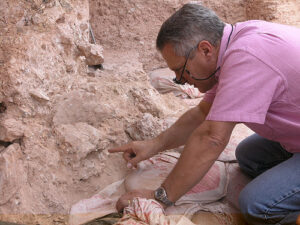
Dr. Jean-Jacques Hublin on first seeing the new finds at Jebel Irhoud. He is pointing to the crushed human skull (Irhoud 10) whose orbits are visible just beyond his finger tip. Credit: Shannon McPherron, MPI EVA Leipzig, License: CC-BY-SA 2.0.
______________________________
One of the objectives of the new investigations was to make sense of the dating at the site. “Our first goal was to obtain accurate radiometric dates confirming or falsifying the Middle Pleistocene age suggested by the study of the fauna,” said Hublin. One of the salient discoveries at the site revolved around the finding of burnt flint samples associated with the sediments containing the human fossils, a key to dating the site and the human remains. With the recent advancements in dating technology and techniques, it was an opportune time to take a new look at the material.
After applying newly refined thermoluminescence dating to the heated flints found at the site, Hublin and his team had astounding results — the samples yielded an age of approximately 300,000 years ago. If the results were valid, this meant that the Jebel Irhoud humans occupied the site tens of thousands of years earlier than the previously oldest Homo sapiens fossils, found at Omo Kibish in Ethiopia, dated to 195,000 years ago, Herto Bouri, also in Ethiopia, dated to 160,000 years ago, and Florisbad, South Africa, at 260,000 years ago. “There was still a long way to go to confirm these dates on a significant number of other samples and to confirm them with another method,” said Hublin about their initial results. “So we worked with specialists of ESR (Electron Spin Resonance) to double-check the dating of the site.”
Geochronology expert Daniel Richter of the Max Planck Institute, who worked on the dating process, played a key role in getting researchers to the end game on age. “Well-dated sites of this age are exceptionally rare in Africa, but we were fortunate that so many of the Jebel Irhoud flint artifacts had been heated in the past,” he said. “This allowed us to apply thermoluminescence dating methods on the flint artifacts and establish a consistent chronology for the new hominin fossils and the layers above them.” Moreover, the researchers were finally in a position to recalculate a date for the Jebel Irhoud mandible found in the 1960s excavations. The mandible was previously dated to 160 thousand years ago by the electron spin resonance dating method. But now, using newly improved methods, the mandible’s newly calculated date was consistent with the new thermoluminescence dates, making it much older than previously thought.
With dates confirmed, Hublin and colleagues could make a bold but supportable claim.
Some form of Homo sapiens lived at Jebel Irhoud about 300,000 years ago.
A Primitive Homo sapiens?
Key to understanding the significance of the human fossil finds is the distinctive combination of modern and archaic features they exhibit, particularly in the skull. The distinguishing hallmarks of modern human skulls include a small and gracile face (in contrast to most other hominin species fossil specimens), and a large, globular braincase. The Jebel Irhoud fossils exhibit the same facial characteristics and a large brain case capacity comparable to that of modern humans, but a more archaic-looking, elongated braincase with relatively prominent supraorbital (brow) ridges similar to what can be found in Neanderthals and other more ‘primitive’ species. Hublin and colleagues applied state-of-the-art tomographic scans and produced digital avatars of the fossils, using advanced mathematical tools to assess 3D morphometry. Statistical shape analysis was performed using hundreds of 3D measurements, showing that the facial morphology of the Jebel Irhoud fossils is nearly identical to that of modern humans living today. This combination with the elongated braincase and other features shared with other, earlier species of humans raised new questions about the evolutionary morphology of the human skeleton.
____________________________

The mandible Irhoud 11 is the first, almost complete adult mandible discovered at the site of Jebel Irhoud. It is very robust and reminiscent of the smaller Tabun C2 mandible discovered in Israel in a much younger deposit. The bone morphology and the dentition display a mosaic of archaic and evolved features, clearly assigning it to the root of our own lineage. Credit: Jean-Jacques Hublin, MPI EVA Leipzig.
____________________________

Virtual palaeoanthropology can correct distortions and fragmentations of fossil specimens. This reconstruction of the Irhoud 11 mandible allows its comparison with archaic hominins, such as Neanderthals, as well as with early forms of anatomically modern Humans. Credit: Jean-Jacques Hublin, MPI EVA Leipzig.
____________________________

A composite reconstruction of the earliest known Homo sapiens fossils from Jebel Irhoud based on micro computed tomographic scans of multiple original fossils. Dated to 300 thousand years ago these early Homo sapiens already have a modern-looking face that falls within the variation of humans living today. However, the archaic-looking braincase indicates that brain shape, and possibly brain function, evolved within the Homo sapiens lineage. Credit: Philipp Gunz, MPI EVA Leipzig, License: CC-BY-SA 2.0.
____________________________
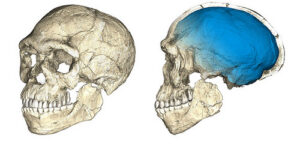
Two views of a composite reconstruction of the earliest known Homo sapiens fossils from Jebel Irhoud based on micro computed tomographic scans of multiple original fossils. Dated to 300 thousand years ago these early Homo sapiens already have a modern-looking face that falls within the variation of humans living today. However, the archaic-looking virtual imprint of the braincase (blue) indicates that brain shape, and possibly brain function, evolved within the Homo sapiens lineage. Credit: Philipp Gunz, MPI EVA Leipzig, License: CC-BY-SA 2.0.
____________________________
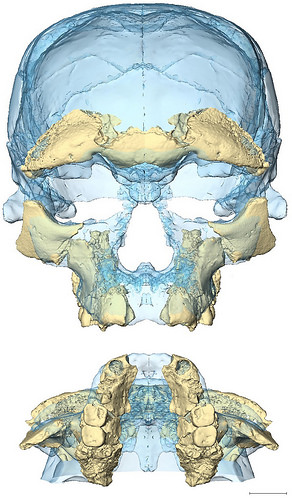
Two views of the Irhoud 10 face. Several reconstructions of the second hominin face discovered at the Irhoud site can be proposed. All these reconstructions enter the variability of extant, anatomically modern humans within the limits of anatomical constraints. Modern conditions for the facial skeleton were, therefore, already reached 300 thousand years ago in the earliest forms of Homo sapiens known to date. Credit: Sarah Freidline, MPI EVA Leipzig.
____________________________
How Modern?
Although these humans exhibited physical characteristics that were anatomically modern, given the accompanying archaic features, just how ‘modern’ really were the people represented by these fossils?
Clues could be found among the other finds excavated at the site, all of which were associated with the human fossils. These finds included animal bones representing gazelles, hartebeests, wildebeests, zebras, buffalos, porcupines, hares, tortoises, freshwater molluscs, snakes and ostrich egg shells. Most plentiful were the remains of gazelles. Teresa Steele, a paleoanthropologist at the University of California, Davis, analyzed the animal fossils. As she examined the hundreds of bones and shells, she identified cut marks and breaks, indicating that many of them had been modified by humans, most likely processed for food. Breaks along the long bones clearly indicated that the humans broke them open for the marrow, she said. And even though the remains of other predators, such as hyenas and leopards, were found at the site, Steele said that there was little evidence of gnawing on the animal bones by the nonhuman predators.
There was a clear behavioral takeaway in all of this. “It really seemed like people were fond of hunting,” Steele said.***
What kinds of tools did these human hunters/consumers use to acquire and process this game?
Stone tools found at the site and associated with the fossils were identified by the team of archaeologists as belonging to the Middle Stone Age. Made from high quality flint imported from elsewhere, they exhibited characteristics typical of the Middle Stone Age, such as objects prepared using Levallois core techniques and pointed forms. Such assemblages have been found at various sites dated to the time range inclusive of the Jebel Irhoud site all across Africa. “The stone artifacts from Jebel Irhoud look very similar to ones from deposits of similar age in east Africa and in southern Africa” says Max Planck Institute archaeologist Shannon McPherron.***
Evidence pointed to a group of people with a capability beyond what could typically be attributed to more archaic species, such as Homo erectus or other species on the early human spectrum.
__________________________

Some of the Middle Stone Age stone tools from Jebel Irhoud. Pointed forms such as a-i are common in the assemblage. Also characteristic are the Levellois prepared core flakes (j-k). Credit: Mohammed Kamal, MPI EVA Leipzig, License: CC-BY-SA 2.0.
__________________________
The Implications of Jebel Irhoud
Assuming that the dating holds under scrutiny by other scholars and any additional studies, the findings at Jebel Irhoud forces current scholarship to reconsider or revamp the traditional thinking about how and where modern humans arose from the ancestral soup in Africa. For one thing, the fossils present new implications for the evolutionary development of modern human species-specific physical characteristics. “Our findings suggest that modern human facial morphology was established early on in the history of our species, and that brain shape, and possibly brain function, evolved within the Homo sapiens lineage,” says Philipp Gunz, one of the authors of the recent detailed studyof the finds published in Nature. To this point have been recent discoveries bearing on comparisons of ancient DNA extracted from Neanderthals and Denisovans to the DNA of modern humans — revealing differences in genes related to the human brain and nervous systems. Changes in the shape of the Homo sapiens braincase over time may be reflective of genetic changes in brain development, organization and nerve connectivity, changes that separate our species from other extinct human species.
Moreover, the morphology and dates of the Jebel Irhoud fossils fit with the designation of the partial cranium found at Florisbad, South Africa, as an archaic form of Homo sapiens. Now, very early, archaic Homo sapiens fossils have been found at very disparate locations across the African continent — Morocco, Ethiopia, and South Africa — and the finds are associated with Middle Stone Age tools, revealing a cognitive capacity and development commonly associated with Homo sapiens. “The fossil and archaeological evidence at Jebel Irhoud obligate us to revise the textbooks,” says Hublin. “It looks like by 300,000 years ago, our species was already represented all over the African continent and not restricted to a small “garden of Eden” in East or Southern Africa.”
Perhaps most significantly, the finds at Jebel Irhoud and other sites across Africa have served to raise questions about what is meant by Homo sapiens. Clearly, there were people who lived in Africa who looked, and perhaps behaved, very much like us, well over 200,000 years ago, the time when most scholars have suggested modern humans emerged. As new evidence indicates, modern humans didn’t suddenly pop into history in a single century or even a single millennium. Nothing in evolution is truly that simple or fantastic. Indeed, as new discoveries have been made, there has been a pattern of pushing back the clock and overturning long-held theories and assumptions about human evolution and what constitutes being a ‘modern’ human. Sites like Jebel Irhoud, Omo Kibish, Herto Bouri, Florisbad, Pinnacle Point, Blombos, and a score of others are slowly painting a much more complex picture of what it means to be Homo sapiens, and where and when our species existed.
_________________________
The Shifting Paradigm of Human Evolution
The discoveries made at Grotte à Hominidés and Jebel Irhoud serve to confirm that, geographically, Northwest Africa offered a critical setting in the developing story of the early evolution of the genus Homo, in addition to the already well-known evidence uncovered in East and South Africa. This suggests the need to take a broader view of when and where in Africa the roots of our species, and those of our common ancestry as embodied in species like Homo antecessor, Neanderthals, and Denisovans, took place. Accompanying paleoclimate studies have reinforced this assessment: Climatic oscillations opened recurring ecological ‘green’ corridors across the region now characterized by the Sahara. Says Denis Geraads, “the idea that the Sahara was a permanent biogeographic barrier [for humans in prehistory] does not hold….The palaeontological evidence shows repeated connections between Northwest Africa and the savannas of the East and South.”*
The path that defines the roots of the evolution of modern humanity spans the entire face of the African continent, and the story is likely far deeper and more complex than we ever have imagined.
_____________________________

African landscape. Frans-Banja Mulder, CC BY 3.0, Wikimedia Commons
_____________________________
*From Early hominins from Morocco reveal an African lineage near the root of Homo sapiens, press release of the Max Planck Institute for Evolutionary Anthropology, January 7, 2026.
**Jean-Jacques Hublin, et al., Early hominins from Morocco basal to the Homo sapiens lineage, Nature, 7 January 2026. https://www.nature.com/articles/s41586-025-09914-y
***https://popular-archaeology.com/issue/summer-2017/article/earliest-known-homo-sapiens-just-got-older
Cover Image, Top Left: Credit Ryan Somma, CC BY-SA 2.0, Wikimedia Commons
_____________________________