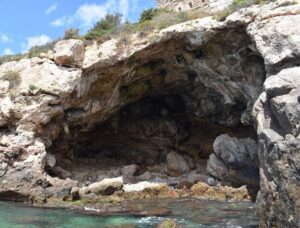
Universität Autonoma de Barcelona—Neanderthal populations in southern Europe collected shellfish throughout the year, with a marked preference for the colder months, according to a new international study led by researchers from the Institute of Environmental Science and Technology at the Universitat Autònoma de Barcelona (ICTA-UAB), the IsoTOPIK Lab at the University of Burgos (UBU), and the Instituto Internacional de Investigaciones Prehistóricas de Cantabria at the University of Cantabria (UC).
The research, recently published in the journal Proceedings of the National Academy of Sciences (PNAS), shows that 115,000 years ago Neanderthal groups from Los Aviones Cave (Cartagena, Region of Murcia, Spain) were already consuming molluscs following a clearly seasonal pattern, particularly during the colder months of the year, from November to April.
For decades, the ability of Neanderthal populations to adapt to coastal environments and exploit marine resources in an organised manner has been the subject of intense debate in archaeology and human evolution. Traditionally, the regular consumption of shellfish and seasonal planning were considered traits exclusive to our species, Homo sapiens. However, this recent finding challenges that paradigm.
The study analysed marine mollusc remains (including small gastropods and limpets) recovered from Los Aviones Cave at an unprecedented resolution. The results show that these populations not only collected shellfish sporadically but also possessed a deep understanding of marine ecological cycles, anticipating by thousands of years behaviours later documented in modern humans from the region.
But how is it possible to determine the season in which a mollusc was consumed thousands of years ago? The key lies in the oxygen isotopic signal preserved in the carbonate of their shells, as the incorporation of heavier or lighter oxygen isotopes depends primarily on seawater temperature. “By reconstructing variation during shell growth, these values act as a prehistoric thermometer. This makes it possible to infer temperature changes as well as the exact time of year when a mollusc was collected, revealing new details about seasonal consumption patterns,” explains Asier García-Escárzaga, lead author of the study.
The results represent a milestone, as they are the first obtained for such early stages of human evolution. “They consumed marine resources throughout the year, but with a very clear preference for winter and autumn months. This pattern, very similar to that developed by more recent populations of modern humans in Europe and other regions, cannot be coincidental,” García-Escárzaga explains.
Winter collection coincides with periods when certain mollusc species have higher meat yield and improved sensory qualities (flavour and texture) due to their reproductive cycles. In addition, Neanderthal populations may have avoided collecting shellfish in summer to minimise health risks, such as the proliferation of toxic algae (red tides) or the rapid decomposition of shellfish due to heat, demonstrating a conscious and safe management of marine resources.
These findings suggest that Neanderthals and modern humans may have been more similar than previously thought. The study highlights that this behaviour reflects a diversified diet incorporating high-quality marine proteins (rich in Omega-3 and zinc), which are essential for brain development and reproductive health. “What we see at Los Aviones is a fully modern subsistence strategy,” the authors state. This discovery reinforces the idea that Neanderthals possessed cognitive, social and economic capacities comparable to our own, establishing the Iberian Peninsula as a key region for understanding the complexity of our closest ancestors.
_________________________
Cueva de los Aviones, Cartagena, Region of Murcia, Spain. Credit: ICTA-UAB
_________________________
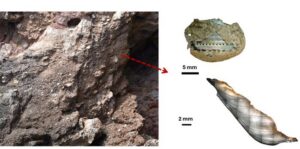
Cueva de los Aviones, Cartagena, Region of Murcia, Spain, and specimens of limpets Patella ferruginea and gastropod Phorcus lineatus. Credit: ICTA-UAB
_________________________
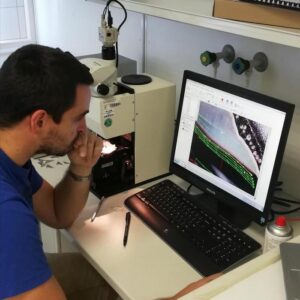
Asier García-Escárzaga in the laboratory. Credit: ICTA-UAB
_________________________
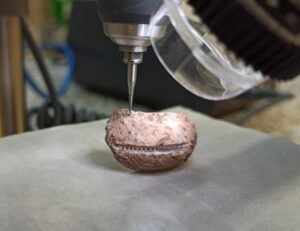
Laboratory analysis of a specimen of the gastropod Phorcus turbinatus. Credit: ICTA-UAB
_________________________
Article Source: Universität Autonoma de Barcelona news release.
*Seasonal shellfish exploitation by Neanderthals 115,000 years ago, Proceedings of the National Academy of Sciences. 10.1073/pnas.2531880123
_________________________
POPULAR ARCHAEOLOGY ON INSTAGRAM