Dr. Joyce White has been specializing in Southeast Asian prehistory since 1974, especially in Thailand and Laos. She has done pioneering work at the UNESCO World Heritage site of Ban Chiang in Thailand. She is the Director of the Ban Chiang Project at the University of Pennsylvania Museum, where she is Consulting Scholar. In 2001, Dr. Joyce White started an archaeological program in Laos. The Middle Mekong Archaeological Project (MMAP) explores and researches the prehistory of northern Laos. MMAP has an international team of researchers in diverse fields, including scholars from Laos.She has a long list of publications on Asian archaeology. Dr. Joyce White is the Executive Director of the Institute for Southeast Asian Archaeology.
Her first great impression of archaeology unfolded when she was fifteen and saw a church and graveyard being excavated in England. Images of Asia in a professor’s class at UPENN helped her set course. She has an MA & Ph.D. in Anthropology from the University of Pennsylvania. Dr. White’s research has been funded by the National Science Foundation, The National Geographic Society, the Henry Luce Foundation, etc. One of her latest articles, cowritten with Elizabeth G. Hamilton, is “The Metal Age of Thailand and Ricardo’s Law of Comparative Advantage” in Archaeological Research in Asia 27.
______________________________
Ban Chiang, Thailand. Welcome to Ban Chiang World Heritage. Mattes, CC BY-SA 3.0, Wikimedia Commons
______________________________
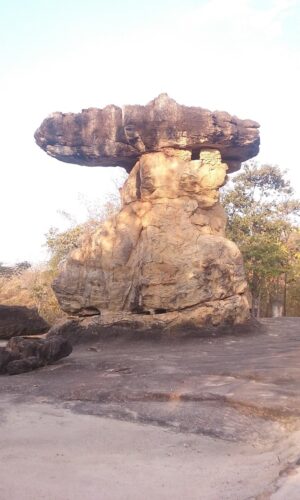
Ban Chiang Prehistory. SF12, CC BY-SA 4.0, Wikimedia Commons
_______________________________
RM (Richard Marranca): You did pioneering work in Ban Chiang and other places in Thailand. What brought you there – what luck and pluck? When did you first work there, and was this continuous over many years?
JW (Joyce White): I was a first-year grad student in Anthropology at the University of Pennsylvania in 1974. After hearing slide presentations by Chet Gorman at the University of Pennsylvania Museum, I wanted to specialize in Southeast Asian archaeology, and specifically Thailand. Chet was not very encouraging at first, but eventually he became supportive.
RM: What are some of the things you did early on in Ban Chiang?
JW: As a grad student, I supervised the lab analysis of the materials from Ban Chiang and other Metal Age and Stone Age sites. The cultural remains were shipped to Penn Museum for study. When it came time to design a PhD Project, I wanted to study plants and foods, using modern Ban Chiang societies to get some ideas on the past in that region. This kind of study is called ethnoarchaeology.
_____________________________

Ban Chiang excavations. Steve from Bangkok, Thailand, CC BY-SA 2.0, Wikimedia Commons
_____________________________
RM: Did you work with Chet Gorman and Pisit Chareonwongsa? Can you tell us about them, as well as any others you worked with?
JW: Chet Gorman was my supervisor until he died in 1981. Pisit Charoenwongsa came to the Penn Museum to also work with the Ban Chiang materials for a couple of years. Chet was a ‘character’ and Pisit was more serious. Fascinating collaborators and peers of Chet frequently came through, really adding to my education on what being a Southeast Asian archaeologist was all about.
RM: Is Ban Chiang a mixed burial/habitation site? Can you tell us about it?
JW: At Ban Chiang, both burials and remains from everyday life were excavated. As I worked with the site’s evidence after Chet’s death, I eventually came to the conclusion that the dead were in fact buried within the settlement in spaces used during daily life. This kind of practice is called “residential burial.” In the world there are some societies still practicing some form of residential burial, and there is an ethos of the living wanting to maintain a strong connection with deceased relatives.
_____________________________
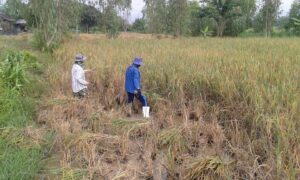
Rice farmers in Thailand. Jtorquy, CC 1.0 Universal, Wikimedia Commons
_____________________________
Rice Farmers in Thailand.jpg Wikimedia commons
RM: You mentioned that people had millet and rice and other foods. Were the people involved in both agriculture and hunting/gathering? Were they animistic/polytheistic? What kind of houses did they live it? What were their ailments and how long did they live?
JW: Pre-state agrarian societies in Thailand practiced both some plant cultivation and animal husbandry, but also engaged in hunting and gathering. This diverse resource base and diet resulted in the people being unusually healthy for an early agrarian society. Average life expectancy was around 35-40 years. Evidence for trauma, such as broken bones, suggested they came from accidents of daily life, not warfare. Their houses must have been made of organic materials like bamboo, as only holes for posts remain.
RM: Can you tell us about curating a traveling exhibition on Ban Chiang, “Discovery of a Lost Bronze Age,” sponsored by the Smithsonian, 1981?
JW: Before Chet died in 1981, he had gotten the Smithsonian’s Traveling Exhibition Service interested in doing an exhibit on Ban Chiang. After Chet died, I was asked to be guest curator for the exhibit as my years working in the lab before I lived in Ban Chiang gave me in-depth knowledge about the site and the materials excavated.
RM: Was the technology (bronze making, pots and such) centered in major places like Ban Chiang, or did it spread out from there? I recall you used the word “decentralized.” You mentioned something about “Ricardo’s Law” having to do with decentralization?
JW: Technologies of pot-making and bronze making were not centralized. The existing evidence indicates these were decentralized crafting activities. This meant relevant skill sets widely distributed in prehistoric sites throughout Thailand. Expectations among archaeologists in the mid-20th century were that metallurgy in particular was likely to be a restricted specialized activity. However, in the latter part of the 20th century, more evidence for other kinds of economic strategies have been recognized.
Ricardo’s Law of Comparative Advantage is one of the concepts that help to illuminate decentralized economic systems from a bottom up rather than a top-down perspectives.
_____________________________

Ceramic Pot, Ban Chiang Museum. Kiwiodysee, CC BY-SA 3.0, Wikimedia Commons
_____________________________
RM: I recall you said that the people were peaceful, that researchers didn’t find any or many skeletons with serious war injuries? Did towns and cities have defensive walls?
JW: The monograph suite (4 volumes) laid out comprehensive evidence for prehistoric exploitation of metals in Thailand. One theme concerns the methodology of study. Some studies of ancient metallurgy take what I call an “art history” approach, focusing only on intact attractive objects, and usually such objects are recovered from graves. But that approach misses the massive evidence from fragmentary remains that metalwork was localized and used in quotidian ways.
Looking at “whole assemblages” (all metals and related objects recovered from a site) reveals a much more accurate picture of the place of metals in societies as—in some cases valued objects—but not so much prestige goods restricted to the rich. As noted above, skeletal trauma is predominantly from everyday activities, and there is no evidence for defensive walls until late in the iron period.
____________________________

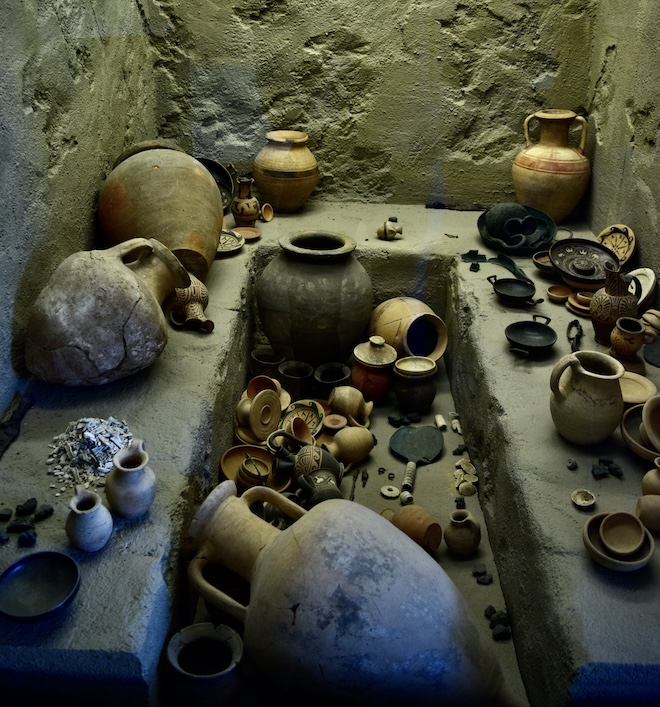
Ban Chiang ceramic ware. Ziegler175, CC BY-SA 3.0, Wikimeda Commons
____________________________
RM: Can you tell us about the Ban Chiang Ethnobotanical Project? One person was Dr. Cristina Castillo from the University of London, I recall. What did she work on?
JW: For our Year of Botany program in 2024, we studied 3 collections with botanical dimensions connected to Ban Chiang. I brought in experts for each part of the program. Dr. Cristina Castillo from University of London trained and supervised two Thai student interns in the process called “flotation”, where excavated sediments are processed in a way to extract plant microfossils. The ethnobotanical collection I did in 1978-1981 in Ban Chiang village was the focus of four Thai botanists, who curated the collection so it could be accessioned to the Philadelphia Herbarium. A fifth Thai I brought to work with the ethnographic collection I did in Ban Chiang in 1981.
RM: So, the PENN museum asked you to head to Laos. You discovered something amazing – 10,000 years of habitation along the Mekong near Luang Prabang city. Can you discuss some of the high points? It’s also a land of rivers and tributaries and crossroads – how does that support people and culture?
JW: The archaeology of Laos is still in its infancy. There are very few projects, and it was shut off from modern archaeology for most of the 20th century. But my initial 2.5 day visit to Luang Prabang in 2001 showed to me that specifically that part of the Mekong River had human occupation for at least 10,000 years. There was the Stone Age site Tham Hua Pu with classic Hoabinhian stone tools; there were sherds from many different periods eroding into the Mekong, including earthenware, stoneware, and porcelains. And there were many polished stone adzes.
I am so far the only American who has successfully established a long-term archaeological research Program in Laos.
Luang Prabang, eventually beginning in AD 1351, became the capital of the Lao Kingdom of Lanxang. Archaeologists are still in the early stages of compiling a narrative with high points. However, I am working with the idea that the numerous tributaries entering the Mekong near Luang Prabang from the left bank is a key geographical factor making that area of enduring significance for humans living there in the past. Even decentralized societies like to trade and communicate. So, the evidence we are finding in things like ceramics do support a crossroads scenario for this location.
________________________________

Lua Prabang. Shelly Zohar, CC BY-SA 4.0, Wikimedia Commons
________________________________

Luang Prabang market. calflier001, CC BY-SA 2.0, Wikimedia Commons
________________________________
RM: You explored a huge number of sites? How did you get around and find them? Where did you do test excavations? It sounds like an especially amazing site was called Tham An Mah – was that the culmination and what was that like?
JW: At this point in time, we do “reconnaissance surveys”. We work closely with local inhabitants to find sites and any evidence for pre-modern use of the terrain. We get around with local transportation, both vehicles and, if needed, small boats, and a lot of walking. From the 100 localities identified, we chose 4 so far for test excavations at cave sites, each site on a different tributary, with access to both upland and lowland landscapes. Tham An Mah was a wonderful site with intact burials. We hope to do 1 more test excavation on the Ou tributary.
________________________________

Luang Prabang Museum. Rebeccamack, CC BY 2.0, Wikimedia Commons
________________________________
RM: I loved Luang Prabang and its museum. Didn’t you do work at the museum?
JW: The government has assigned us space several times in outbuildings for the Luang Prabang National Museum. We do love to work in those spaces, which are essentially un-renovated but sturdy late colonial structures but perfect for our needs.
RM: It was fascinating that you mentioned scientists that joined your team to study remains, to get DNA samples from villagers, to study climate, etc.? Can you tell us a few things about the scientists?
JW: Stephen Oppenheimer, who is affiliated with both Oxford and the Liverpool School of Tropical Medicine, took DNA samples from several villages in Luang Prabang Province. A team led by Dr. Kathleen Johnson, who is at the University of California Irvine, is studying climate change evidence from speleothems (stalagmites). Her team includes Australians, Italians, Chinese and more. We have a very multi-national approach to our work.
____________________________
You can learn more about the Ban Chiang Project at this website, and the Middle Mekong Archaeological Project here.