Hierapolis, 2nd century A.D. The sky was painted in a hue of blood-orange as the sun descended. The white travertines of Pamukkale glowed crimson, as if soaked in ancient blood. In the heart of Hierapolis, behind the Temple of Apollo, a sacred courtyard stood silent. Only the priests of Cybele —the Galli, dressed in red robes with silver clasps— bowed before the gate of the underworld.
Ariston, high priest of the temple and guardian of the Ploutonion, was a man past fifty, but his eyes gleamed with the fire of youth. His voice rumbled like the breath of the earth itself. Like his father before him, he had inherited the duty of guarding this gate — the door between the world of the living and the realm of the dead.
But tonight was different. Even visitors from Rome had come for the ritual. According to ancient lore, once every seventy-nine years, when the stars aligned, the gate would open for the blink of an eye, and the voice of the god Pluto could be heard. That night, the sky promised such an event.
The Deadly Breath and Rising Legends
Every creature that approached the arched gate of the Ploutonion collapsed within minutes. Even today, this deadly gas was demonstrated using small animals. But tonight, something else was planned.
Ariston opened the lid of a small marble coffin. Inside lay a carefully preserved body — Eurynome, the ancient sorceress of the city and once the woman Ariston had loved. Myths surrounded her. Some claimed she had spoken to the god of the underworld three days before her death and vowed to return. Some called her mad, others a prophetess. But Ariston had never forgotten her words.
He placed the coffin near the cave’s mouth, where the gas subtly rose. The priests chanted, and the stars slowly shifted into alignment.
The Gate Opens
Just before midnight, the ground trembled. A deep, low hum echoed from the Ploutonion. The gas at the entrance momentarily dispersed. The gate —or as Ariston believed, the veil between life and death— had indeed parted.
A whisper: “Eurynome…” It was a woman’s voice. Familiar.
Ariston fell to his knees, tears in his eyes. A silhouette appeared at the gate —draped in white, glowing eyes, empty yet full of light. The body in the coffin stirred. The priests stepped back in awe. No one had ever seen such a thing.
From Eurynome’s chest, a wisp of smoke rose and drifted into the Ploutonion. Her soul was being offered to the god.
The Price of Forbidden Knowledge
But every open gate demands a price. The tremors intensified. Columns cracked. The hum from the depths became a roar. Was it Pluto’s wrath? Or had the balance between life and death been disturbed?
Ariston heard the god’s voice, deep and terrible: “Close the gate.”
He understood. The gate was not merely a passage for the dead —it was a temptation for knowledge, power, and corruption. Humanity was not ready.
He shouted: “Seal the gate! Set the stones, begin the prayers!”
The priests obeyed. Ancient texts described the three seals to close the Ploutonion: Fire, Blood, and Breath.
A goat was sacrificed, its blood poured onto the threshold. Ariston cut his own hands and reached into the rising mist. Lastly, three priests extended their arms and offered sacred breath with solemn hymns.
Silence fell. The roar ceased. The mist withdrew. Eurynome’s body, now serene, was returned to the coffin —a smile on her face.
A Thousand Years of Silence
The gate never opened again. Ariston never left the temple. He never spoke of what he had seen. On his tombstone, he had one sentence engraved:
“To open a gate is not to speak with gods; it is to silence oneself.”
Centuries passed. Wars, earthquakes, and empires came and went. Until one day in 2013, archaeologists descended beneath the ancient stones and found an inscription near the gate of Ploutonion:
“The passage sealed by Ariston. He who opens it will speak through the price.”
_______________________________
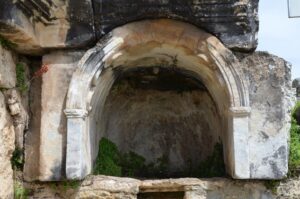
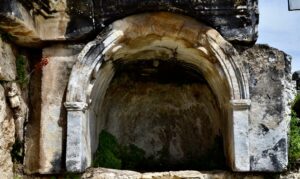
(Pluto’s Gate), a sacred cave believed to be an entrance to the underworld and the oldest local sanctuary, Hierapolis. It was described by Strabo (629-30) as an orifice in a ridge of the hillside, in front of which was a fenced enclosure filled with thick mist immediately fatal to any who entered except the eunuchs of Kybele. The Plutoneion was mentioned and described later by numerous ancient writers, in particular Dio Cassius (68.27), who observed that an auditorium had been erected around it, and Damascius ap. Photius (Bibl. 344f), who recorded a visit by a certain doctor Asclepiodotus about A.D. 500; he mentioned the hot stream inside the cavern and located it under the Temple of Apollo. There is, in fact, immediately below the sidewall of the temple in a shelf of the hillside, a roofed chamber 3 m square, at the back of which is a deep cleft in the rock filled with a fast-flowing stream of hot water heavily charged with a sharp-smelling gas. In front is a paved court, from which the gas emerges in several places through cracks in the floor. The mist mentioned by Strabo is not observable now. The gas was kept out of the temple itself by allowing it to escape through gaps left between the blocks of the sidewalls. Carole Raddato, CC BY-SA 2.0, Wikimedia Commons
_______________________________
Cover Photo, Above Left: Credit Carole Raddato, CC BY-SA 2.0, Wikimedia Commons