Standing deep within the expansive Nefud desert in north-central Saudi Arabia, one sees a vast expanse of distinctive, pastel orange dunes. Often crescent-shaped, they are lifted and formed by the region’s sudden, violent winds, some of them reaching heights that bring back mind’s-eye images of the low, smooth, mound-like terrain of the lunar landscape observed by American astronauts 50 years ago. Though not nearly as hot as the surface of the moon in direct sunlight, temperatures here can reach at least 122 degrees Fahrenheit in the middle of the day. But amidst this almost monotonous, undulating sea of dunes lie low patches of bright white sediment. They are interspersed seemingly at random across the desert landscape. These patches tell the story of ancient lakes that have long dried up, leaving a legacy of fossils and other remains from a vanished world that once teamed with animals and vegetation.
Al Wusta is one such ancient lake. About 90,000 years ago, the lake was surrounded by a grassland environment. Here also were hippos, Pelorovis — an extinct genus of African wild cattle — antelopes, carnivores……..and humans—more specifically, Homo sapiens….
Al Wusta: Following the Green
Over the past decade, multidisciplinary teams of researchers have been seeking answers to questions related to the effect environmental change has had on early humans and animals that have passed through and settled the desert subcontinent of the Arabian Peninsula over the past 1+ million years. Along the way, they have uncovered a profusion of lithic (stone tool) assemblages. The finds testify to a human presence here that dates back hundreds of thousands of years, researchers suggest, marking the trail and habitation zones of humans that followed and exploited green zones created by climatic humid or “wet periods” in an otherwise harsh, arid Arabian palaeoenvironmental history.
With these lithics, scientists had the ‘smoking gun’ for a human presence. But one important thing in the quest had eluded them: human fossils. That is, until 2016.
Huw Groucutt, an archaeologist at the University of Oxford who has played a key role in the ongoing research on early humans in the Arabian Peninsula, tells the story of a tantalizing discovery made while investigating a number of sites in the region:
“We made a quick visit to Al Wusta in 2014, which involved driving down steep dunes to the base of an inter-dunal depression. We noted some stone tools and interesting sediments, but it was late in the day and the sun was getting low in the sky so we did not stay long. It was clearly an interesting site, but we located dozens of interesting sites. It was a place to which we wanted to return at some point, and our team member Prof Nick Drake (Kings College London) kept mentioning the site as something that looked significant. In 2016 we returned to the site with a large interdisciplinary team of international and Saudi scholars. We walked to the far end of the site where we had not previously been, and immediately found numerous animal bones and human-made stone tools on the surface. These were scattered around deposits of lake sediments. Then our colleague, Dr Iyad Zalmout from the Saudi Geological Survey, picked up a small and well preserved fossil.” *
The find turned out to be a human intermediate phalanx (middle finger bone, the bone from the knuckle toward the end of the finger). And by employing a series of chronometric dating techniques, scientists were able to determine the age to be between 95-86 thousand years old.
That made this find rare and remarkable, as it represented the only direct fossil evidence ever found of human habitation in the region as long ago as nearly 90,000 years BP.
What kind of human?
So the phalanx was human, but to what species of human did it belong? Given the age, could it be Neanderthal?
“In many cases, a single fossil would not be enough to determine the species represented,” says Groucutt. “In the case of the finger bone, however, we are lucky in that this bone is very different in Neanderthals and Homo sapiens. In basic terms, Neanderthal intermediate phalanges are relatively shorter and are generally more robust, while those of Homo sapiens are relatively longer and are more gracile. The [measurement] values for the Al Wusta finger bone clearly aligns it with Homo sapiens.”*
Combined with the associated lithics, the case then became a slam-dunk for early modern humans. Many of the Al Wusta site artifacts “feature an emphasis on centripetal Levallois technology”, says Groucutt. It is a manufacturing technique typical of Middle Paleolithic/Middle Stone Age period stone tools, common among finds associated with the early modern human presence at other sites, such as in east and north Africa.
____________________________
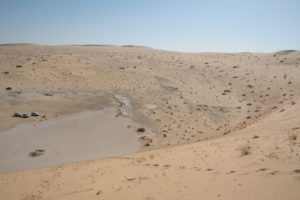
The Al Wusta site from the top of a neighboring sand dune. Photo: Ian Candy. Republished from the article, One Small Arabian Finger Bone, Popular Archaeology, July 7, 2018.
____________________________

The Al Wusta site. The human finger bone was found where the right hand crouching figure is standing. Photo: Huw Groucutt. Republished from the article, One Small Arabian Finger Bone, Popular Archaeology, July 7, 2018.
____________________________

Excavations underway at Al Wusta. Photo: Klint Janulis. Republished from the article, One Small Arabian Finger Bone, Popular Archaeology, July 7, 2018.
____________________________
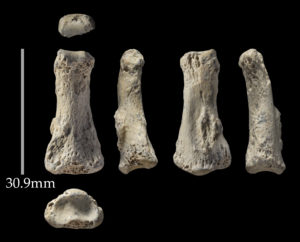
The Al-Wusta 1 intermediate phalanx finger bone. Photo: Ian R. Cartwright. Republished from the article, One Small Arabian Finger Bone, Popular Archaeology, July 7, 2018.
____________________________
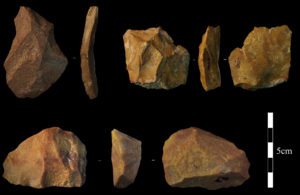
Lithic artifacts (stone tools) from Al Wusta. Top row: two Levallois flakes, bottom: Levallois core. Photo: Eleanor Scerri. Republished from the article, One Small Arabian Finger Bone, Popular Archaeology, July 7, 2018.
______________________________
Scientists could now make a case for an early presence of modern humans in Arabia 90,000 years ago, fully 30,000 years before the broadly accepted paradigm of modern human dispersal out of Africa at about 60,000 years BP.
But this was not the only case where early modern humans were found outside Africa before 60,000 years BP….
______________________________
Misliya Cave and the Levantine Corridor
The Carmel range, better known as ‘Mount Carmel’, is a 4 to 5-mile wide Mediterranean coastal mountain system that stretches from the northern coast of Israel southeast for 24 miles. It slopes gradually on its western face toward the southwest, but features a prominent steep ridge on its northeastern face. It has figured historically in the background of well-known biblical accounts, and to this day hosts towns and settlements, including the major city of Haifa on Israel’s northern coast. For archaeologists, prehistorians, palaeoanthropologists and other scientists, Mount Carmel is perhaps best known for the prolific evidence it has brought forth bearing on a hominin presence that extends back hundreds of thousands of years, particularly from cave sites such as Skhul, Tabun, Jamal, el-Wad, and Misliya.
Although the discoveries that have been made in these caves have been remarkable enough, few finds have captured the attention of scientists and others on the subject of early humans, especially related to the movement and dispersal of Homo sapiens, as much as the recent discoveries made at the Misliya Cave. In the January 26, 2018 Science magazine article, The earliest modern human outside of Africa, author Israel Hershkovitz and colleagues reported the discovery and analysis of a modern human fossil dated to between 177,000 and 194,000 years old. The find, according to the report authors, pushed back the estimated time range, as evidenced by the archaeological record, for the arrival of modern humans (Homo sapiens) out of Africa to a time much earlier than previously thought.
The fossil, an upper jaw bone designated ‘Misliya-1’, featured some intact teeth and falls within the upper size range characteristic of modern human teeth. Scientists examining Misliya-1 have maintained that the fossil shares some features with earlier hominins. But it also lacked other key features identifiable with Neanderthals and other earlier hominin species, such as a low, broad tooth crown. It otherwise shared many features of teeth and jawbones typical of modern humans. They came to this conclusion by analyzing the fossil using microCT scans and 3D virtual models, then compared the specimen to other hominin fossils from Africa, Europe and Asia. “While all of the anatomical details in the Misliya fossil are fully consistent with modern humans, some features are also found in Neanderthals and other human groups,” said Rolf Quam, Binghamton University anthropology professor and a coauthor of the fossil study. “One of the challenges in this study was identifying features in Misliya that are found only in modern humans. These are the features that provide the clearest signal of what species the Misliya fossil represents.”**
Stone tools were also excavated near Misliya-1. The tools, said by the archaeologists to have been produced using the Levallois technique, may represent the earliest known association of the technique with modern humans in this region, suggesting that the emergence of this technology may have been due to the appearance of modern humans in the Levant. Interestingly, stone tools made using the Levallois technique have also been found in Middle Stone Age assemblages associated with Home sapiens in Africa.
The big take-away from Misliya Cave so far reveals that at least some of the inhabitants of the cave were early modern humans who were big game hunters, knew how to control fire, and used Early Middle Paleolithic stone tools that resembled the same stone tool kits associated with the earliest modern humans in Africa. The implications of Misliya for our understanding of early human dispersal and human evolution have thus become important and far-reaching — supporting the view that the Middle East was an early major corridor for modern human migration during the Pleistocene. Reported Quam in a news release by Binghamton University, “Indeed, the evidence from Misliya is consistent with recent suggestions based on ancient DNA for an earlier migration, prior to 220,000 years ago, of modern humans out of Africa.”***
For all these reasons, “Misliya is an exciting discovery,” said Quam, “It also means that modern humans were potentially meeting and interacting during a longer period of time with other archaic human groups, providing more opportunity for cultural and biological exchanges.”***
____________________________
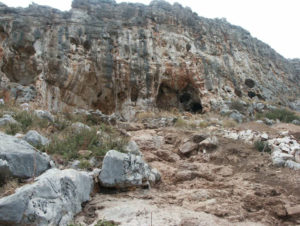
A view of Misliya Cave when approached climbing from the coastal plain. The cave is located some 90 m above mean sea level (AMSL) and is part of a series of prominent prehistoric cave sites located along the western slopes of Mount Carmel, Israel. The cave had collapsed following the Early Middle Paleolithic human occupation, represented by rich lithic and faunal assemblages associated with the maxilla (Misliya-1) of a modern human. Strongly cemented archaeological sediments (breccias) that extend some 30 m west of the cliff indicate that the cave had once been very large. Mina Weinstein-Evron, Haifa University. Republished from Oldest Known Human Fossil Outside Africa Discovered, edited and adapted from the subject AAAS and Binghamton University news releases.
____________________________
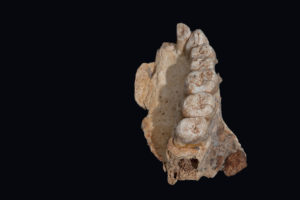
The Misliya-1 left maxilla. All teeth are present except the central incisor. The shape and structure of the teeth and the dentine underneath yielded important data regarding the definition of this specimen as Homo sapiens. Israel Hershkovitz, Tel Aviv University. Republished from Oldest Known Human Fossil Outside Africa Discovered, edited and adapted from the subject AAAS and Binghamton University news releases.
____________________________

The Misliya Cave Early Middle Paleolithic layers of the Upper Terrace of the cave, during excavation (viewed from the southeast). The layers here are some 1.5-2 m thick. Note the in-situ hearth, consisting of indurated dark ashy sediment, at the bottom central-right part of the picture. Hearths were repeatedly constructed during the long habitation of the cave. The habitual use of fire is also evident from abundant wood ash, as well as burnt animal bones, flint implements and phytoliths. Charred laminated vegetal tissues constitute the earliest evidence for bedding or matting to date. Mina Weinstein-Evron, Haifa University. Republished from Oldest Known Human Fossil Outside Africa Discovered, edited and adapted from the subject AAAS and Binghamton University news releases.
______________________________
Apidima: The Earliest Modern Human Fossil in Europe
More than 40 years had passed since the initial fossil discovery before Katerina Harvati, the Director of Paleoanthropology at the University of Tübingen, was approached by her colleagues of the National Kapodistrian University of Athens School of Medicine. Beginning in 1978, a team from the university’s Museum of Anthropology conducted field investigations at the Apidima Cave in southern Greece. During the process, they recovered a block of breccia (a rock composed of broken fragments of minerals or rock cemented together by a fine-grained matrix), from the ceiling of the cave. Normally, such a find would not be noteworthy. But this block of breccia contained two fossilized crania specimens the discoverers identified as possibly belonging to humans.
“They asked me to lead a new investigation and re-analysis of this important fossil material,” she said. “Despite their obvious importance, these fossil crania remained unstudied and unpublished and very little was known about them, except preliminary assessments.”****
Those previous assessments included: an estimation that the breccia block dated somewhere between 150,000 — 400,000 years old; that one of the crania, designated Apidima 2, which was better preserved and featured most of the face and skull, showed Neanderthal or pre-Neanderthal affinities; and that the second cranium, designated Apidima 1, was still a mystery in part because it was only part of a skull, though it appeared less distorted than Apidima 2, which had incurred considerable distortion and damage from natural forces after the death of the individual.
Harvati’s study included a new assessment of the chronology of the fossil finds using the latest laser ablation Uranium-Thorium series dating techniques, and a new attempt at identifying the nature and species of the fossil finds through the application of virtual anthropological cranial/facial reconstruction, and then conducting extensive comparative analysis of their anatomical morphology with other known hominin crania in the archaeological record through 3-D shape analysis.
The results were nothing less than extraordinary.
Although both crania specimens were found apparently associated together in the same breccia block, their respective ages were significantly different.
“Because they were found so close together it was generally assumed that they lived roughly at the same time and that they belonged to the same species and possibly event the same group,” said Harvati. But the dating results belied the assumptions. “Apidima 2 dated to 170,000 before present and Apidima 1 dated to approximately 210,000 years before present. This means that Apidiam 1 is older than Apidima 2, and that the final resting place was not where they were originally deposited.”****
Further analysis based on these results suggested that the specimens had initially come from different parts of the cave, and had fallen into a fissure filling through time and erosion activity, mixing them together into a matrix that had subsequently solidified at about 150,000 years BP.
Equally tantalizing as the respective dates, however, were the results of the reconstructive imaging and comparative analysis. Both crania, based on their overall dimensions and cranial thickness, were determined to be adults. Apidima 2, the suspected Neanderthal cranium, was indeed confirmed to exhibit a suite of Neanderthal features, making it clearly Neanderthal with a “more than 90% probability”. But Apidima 1 was different. Says Harvati, referring to the morphology of Apidima 1, “the part of the anatomy that it preserves, the back of the skull, actually should show quite a lot of unique Neanderthal features. Nevertheless, Apidima 1 shows none of these features. Instead it shows a combination of ancestral (primitive] and uniquely modern features, and most strikingly the rounded [globular] aspect of the back of the skull, which is something that we normally associate with modern humans.”**** This cranium exhibited a combination of more ‘primitive’ features and modern features, a combination pattern similar to what has been seen in examples of other early, archaic modern human fossils. The statistical analysis of the data supported this. “Apidima 1,” Harvati concluded, “plotted as having a more than 90% probability of being a modern human.”****
What did these findings mean?
Both crania represented different species groups who occupied the same location at different times in prehistory. Apidima 2, the Neanderthal, fits consistently into the time range of Neanderthal presence in southern Europe with a date of 170,000 years BP. But Apidima 1, the modern human, occupied the site at 210,000 years BP. This was nearly 150,000 years earlier than the date heretofore established for the appearance of modern humans in Europe.
Says Harvati, “this shows that the early dispersal of Homo sapiens dispersal out of Africa [what has generally been called the ‘failed first dispersal’ based on previous research and fossil and artifactual evidence from the caves in Israel] occurred earlier and reached much further than previously thought. This fits well with Israel, where we we have a Homo sapiens presence by 180,000 years ago.”****
Perhaps most newsworthy, however, is that the Apidima 1 fossil now represents the earliest known presence of Homo sapiens on the continent of Europe, and by extension, in Eurasia. Moreover, the findings indicate, like the findings from the fossil-yielding caves in Israel, that the Homo sapiens/Neanderthal dispersal and interaction paradigms are likely more complex than scientists have previously thought. But in any case, “in both regions,” Harvati suggests, “early modern humans appear to have not persisted in the long term, with Neanderthal populations appearing to replace the early modern humans.” These findings, she adds, “also fit with the genetic evidence that has suggested an ancient breeding event between Neanderthals and modern humans before 200,000 years ago.”****
____________________________
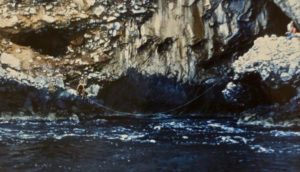
Apidima Cave A, on the left in the photo, contained the “skull breccia”. Courtesy University of Tübingen, University of Athens School of Medicine and Katerina Harvati. Harvati, K., Röding, C., Bosman, A.M. et al. Apidima Cave fossils provide earliest evidence of Homo sapiens in Eurasia. Nature 571, 500–504 (2019). https://doi.org/10.1038/s41586-019-1376-z
____________________________
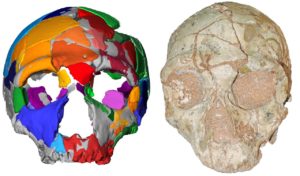
Apidima 2 and reconstruction. Courtesy Katerina Harvati, Museum of Anthropology, National and Kapodistrian University of Athens, and University of Tübingen, Harvati, K., Röding, C., Bosman, A.M. et al. Apidima Cave fossils provide earliest evidence of Homo sapiens in Eurasia. Nature 571, 500–504 (2019). https://doi.org/10.1038/s41586-019-1376-z
____________________________
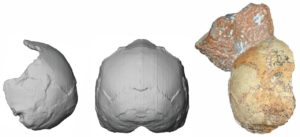
Apidima 1 and reconstruction. Courtesy Katerina Harvati, Museum of Anthropology, National and Kapodistrian University of Athens, and University of Tübingen, Harvati, K., Röding, C., Bosman, A.M. et al. Apidima Cave fossils provide earliest evidence of Homo sapiens in Eurasia. Nature 571, 500–504 (2019). https://doi.org/10.1038/s41586-019-1376-z
_______________________________
Dhaba and the Lithics Trail
Despite the remarkable finds from sites like Al Wusta, Misliya, and Apidima, the reality is that the relative scarcity of fossils bearing on Homo sapiens’ journey out of Africa has proven to be a major barrier for scientists attempting to formulate a portrait of that dispersal scenario. So without a robust archaeological record of the fossil evidence, it has been difficult to make a definitive, indisputable argument for specifically when, where and how modern humans made their earliest debut as a global species. But genetic evidence, as well as archaeological evidence in the form of lithic remains, have served as key non-fossil proxies for developing ‘smoking gun’ theories about early modern human dispersal. Recent discoveries at one site in South Asia, for example, have helped to elucidate this:
Digging on the banks of the Middle Son River in Madhya Pradesh, northern India at a site known as Dhaba, teams of scientists have been unearthing stone tools that give possible clues to an early presence of Homo sapiens there as far back as 80,000 years BP. Site surveyors observed spots showing relatively dense concentrations of what appeared to be Middle Paleolithic type lithic artifacts that had eroded to the surface, and focused on these locations to begin excavations. Digging three separate step trenches simultaneously into sloping sediment near and above the river, they recovered numerous implements made primarily from chert, mudstone and silicified limestone. Most telling were the clear ancient signs of the application of an identifiable production technique — a tool production method often associated with stone tools found at other sites and attributed to the presence of Homo sapiens. Huw Groucutt, excavator of the famous Al Wusta site in Saudi Arabia and mentioned previously in this writing, has best explained this technique and its association with early modern humans at other locations:
“Homo sapiens in East and North Africa, the areas bordering Eurasia, tended to focus on centripetal Levallois production. This involved flaking cores from multiple directions, leading to more rounded Levallois flakes than those produced by Levantine Neanderthals, for example. The famous Levantine sites of Skuhl and Qafzeh represent expansions of Homo sapiens out of northeast Africa between approximately 130 and 90 thousand years ago, and they produced stone tools similar to those in East and North Africa, with an emphasis on centripetal Levallois technology. Al Wusta – and several other sites in Arabia dating to the same period – likewise feature an emphasis on centripetal Levallois technology, as we would expect for expanding Homo sapiens populations.*
And now, the same production technique has been found at Dhaba, over 2,000 miles eastward from Al Wusta in Saudi Arabia and much farther still from sites with similar stone tool production techniques in East and North Africa.
Equally significant were the results of dating the sediments in which the artifacts were found. Scientists applied multiple-elevated-temperature post-infrared IRSL (infrared stimulated luminescence) dating tests to thirteen sediment samples. Results showed a date range, combining results from all three Dhaba step-trench localities, from 78.0 ± 2.9 ka (thousand years) for the earliest occupation to 26.9 ± 3.8 ka for the latest occupation. The earliest level, at nearly 80,000 years BP, contained stone artifacts exhibiting the centripetal Levallois production technique.*****
Early modern humans, it seems, were present at the Dhaba location long before the generally accepted successful, more enduring modern human dispersal out of Africa, which occurred based on archaeological and genetic evidence at about 50 – 60,000 years ago (recent genetic analyses indicating around 70–52 ka for the exit), with evidence of the latter dispersal showing up at Dhaba in the form of microlith technology. Dhaba excavation researchers have suggested that the earlier human presence may have been part of the ‘first wave’ dispersal revealed by the finds at sites like Misliya, Al Wusta and Apidima.
But there is more. The fossil record thus far suggests an earlier dispersal of Homo sapiens not only to Greece and the Levant by 200–185 ka, to Arabia by at least 85 ka, and to India by about 80,000 ka, but also to what is present-day China before about 80 ka and then to Southeast Asia by 73–63 ka, At least some of the sites contained associated, diagnostic Middle Paleolithic technology attributed to Homo sapiens. Moreover, finds in northern Australia suggest a modern human presence by about 65,000 year BP. Comparisons and analyses of the production technologies for the Middle Paleolithic artifacts indicate a technological continuity between Africa and Australia.
The unfolding story from Dhaba is not over. Chris Clarkson, an archaeologist with the University of Queensland and the Max Planck Institute for the Science of Human History, who also led the research at Dhaba, comes to a far-reaching hypothesis with his colleagues about the implications of Dhaba and the other sites:
“Modern human dispersal out of Africa, and more importantly east of Arabia, must therefore have taken place before ~65 ka, so cultural and fossil evidence from sites dating to this period will be important for future tests of this hypothesis, notwithstanding the fact that population contractions and turnovers may have also occurred. The Dhaba locality serves as an important bridge linking regions with similar archaeology to the east and west.”*****
Nonetheless, until a more robust fossil record across Eurasia emerges, the debate concerning when, where and how early modern humans made their way across the globe will continue to define scholarly inquiry.
_____________________________
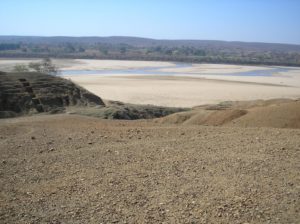
Standing on the Dhaba site, overlooking the Middle Son Valley, India. Note the archaeological trench location on the left hand side of the photo. Christina Neudorf. MAX PLANCK INSTITUTE FOR THE SCIENCE OF HUMAN HISTORY news release; *Chris Clarkson, Clair Harris, Bo Li, Christina M. Neudorf, Richard G. Roberts, Christine Lane, Kasih Norman, Jagannath Pal, Sacha Jones, Ceri Shipton, Jinu Koshy, M.C. Gupta, D.P. Mishra, A.K. Dubey, Nicole Boivin, and Michael Petraglia; Human occupation of northern India spans the Toba super-eruption ~74,000 years ago. Nature Communications,
_____________________________
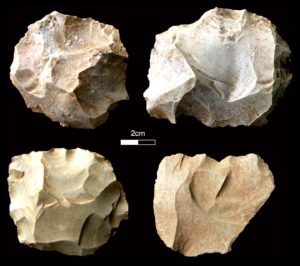
Stone tools found at the Dhaba site corresponding with the Toba volcanic super-eruption levels. Pictured here are diagnostic Middle Palaeolithic core types. Chris Clarkson; MAX PLANCK INSTITUTE FOR THE SCIENCE OF HUMAN HISTORY news release; *Chris Clarkson, Clair Harris, Bo Li, Christina M. Neudorf, Richard G. Roberts, Christine Lane, Kasih Norman, Jagannath Pal, Sacha Jones, Ceri Shipton, Jinu Koshy, M.C. Gupta, D.P. Mishra, A.K. Dubey, Nicole Boivin, and Michael Petraglia; Human occupation of northern India spans the Toba super-eruption ~74,000 years ago. Nature Communications,
_____________________________
*Huw Groucutt, One Small Arabian Finger Bone, Popular Archaeology, July 7, 2018.
**”The earliest modern humans outside Africa,” by I. Hershkovitz; R. Sarig; H. May; V. Slon; D.E. Bar-Yosef Mayer at Tel Aviv University in Tel Aviv, Israel; G.W. Weber; C. Fornai; V.A. Krenn at University of Vienna in Vienna, Austria; R. Quam at Binghamton University (SUNY) in Binghamton, NY; R. Quam; J.L. Arsuaga; L. Rodríguez; R. García; J.M. Carretero at Centro UCM-ISCIII de Investigación sobre la Evolución y Comportamiento Humanos in Madrid, Spain; R. Quam at American Museum of Natural History in New York, NY; M. Duval; R. Grün at Australian Research Centre for Human Evolution (ARCHE) at Griffith University in Nathan, QLD, Australia. (http://science.sciencemag.org/content/359/6374/456)
****Homo sapiens Dispersal Out of Africa, presentation by Katerina Harvati at the symposium of the Center for Academic Research and Training in Anthropogeny, February 21, 2020; Harvati, K., Röding, C., Bosman, A.M. et al. Apidima Cave fossils provide earliest evidence of Homo sapiens in Eurasia. Nature 571, 500–504 (2019). https://doi.org/10.1038/s41586-019-1376-z
*****Clarkson, C., Harris, C., Li, B. et al. Human occupation of northern India spans the Toba super-eruption ~74,000 years ago. Nat Commun 11, 961 (2020). https://doi.org/10.1038/s41467-020-14668-4 http://creativecommons.org/licenses/by/4.0/
___________________________
Advertisement