Nestled quietly between the modern provinces of Antalya and Muğla, Letoon stands as one of the most remarkable religious centers of ancient Lycia. Just four kilometers from the administrative hub of Xanthos, Letoon was the spiritual counterpart to its bustling neighbor, serving as the central sanctuary where myth, ritual, and political authority intersected. Today, recognized as a UNESCO World Heritage Site alongside Xanthos since 1988, Letoon preserves more than the echoes of stone and mortar—it harbors the living pulse of Lycian religion, mythology, and culture that endured for over a millennium and a half.
A Historical Crossroads
The story of Letoon cannot be disentangled from the history of Xanthos. Founded as the greatest administrative city of Lycia, Xanthos occupied a strategic position near the modern village of Kınık. Throughout its long history, Xanthos fell under successive dominions: from independence until the Persian conquest of 545 BCE, to periods of reconstruction following devastating fires, then to Roman control and later Byzantine rule until the Arab incursions of the 7th century CE. Each civilization left its mark, blending local Lycian traditions with Hellenistic and Roman influences. Letoon, located along the banks of the Ksanthos River, became the sacred heart that complemented Xanthos’s political center.
______________________________

Lycian tombs in Xanthos, Turkey. Nikodem Nijaki, CC BY-SA 4.0, Wikimedia Commons
______________________________
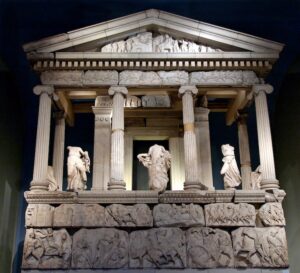
Partial reconstruction of the Nereid Monument at Xanthos in Lycia, ca. 390–380 BC. Jastrow (2006), Public Domain, Wikimedia Commons
______________________________
Foundations of the Sacred Site
Letoon’s mythological significance begins with Leto, the Titaness mother of Apollo and Artemis. According to legend, Zeus, the chief of the gods, fell in love with the beautiful Leto and fathered twins by her. In Hera’s jealous pursuit, Leto fled across the Mediterranean, giving birth first to Artemis and then to Apollo on the rocky, uninhabited island of Delos. But Leto’s journey did not end there. The mother and her children eventually arrived at Lycia, seeking a place where her divine presence could be honored. Here, she encountered local resistance at a sacred spring along the Ksanthos River. Frustrated by the villagers’ refusal to allow her to purify her children in the water, Leto cursed them, turning them into frogs—a myth that echoes through the region even today, where frogs continue to inhabit the sacred waters of Letoon.
The site itself reflects this rich narrative. Three major temples dominate the sacred precinct: the Leto Temple to the west, the Apollo Temple to the east, and the small but central Artemis Temple between them. The Leto Temple, measuring approximately 30.25 by 15.75 meters and built in the peripteros style, stands as a testament to her prominence in Lycian worship. The Apollo Temple, Doric in style but less well-preserved, measures 27.90 by 15.07 meters, while the modest Artemis Temple measures 18.20 by 8.70 meters. Together, these structures formed the triad of divine focus, where rituals, offerings, and sacred ceremonies unfolded.
___________________________

Above and below: Leto Temple of Letoon. QuartierLatin1968, CC BY-SA 2.0, Wikimedia Commons
___________________________

Dosseman, CC BY-SA 4.0, Wikimedia Commons
___________________________
Three Languages, One Legacy
One of Letoon’s most remarkable discoveries is its trilingual stele, unearthed in 1973 and now displayed at the Fethiye Museum. Inscribed in Lycian, Greek, and Aramaic, the stele dates back to 338 BCE, under the Persian hegemony over Lycia. The text decrees the appointment of a priestess named Simian to establish a new cult at the behest of King Kaunos and Arkesimas, under the supervision of Satrap Pixodaros. This rare inscription not only attests to Letoon’s religious significance but also provides invaluable insight into the administrative and legal frameworks of the region.
Such inscriptions emphasize that Letoon was more than a spiritual sanctuary; it was a civic hub where decrees were made, disputes mediated, and alliances cemented. The presence of notable monuments like the Arruntii Monument, dedicated to Marcus Arruntius Claudianus—a Lycian senator who served in the equestrian order during Emperor Vespasian’s reign—underscores the intertwining of sacred and civic life.
____________________________
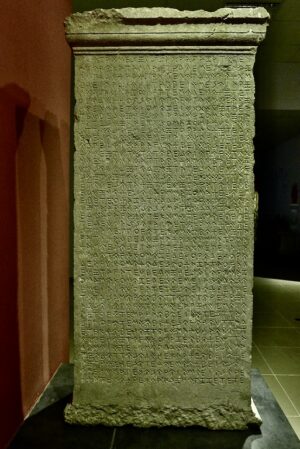
Letoon Trilingual, Lycian Side. Author Ansgar Bovet, CC BY-SA 3.0, Wikimedia Commons
____________________________
Sacred Waters and Ritual Spaces
Central to Letoon’s identity was its sacred spring. Revered for its purifying properties, the spring likely originated from pre-Lycian water cults, possibly dating back to the Hittite period. Water was life, cleansing, and divine; the ritual use of springs was a consistent theme in the region’s spiritual landscape. During the Hadrianic period in the 2nd century CE, an ornate fountain was constructed near the spring, further elevating its sacred status. Pilgrims and local worshippers alike sought the water’s blessings for healing, fertility, and protection—a practice that persisted into the Ottoman period.
The Letoon Theater, carved directly from the bedrock, provided the stage for civic and religious performances. Capable of seating 7,800 spectators, it reflects the integration of communal life with ritual observance. The theater, along with terraced walls, porticoes, and other civic constructions, embodies the harmony of functional architecture and sacred design.
___________________________

Leotoon Hellenistic Theatre. Dosseman, CC BY-SA 4.0, Wikimedia Commons
___________________________
Echoes of a Lost Priesthood
Among the shadows of Letoon, whispers of lost priestesses linger. Inscriptions and myths suggest the presence of women who conducted sacred rites, guided pilgrims, and preserved the rituals of Leto, Apollo, and Artemis. These priestesses, operating within a male-dominated world, wielded influence in both spiritual and social domains. Their disappearance from historical record leaves gaps filled only by fragments of inscriptions, artifacts, and enduring legends of their devotion and authority.
The Continuity of Sacred Space
Letoon’s religious significance endured through successive civilizations. From the Hellenistic constructions of the 5th century BCE, through Roman additions such as Hadrian’s Fountain, to early Christian adaptations like the 6th-century church and monastery—built using stones from the older temples—Letoon exemplifies continuity in sacred space. Even as political and cultural tides shifted, the area remained a locus of veneration.
Today, visitors encounter not only ruins but a tangible sense of sacred history. Frogs still inhabit the spring, relics of myth; mosaics from the Apollo Temple floor preserve the artistic and symbolic vocabulary of Lycia; and the trilingual stele quietly testifies to a once-flourishing cultic and civic life. Walking through the site, one experiences the layering of history, mythology, and devotion, an experience unique to Letoon.
Letoon’s Enduring Legacy
Letoon represents more than archaeological interest; it is the spiritual memory of Lycia. Its temples, inscriptions, fountains, and monuments offer glimpses into a culture where mythology, civic authority, and religion were inseparable. The lost priestesses, the sacred waters, and the enduring myths of Leto and her divine children continue to resonate, reminding us of the human impulse to connect with the divine, to sanctify space, and to leave a legacy that transcends centuries.
As a UNESCO World Heritage Site, Letoon today draws scholars, tourists, and pilgrims alike, offering a profound encounter with the past. Its story is not merely a tale of stones and ruins, but of living traditions, mythic narratives, and sacred continuity—a testament to the enduring power of belief in shaping both landscape and memory.