CNRS—Far from the common assumption of a strictly binary division of labor, the roles of women and men in Neolithic Europe were both clearly differentiated and flexible. This is what a new study* conducted by CNRS1 researchers within an international team reveals. These findings are published in the journal American Journal of Biological Anthropology on February 16, 2026.
To reach this result, the research team analyzed 125 adult skeletons from two Hungarian archaeological sites, Ferenci-hát (5300–5000 BCE) and Csőszhalom (4800–4600 BCE). The researchers combined the study of activity traces on bones — microtraumas at muscle attachment sites, vertebral lesions linked to intense physical strain, and markers of repeated postures such as kneeling — with the analysis of funerary practices, including body position and objects deposited in graves.
At both sites, male skeletons, unlike female ones, showed recurrent lesions on the dominant arm linked to physical tasks such as throwing or working stone and wood — a pattern commonly observed at the European scale.
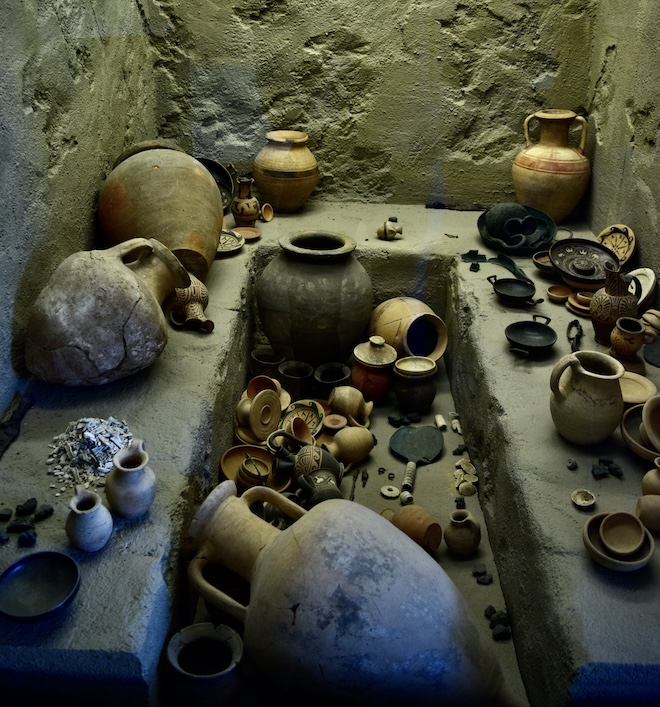
At Csőszhalom, funerary practices reflect strong social structuring: women were buried on their left side, men on their right, often accompanied by polished stone tools. Kneeling posture markers are significantly more frequent among the latter, suggesting specific activities and a particular status. One woman, however, was buried with these traditionally male-associated attributes.
This study thus shows that gendered roles did exist, and that some corresponded to a general pattern observed in other European prehistoric groups. However, Neolithic society tolerated exceptions and was already experiencing the complexity of identities.
____________________________
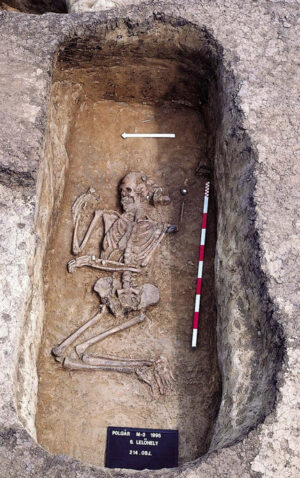
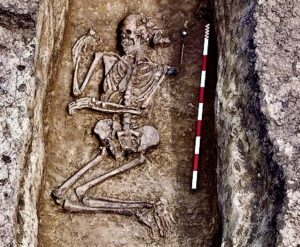
Typical male burial from Csőszhalom. Skeleton of a man buried on his right side with a polished stone tool (at the level of the left shoulder). © Alexandra Anders
____________________________
Article Source: CNRS news release.
Notes
- Working at the “Eco-anthropologie” laboratory (CNRS/MNHN), scientists from the laboratory “De la préhistoire à l’actuel : culture, environnement et anthropologie” (CNRS/Ministère de la Culture/uiversité de Bordeaux) are also involved.
*Fixed and fluid: The two Faces of Gender Roles — A Combined Study of Activity Patterns and Burial Practices in the European Neolithic, Sébastien Villotte, Tamás Szeniczey, Sacha Kacki, Alexandra Anders, American Journal of Biological Anthropology, 16 February 2026. DOI : doi.org/10.1002/ajpa.70217
____________________________