Anyang, located in China’s great North Plain, is a modern industrial city of almost 5.5 million people. It is known economically for the production of iron and steel, coal coking, and clothing production. But long before the modern city arose, the city landscape hosted an ancient urban presence that in time ranked among the world’s great Bronze Age centers. Clues to its remains first began to emerge over a hundred years ago…..
Written on Bone
For hundreds of years, farmers dug them up in their fields near the village of Xiaotun, a small village near Anyang and about 500 kilometers south of Beijing. They were fragments of ox scapula and turtle shell. The farmers sold them to apothecaries, where they were ground into powder for use as tonics or medicines for curing malaria and treating wounds.
But there was another peculiar thing about these bone fragments.
Many of them featured mysterious inscribed markings. In 1899, several of them fell into the hands of Wang Yirong, who was the chancellor of the Imperial Academy in Beijing at the time. Wang collected Chinese bronzes, some of which were Zhou dynasty bronzes inscribed with what he believed to be ancient Chinese writing. The markings on the bone fragments were tantalizingly similar. So similar, in fact, that it wasn’t long before the bone artifacts hit the antiquities trade with a storm and eventually came to the attention of James Mellon Menzies, who conducted the first scientific excavations of the bones, including decipherment. He published the first scientific study of the bones in 1917, which included 2,369 drawings and inscriptions, and eventually amassed a collection of as many as 35,000 objects related to what became known as the “oracle bones”.
Excavation and Discovery of the Lost City
More important than the oracle bones was the drive to find answers to the questions of who made them and why. Scholars were keen to know their context, so in 1928 an excavation team led by Li Ji of China’s Academia Sinica began work near the village of Xiaotun close to modern Anyang, with the initial financial backing and support of the Freer Gallery of Art of the Smithsonian Institution in Washington, D.C. Excavations under Li Ji’s directorship continued with seasons over a 9-year period, recovering more oracle bone artifacts, the decipherment of which showed that the bone inscriptions represented divinations performed by an ancient royal household. Further excavation revealed the remains of a major Bronze Age city, eventually identified by archaeologists as Yinxu, the last capital city of the Shang Dynasty. It was a remarkable discovery, as before the excavation, even the very existence of the Shang Dynasty was in question. Clues to the Shang Dynasty were known only through historical documents. This dynasty was more than a myth.
_____________________________________
Article Supplement
The Oracle Bones
By definition, oracle bones are fragments of ox scapula and turtle plastron, which were used for pyromancy – a form of divination – in ancient China. These objects were used mainly during the late Shang dynasty. Diviners would submit questions to deities by carving them into the ox scapula or turtle shell pieces using a sharp tool, on topics like weather, crop planting, the fortunes of members of the royal family, military endeavors, and other topics. Intense heat was then applied with a metal rod until the bone or shell cracked due to thermal expansion. The diviner would then interpret the pattern of cracks and write the prognostication upon the same piece. The oracle bones bear the earliest known significant corpus of ancient Chinese writing, using an early form of Chinese characters. The inscriptions contain about 5,000 different characters, many of them still in use today. Although much of the ancient script is not yet completely understood, what has been deciphered provides important information on the late Shang Dynasty, and scholars have reconstructed the Shang royal genealogy from the cycle of ancestral sacrifices they record.
_________________________________

Pit YH127 of oracle bones (甲骨) at Yinxu, Anyang, China. Chez Cåsver, CC BY-SA 4.0, Wikimedia Commons
_________________________________

Oracle bone recording divinations by Zhēng 爭, one of the Bīn 賓 group of diviners from period I, corresponding to the reign of King Wu Ding (late Shang dynasty). CC BY-SA 4.0, Wikimedia Commons
_________________________________

This oracle bone is incomplete. A diviner asked the Shang king if there would be misfortune over the next ten days; the king replied that he had consulted the ancestor Xiaojia in a worship ceremony. Editor at Large, CC BY-SA 4.0, Wikimedia Commons
_________________________________

Tortoise plastron with divination inscription from the Shang dynasty, dating from the reign of King Wu Ding. The piece has complementary charges down the left and right sides. Cracks caused by applying a heat source to the reverse are numbered 1–6 on the left and 1–7 on the right. The outcome of the interpretation of these cracks is recorded at bottom right. Circa 1200 BC. BabelStone, CC BY-SA 4.0, Wikimedia Commons
Edited text, under CC BY-SA 4.0, Wikipedia
_____________________________________
The Yinxu Reveal
Between 1928 and 1937, Li Ji and his team made remarkable discoveries at Xiaotun. Among the most notable finds, they uncovered the remains of what they determined to be a royal palace, royal tombs, and a haul of more than 100,000 more oracle bones. Analysis of the remains and the oracle bones, along with the dating, sealed the suggestion that what they were looking at was the last capital of the ancient Shang Dynasty, confirming what was already recorded in later historical documents. Moreover, the incised markings on the oracle bones confirmed that, under the Shang Dynasty, China had developed a sophisticated and complete corpus of written signs by the 13th century, B.C..
Excavations since 1950 under the auspices of the Institute of Archaeology, Chinese Academy of Social Sciences, have only added to the discoveries, ultimately revealing a 30 km² area consisting of monumental palaces, temples, tombs and a massive industry of workshops.
___________________________

Aerial photo of Yinxu. Gary Todd, CC0 1.0 Universal Public Domain, Wikimedia Commons
___________________________

Yinxu excavation area. tak.wing, CC BY-SA 4.0, Wikimedia Commons
______________________________
Article Supplement
The Tomb of Lady Fu Hao
Among the most spectacular finds of the excavations were the royal tombs. One tomb, however, stands out from the rest for its significance. Discovered in 1976 by Zheng Zhenxiang, it was found largely intact, showing no signs of the looting common to most of the other royal tombs uncovered during the excavations. Dated to 1250 BCE, the prime occupant of the tomb was identified as the remains of Lady Fu Hao, a military leader and the wife of King Wu Ding, Wu Ding ruled from c. 1250 to 1200 BCE, and is considered the earliest king documented in the contemporary Chinese historical record. He presided over one of the most prosperous periods of early ancient Chinese civilization. In addition to the remains of Queen Fu Hao within the tomb, archaeologists uncovered 16 sacrificial human slave skeletons, 6 dog skeletons, and numerous grave goods.
_______________________________

Reconstructed tomb of Fu Hao. CC0 1.0 Universal Public Domain, Wikimedia Commons
____________________________

Fu Hao burial remains. Gary Todd, CC0 1.0 Universal Public Domain, Wikimedia Commons
____________________________

Bronze mirror found in tomb. Gary Todd, CC0 1.0 Universal Public Domain, Wikimedia Commons
____________________________
Article Supplement
The First Chariots
Along with writing, the Shang Dynasty was also known for the introduction of the use of horse-drawn carts and chariots in China, as evidenced by the remarkable discovery and excavation of chariot pits at the site by the Anyang Working Station of the Archaeological Institute of the Chinese Social Science Academy and the Historical Relics Working Team of Anyang Municipality in the northern and southern lands of Liujiazhuang village and the eastern land of Xiaomintun village. Detailed traces of their remains were found in 6 pits, each containing the remains of a carriage and two horses. Five of the pits also contained the remains of human sacrifices.
Archaeologists suggest that the chariot was introduced from the northern Eurasian steppes, possibly from the Deer stones culture.
_______________________

Above and below: Excavated evidence of chariots and associated remains, including human and horse skeletal remains. Gary Todd, CC0 1.0 Universal Public Domain, Wikimedia Commons
_____________________

_____________________

_____________________
More Than Palaces and Tombs
As remarkable as the tomb, palace, oracle bone, and temple/shrine discoveries were, perhaps even more significant to understanding the workings of the royal city were the prolific finds relating to the industry of the urban landscape. Excavations revealed a numerous array of workshops. Manufacturing debris and complex fabrication methods showing obvious divisions of labor suggested factory-like production on a large industrial scale. Individual plants were developed and organized into factory districts, producing goods in bronze, ceramic material, stone and bone. These factory districts were located near means of public infrastructure related to storage, housing, water, and transportation. Specialized workshops that worked in precious materials like ivory, jade or marble were usually located within the royal precinct of the city.
Based on the results of excavations thus far, it appears the Shang capital expanded to eventually cover over 14 square miles. However, its true boundaries remain uncertain, as archaeologists continue to reveal more habitation spaces through time. In addition to the tombs and the royal precinct of temples, palaces and other elite and administrative structures, continuing excavations have revealed a complex network of roads and canals that penetrated dense neighborhoods with large workshops.
Archaeological research has suggested that the city population drew its diversity from the surrounding territories. The largest proportion consisted of laborers in agriculture and construction, who also fed the need for conscripted military service. A somewhat smaller proportion consisted of specialized or skilled workers and artisans, who fashioned the raw material received from other parts of China into the bronzes, pottery, bone and stone goods for consumption by both the elite and people of other classes. Much like other Bronze Age cities across the globe, the wealth produced by the city’s production became reflected in the elaborate tombs, palaces, and residences of the elite. The entire urban landscape, including the associated agricultural lands that fed into the city’s sustenance, was managed by the King’s bureaucracy of officials who oversaw and governed the labor force, public infrastructure, the military, and the means of agricultural production.
The capital endured 255 years through 12 kings and 8 generations.
In time, archaeologists and other scholars are hoping a more complete and detailed picture of life in the Shang city of Yinxu will be revealed, shedding new light on one of the great Bronze Age centers of the ancient world.
______________________________

A bronze Ding. Dings are ancient Chinese cauldrons supported by legs with a lid and two handles. They were used for ritual offerings, storage and cooking. Late Shang Dynasty. Mountain, CC BY-SA 4.0, Wikimedia Commons
______________________________

Skull of Shang Soldier with Embedded Bronze Arrowhead, Tomb M745. Gary Todd, CC0 1.0 Universal Public Domain, Wikimedia Commons
______________________________

Shang Bronze Bu. Gary Todd, CC0 1.0 Universal Public Domain, Wikimedia Commons
______________________________

Turquoise-inlaid jade dagger Shang Dynasty 1300-1200 BC. Mary Harrsch, CC BY-SA 4.0, Wikimedia Commons
______________________________

Houmuwu Ding or Simuwu Ding. Amypaper, CC BY-SA 4.0, Wikimedia Commons
______________________________

Artist’s recreation of ancient Yinxu. tak.wing, CC BY-SA 4.0, Wikimedia Commons
______________________________
Image, Top Left: From the tomb of Fu Hao, Yinxu. Gary Todd, CC0 1.0 Universal Public Domain, Wikimedia Commons
______________________________
Advertisement
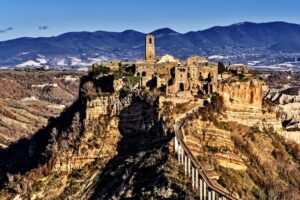
EXPLORE THE ANCIENT ETRUSCANS IN PERSON!
Experience a unique, up-close-and-personal hike among ancient hilltop towns in central Italy. You will walk the sensational countryside of the regions of Umbria and Tuscany, soaking in important sites attesting to the advanced Etruscan civilization, forerunners of the ancient Romans; imposing architectural and cultural remains of Medieval Italy; local food and drink; and perhaps best of all — spectacular scenic views! Join us in this collaborative event for the trip of a lifetime!