Tel-Aviv University—A new study from Tel Aviv University proposes a solution to a historical mystery that has puzzled researchers for decades: Was the unique calendar of the Qumran sect, based on a 364-day year, ever used in practice, or was it merely a theoretical model?
The study hypothesizes that the calendar was indeed used by the sect in its early years, and even stood at the crux of the controversy that drove the sect to isolation in the desert. However, the calendar was later abandoned due to an inherent problem that made it impracticable over time, as well as warming relations with Hasmonean leadership under Alexander Jannaeus.
The study was conducted by Prof. Eshbal Ratzon of the Department of Jewish Philosophy and the Cohn Institute for the History and Philosophy of Science and Ideas at the Entin Faculty of Humanities. The paper was published in the Tarbiz Quarterly for Jewish Studies.
The Qumran calendar differed from the lunisolar calendar that served as a basis for Jewish life during the Second Temple period. It consisted of exactly 364 days – a number that is perfectly divisible by seven, and thus every year included 52 full weeks, and every holiday always fell on the same day of the week. For the Qumran sect, this reflected a perfect divine order. In the political sense, the calendar represented a rebellion against the political and religious leadership at the Temple in Jerusalem, which determined all significant dates. The sect believed that these dates had already been set by God during the creation of the world, and humans must not interfere.
Yet the Qumran calendar’s mathematical perfection created a serious difficulty: it diverged by one day and a quarter from the 365-day astronomical year. This difference may appear negligible, but it accumulates rapidly. For instance, if the Qumran calendar was used for twenty years, the festivals would shift by almost four weeks relative to the seasons. After several decades, a spring festival would end up being celebrated in winter, or even in the fall. For a community that regarded festivals as agricultural events connected to the harvest, first fruits, and seasons of the year, this posed a fundamental problem.
To understand the significance of the gap, one can compare the calendar to a clock that deviates by one minute every day. At first, no one notices the problem, but after months and years, such a clock no longer represents reality. The study explains that this is exactly what happened to the Qumran calendar: while ideal from a conceptual and mathematical perspective, over time it drifted further and further away from the natural cycles it sought to govern.
Over the past decades, researchers have proposed various solutions to this enigma. Some maintained that the Qumran sect periodically added days or weeks to its calendar, while others claimed that the calendar had never actually been used in the real world, serving only as a theoretical framework. Prof. Ratzon argues that neither option is supported by the Dead Sea Scrolls. According to her study, the evidence indicates that the calendar was regarded by the sect as a key component of their religious identity and a major point of contention with the Jerusalem establishment.
The study notes that almost twenty of the scrolls found in Qumran deal with calendars and astronomy – an exceptional number that attests to the topic’s immense importance for the community. The Book of Jubilees, a central work in the Qumran library, fiercely attacks the prevailing lunar calendar, presenting the 364-day calendar as the original calendar received by Moses on Mount Sinai.
*Based on this body of evidence, Prof. Ratzon proposes a new historical reconstruction: she contends that the Qumran calendar was actively used during the sect’s formative days in the second century BCE, exacerbating its conflict with the religious leadership in Jerusalem. However, as the years went by, the calendar’s accumulating digression from the seasons could no longer be ignored. In addition, the sect’s relations with the ruling Hasmonean dynasty warmed during the reign of Alexander Jannaeus, who supported a halacha similar to their own and opposed the Pharisaic leadership. This enabled the Qumran sect to relinquish their previously adamant position and adopt the more practical calendar used at the Temple. They retained their own calendar as a theoretical concept that had been valid at the time of Creation and might be used again in the End of Days.
Prof. Ratzon concludes: “The Qumran calendar has long been regarded as one of the Qumran sect’s defining features, but also as one of the most baffling mysteries of the Dead Sea Scrolls. This study proposes an alternative for the seeming contradiction between a functional calendar and a theoretical one. It is quite possible that the calendar was in fact used for a certain period of time, but then, losing its practical role due to both inherent problems and political changes, became a religious ideal and a symbol of identity. This would explain both its centrality in the Qumran scrolls and its gradual disappearance from historical reality.”
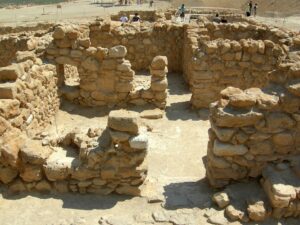
Cover Image, Top: Qumran living quarter. Wilson44691, Public Domain, Wikimedia Commons
__________________________
POPULAR ARCHAEOLOGY ON INSTAGRAM

__________________________