University of Southampton—Major drought forced people to migrate across the Pacific beyond Samoa and Tonga and towards the Americas, scientists have discovered.
With the new live action Moana film hitting cinemas on Friday [10 July], a team of geographers and climate scientists from the Universities of Southampton and East Anglia has discovered the true history of the tale.
Moana tells the story of a young Polynesian girl who leaves her threatened home island to sail past its barrier reef to save her island and its people.
The story is built on a period of history called the ‘Long Pause’. Around 3,000 years ago the ancestors of modern Polynesians arrived in Samoa and Tonga, and for 1,700 years they did not sail further east into the Pacific. Then around the years 900-1050 AD, they voyaged east and within 250 years settled the remaining island archipelagos of the South Pacific including Tahiti, Hawai’i and the continental Americas, in what was the greatest seafaring migration in history.
David Sear, Professor of Physical Geography at the University of Southampton and lead author of the study, said: “We have confirmed the theory that the end of the Long Pause coincided with a period of mega drought in the homeland islands of Samoa and Tonga – and also a period of increasing rainfall in the receiving islands. As they headed east, they found wetter islands with nobody on them.
“There was a huge explosion of migration, and within 250 years they had landed and settled every little dot in the South Pacific, from tiny coral atoll islands to larger lands. It was a very rapid process.”
Analysing samples from mud
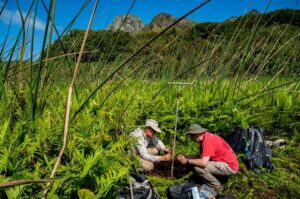
The research team analysed mud samples from deep beneath swamps and lakes in Samoa, Tonga, French Polynesia and the Cook Islands.
They used ‘biochemical fossils’ produced by freshwater algae and leaves to measure the isotopic ratio of hydrogen to determine historic rainfall levels. This data consistently showed evidence of a severe and prolonged drought just before and during the period of migration.
“Hydrogen in rainwater contains heavier and lighter isotopes, the proportion of which is determined by the amount of precipitation in the tropics– which we were able to analyse in the mud,” explained Dr Mark Peaple, research fellow in paleoclimate at the University of Southampton, who undertook the geochemical analysis. “So analysing the ancient biomarker fossils we can reconstruct rainfall changes from thousands of years.”
When the Long Pause ended, it was the driest period in the last 2,000 years for these islands, so the islands’ populations were forced to move.
Climate modelling
The scientists also used climate modelling to understand the drivers of the dry conditions found in Samoa and Tonga.
Manoj Joshi, Professor of Climate Dynamics at the University of East Anglia, led the climate modelling. He said: “Our research shows that changes in sea surface temperatures across the Pacific Ocean over many decades drove an eastward shift in the vast rain belt that lies over this whole region, causing the dry conditions found in Samoa and Tonga.
“The climate changes we identified would have transformed daily life on these islands. Reduced rainfall would have affected freshwater availability, food production and the resilience of communities, creating powerful incentives for people to seek opportunities elsewhere.”
Dan Skinner, research fellow at the University of East Anglia who undertook climate modelling experiments said: “We now know that the climate – and specifically a period of severe drought for many years, even decades – is a definite factor in forcing this impressive migration.
“These findings illustrate how sensitive human societies can be to long-term changes in climate. Even highly skilled and adaptable communities may be driven to undertake extraordinary journeys when environmental conditions deteriorate over many years.”
Professor Sear added: “Other factors would also have contributed to the tipping point that made the costs of sailing into the eastern Pacific worth risking. There was an increasing population, meaning resources had to stretch further. Also, they had probably developed advanced sailing technology for their voyaging canoes by this point, adapting from U to V-shaped hulls and improving their rigging, which meant they could sail into the wind, which is predominantly east to west across the South Pacific.”
The research is published in the Journal of Pacific Archaeology.
______________________
Prof David Sear (l) and Dr Mark Peaple (r) coring a swamp in Polynesia to collect mud samples that contain records of rainfall over thousands of years. Credit: University of Southampton
______________________
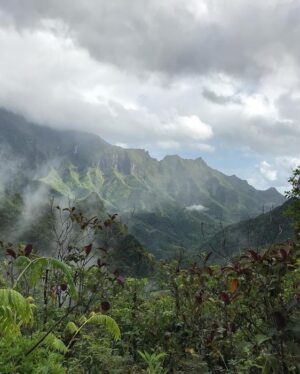
Swamp and lake sediments are found across the Pacific islands often in remote volcanic crater lakes or mountain rain forests like here on Tahiti. Credit: University of Southampton
______________________
Article Source: University of Southampton news release.
*How Did changing climate in the tropical South Pacific contribute to the eastward migration and settlement of Polynesia? Journal of Pacific Archaeology, 5-May-2026. 10.70460/jpa.v16i2.399
____________________
POPULAR ARCHAEOLOGY ON INSTAGRAM