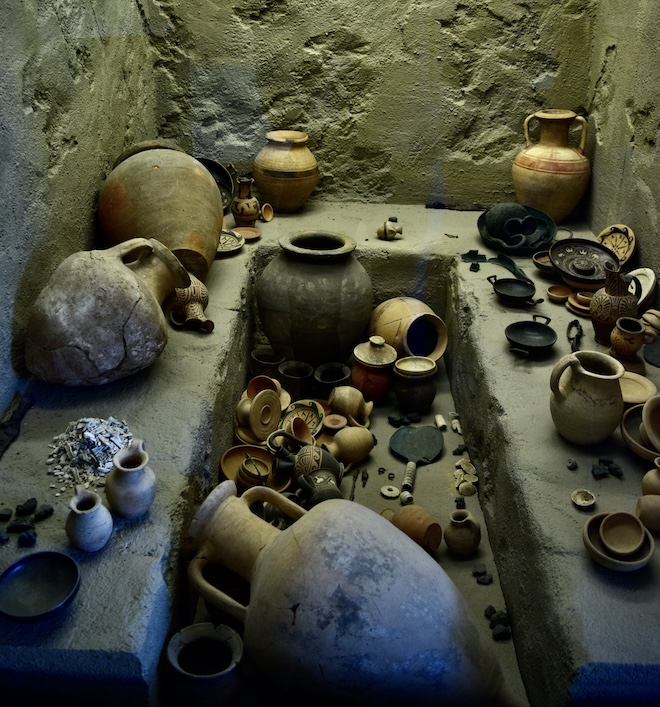
Malta, 2023 — It was a discovery that proved nothing less than astonishing.
Well more than 8,000 years ago, these humans should not have been here.
They hunted, foraged, cooked. Overlooking the sea and a landscape spread out far below them, this was, for this cave’s first human inhabitants, like a “room with a view” — prime real estate.
In the larger sense, it challenged the conventional thinking about what we knew about humans in 6500 BC….
_____________________
Latnija
Malta, though comparatively tiny and seemingly isolated in the middle of the Mediterranean Sea, is a developed country, boasting a high-income economy. Heavily reliant on tourism, it draws both short-visit travelers as well as a growing expatriate community with its warm climate, numerous recreational areas, and architectural and historical monuments. Notably, among these monuments are astounding UNESCO World Heritage Sites: the Ħal Saflieni Hypogeum, in Valletta, and seven megalithic temple sanctuaries, consisting of structures considered to be among the oldest free-standing structures in the world, built by a Neolithic agriculturally-based population that still remains defined by at least as many questions as answers.
_____________________________
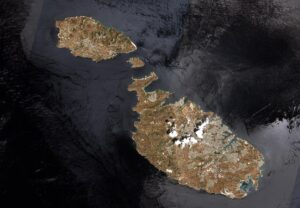
Malta, satellite image. European Space Agency. CC BY-SA 3.0 IGO, Wikimedia Commons
_____________________________
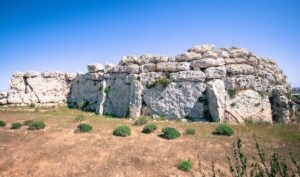
Ġgantija Megalithic Temples complex on Gozo in Malta. r Bs0u10e01, CC BY-SA 4.0, Wikimedia Commons
_____________________________
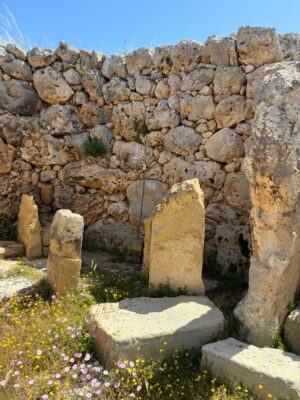
Ggantija, interior space detail.
_____________________________
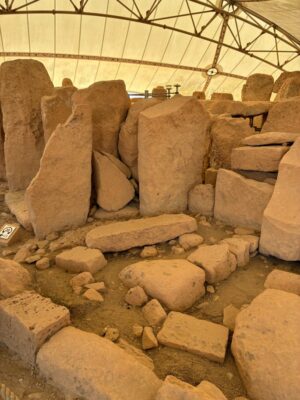
Megalithic temple at Ħaġar Qim. Above and below.
_____________________________
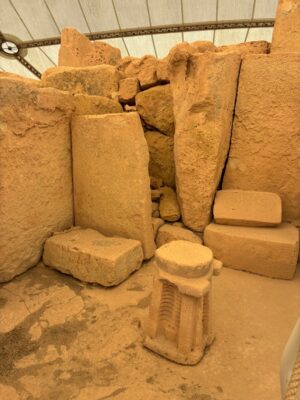
_____________________________
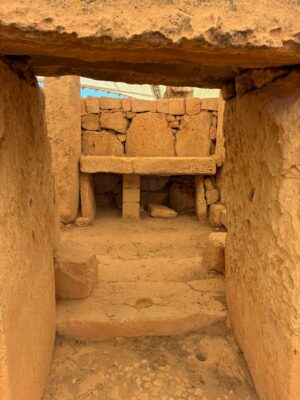
Above, Mnajdra Temple complex, interior detail.
_____________________________
Archaeologists have uncovered plentiful evidence that farmers settled and exploited this naturally circumscribed landscape as long as 7,400 years ago. Most scholars would consider this a relatively early occupation for a tiny island. Isolated islands are generally known to show evidence of their earliest human presence significantly later than their mainland counterparts, for obvious reasons. So the thought of any humans here before 7,400 years ago was almost unthinkable.
Until now.
Enter Eleanor Scerri (pictured below), who is an evolutionary archaeologist and head of the multidisciplinary Human Palaeosystens research group at the Max Planck Institute of Geoanthropology in Germany. In this capacity, she also heads the Islandlab Project , mandated to explore questions focusing on the effects of anthropogenic ecosystem fragmentation, using the Maltese Islands as the geographic base for study and research. Thus drawn to Malta in 2017, she and colleagues came initially with questions about the prehistoric ecosystem of the island. Natural evolutionary forces on Malta had created a tiny world of miniaturized megafauna, such as dwarf elephants, pygmy hippos, and small deer. Conversely, some fauna became unusually large, such as giant swans and dormice. Scerri’s team plan was to explore a number of research questions. Among them: were the prehistoric fauna still here when the first farmers entered the scene, and if so, what impact did these early farmers have on these now extinct fauna?
At the same time, the question of an even earlier human presence was not altogether absent from consideration.
“We knew….that it was possible hunter-gatherers had made it to Malta, but that it was unlikely given the seafaring distances involved,” says Scerri. “Even if they had made it, the chances of finding traces of such an ephemeral presence seemed slim.”
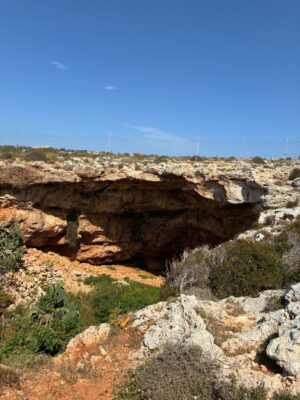
When conducting reconnaissance in northwestern Malta, Scerri came across a remarkable geologic feature known as Latnija Cave.
“When I first went to Latnija Cave it seemed clear to me that if hunter-gatherers had been present on Malta, there was a good chance they had visited the site, given its exceptional qualities,” said Scerri. “Fresh water is present at the site, it features a rock shelter in the lee of the prevailing northwesterly wind, and would have overlooked a coastal plain giving a good vantage point to the people there.”
___________________________

Dr, Eleanor Scerri. Credit: Alexandra Pace
___________________________
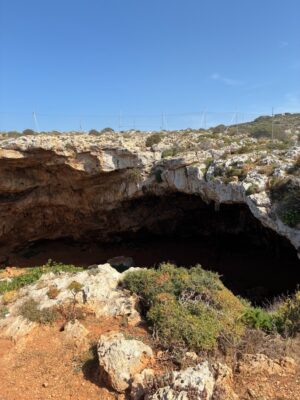
Above and below: Latnija Cave, exterior views.
___________________________
___________________________
Digging into the Mesolithic Horizon
Scerri and her team, along with cooperation and partnership with the University of Malta, began the work of digging to uncover the cave’s secrets.
It was not easy.
“Cave deposits are usually extremely complex, requiring slow and painstaking work,” said Scerri. “We excavate in August and September, which are also the hottest months of the year, and [we] remove 100% of the sediment excavated at the site for processing elsewhere. The conditions of the cave are such that everything has to be carried out [uphill] and taken to the cars, which cannot get near the site since there is no road [next to the cave]. It’s physically demanding and exhausting work.”
The initial test trench within the cave was laid out in 2019, progressing in time through four test trenches. Of these trenches, it was Trench 4 where excavation revealed some remarkable finds. Excavating down, they uncovered the expected artifacts representing, to begin with, the early modern material scattered over the surface and just beneath, then on through Roman, Phoenician, Bronze Age, Late Neolithic Temple Period, and the earliest evidence of Neolithic occupation, including domesticated animals. Evidence for human presence, Scerri thought, would then terminate, leaving remains and evidence attributed to fauna and flora devoid of anthropic (human) impact.
But not at Latnija.
As they dug further they encountered, instead of domesticated animals, skeletal remains of wild animals, dominated by the dwarf red deer, a species thought to have gone extinct long before human arrival on the island. Moreover, many of these bones were burned and blackened by fire — not by nature. And the smoking gun: they were associated with stone tools, made from local limestone.
It was remarkable. Until now, there had never been any indisputably valid evidence of humans on Malta before the early farmers of the Neolithic. So Scerri and her team then did what any archaeologists would do. They submitted samples for initial radiocarbon testing. The results were exciting. The dating showed the samples were pre-Neolithic.
They were now digging into another world. This was the Mesolithic Horizon, or Middle Stone Age, the transitional archaeological period between the Paleolithic (hunter-gatherer) and Neolithic (agricultural) eras.*
But as a famous scholarly saying goes, “extraordinary claims require extraordinary evidence”.
They began the work of expanded, full-scale excavation of the site to validate their finding.
Pay Dirt
Beginning in 2021, the team began by expanding Trench 4 from a 1 x 1 meter trench to a 5 x 5 square, employing the full scale of up-to-date techniques and technology, equipment, and recording to investigate the sediments millimeter by millimeter. Excavating to a maximum depth of 1.48 meters, they grouped sediment layers into six phases based on changes in sediment color, texture, composition and structure, as well as changes in the patterns of material culture unearthed in the sediments. A large international team of scientists, specialists, scholars and institutions were employed to provide focused research and analysis in specialized areas such as geochronology, computational modeling, genetics, archaeobotany, pyroarchaeology, isotope analysis, and radiocarbon dating. Scerri was determined to ‘science this to death’.
___________________________
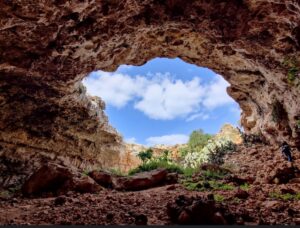
View of the doline roof and looking outward from inside Latnija Cave. Credit: Andres Curras.
___________________________
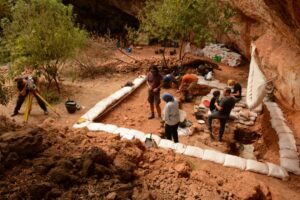
IslandLab team led by Prof. Eleanor Scerri excavating at the Latnija Cave site. Credit: Huw Groucutt
___________________________
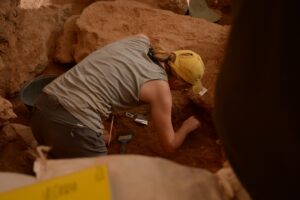
Prof. Eleanor Scerri digging at the site. Credit: Andres Curras
___________________________
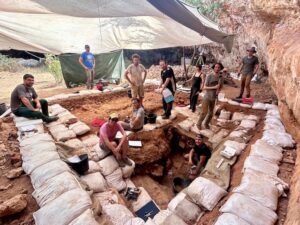
IslandLab team led by Prof. Eleanor Scerri at the excavation site. Credit: Huw Groucutt
___________________________
Findings
Intense excavations carried out between 2021 and 2023 exposed a series of sediments dated from the early to the mid-Holocene (the current geological epoch, beginning 11,700 years ago). They yielded stone tools, hearths, ash-tips, and a range of flora and fauna such as the extinct red dwarf deer, marine gastropods, fish and marine mammals. Some of the remains had been burned.
A total of 64 ltihics (knapped or worked stone tools) mostly made of limestone, but one made of chert, were excavated from Phase V — III deposits, comprising the Mesolithic Horizon. The materials for the stone tools were determined to have been procured as cobbles and pebbles from beach contexts and others from terrestrial outcrops in the landscape. Most of the tools were simple flakes created by stone hammer percussion activity.
A total of 955 faunal specimens were recovered, as well as many more very small faunal fragments recovered through sieving and flotation. Faunal remains were all wild, including red deer (the dominant species), birds and marine gastropods (10,000 shells). Smaller numbers of the remains of reptiles, fish, crustaceans, sea urchins, and seals, were found.
About 25% of faunal remains that were studied showed evidence of having been burned or charred. They included red deer, birds, tortoises, and marine gastropods.
Everything revealed “conspicuous evidence for anthropic activity”, according to the published study,** and the use and apparent consumption of marine resources at the cave were consistent with subsistence patterns at other Mesolithic-dated sites in the Mediterranean.
Humans were here, and they were actively thriving in a limited island environment.
__________________________
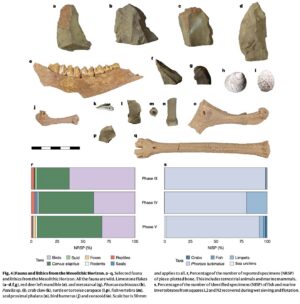
Above, source: Scerri, Eleanor M.L. et al., Hunter-gatherer sea voyages extended to remotest Mediterranean islands, Nature, Vol. 642, 1 May 2025. CC BY 4.0 Attribution 4.0 International
__________________________
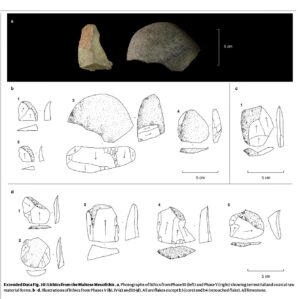
Above, source: Scerri, Eleanor M.L. et al., Hunter-gatherer sea voyages extended to remotest Mediterranean islands, Nature, Vol. 642, 1 May 2025. CC BY 4.0 Attribution 4.0 International
__________________________
How Old?
Radiocarbon dating was conducted on charcoal, seed, and marine shell samples at the Curt-Engelhorn-Centre Archaeometry lab in Mannheim, Germany, with bone sample dating conducted at the University of Georgia Center for Applied Isotope Studies. Accelerator Mass Spectrometry analysis yielded 32 dates on charcoal and one on bone. Both charcoal dates and shell dates were generally consistent with each other. All in all, report the researchers in the resulting study paper, “the consistent chronological data and highly resolved stratigraphy support the integrity and well-dated character of the Latnija sequence”.**
The results supported an argument that the human occupation of the site began at about 8.5 ka (thousand years ago), significantly before the earliest known dates for occupation of Malta by Neolithic period inhabitants. Human prehistory on the island extended back into the Mesolithic, a time period domain associated with prehistoric hunter-gatherers.
__________________________
Dugout Mariners
Given the very early occupation, however, what would support the argument that these were prehistoric hunter-gatherers, as opposed to perhaps a very early, unprecedented presence of Neolithic farmers, extending the Neolithic back in time beyond the traditional scholarly consensus?
The answer is summarized in the April 2025 applicable research report published in the prestigious journal Nature:
“….The evidence from Latnija confirms a Mesolithic occupation of the Maltese islands spanning from around 8.5 ka to 7.5 ka, which differs markedly from younger, agro-pastoral societies in technology, raw materials, diet, and subsistence practices.”**
More remarkable still, however, is the answer to the question of how these early Mesolithic inhabitants got to the island in the first place. Malta at 8,500 years ago was separated by the sea from its closest neighboring landmass, present day Sicily, by a straight-line distance of approximately 85 km.
“….once we began accounting for wind directions, currents, and navigation, it became obvious that we were looking at a minimum distance of 100 km in open water,” states Scerri in her essay published in the April 2025 Springer Nature Research Communities.***
The research reports a startling conclusion:
“These findings….provide evidence of long-distance, open-water sea journeys that were far longer than any previously documented in the Mediterranean, before the Neolithic and Bronze Age, when developments such as the invention of the sail occurred. Such inter-island crossings fall into the category of ‘difficult routes’”….**
Perhaps the most sensational takeaway from the Scerri team investigation leaves a new question:
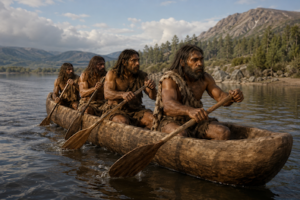
Would it be reasonable to assume that prehistoric hunter-gatherers could make their way across a stretch of water like this, using technology of their time that likely suggested the use of dugout canoes, no sails, and without the use of modern navigation techniques?
It would be a mighty feat, indeed, but not impossible. And in some ways, not entirely without precedent in the Mediterranean.
Naxos, for example, an island 990 km northeast of Malta in the Cyclades of Greece, has shown evidence of a Paleolithic human presence as much as 200,000 years ago, tens of thousands of years before the hunter-gatherers of Latnija. As many as 9,000 stone tool artifacts have been uncovered within a remarkable stratigraphic sequence dating from about 13,000 to 200,000 years ago. The artifacts also included stone tools (Levallois and Mousterian industries) commonly associated with Neanderthals.
But the Naxos case differs from Malta in a very significant way.
Says Scerri:
“The Naxos presence is significantly older and dates back to the Middle Palaeolithic when there was either a land connection between Naxos and the mainland, or a very short stretch of water. If there was a short stretch of water, then the evidence from Naxos is an important part of the seafaring story, showing an early “seagoing” phase involving short hops. The evidence from Malta pertains to a much later and complex stage of the seafaring story. Here, we see sustained, long distance sea journeys of around 100 km – this up there with the longest distances known to have been crossed by hunter-gatherers.”
Though the finding of early seafaring by prehistoric humans to Malta is remarkable by itself, it also adds to a developing realization among scholars through the discovery of other arguable evidence for open water journeys in the Mediterranean, as well as in regions far beyond the Mediterranean — pushing the timeline even further back, even hundreds of thousands of years, demonstrating that ancient hominins repeatedly crossed open seas using non-sailing watercraft.**** Discoveries of the remains of ancient prehistoric dugout canoes and simple oars at various locations, as well as experimental archaeology demonstrating the feasibility of relatively long-distance seafaring using the technology that likely would have been available to prehistoric hunter-gatherers, have served to reinforce new seafaring scenarios advanced by researchers.***** The Monoxylon Project, for example, showed that humans could successfully achieve cross-island routes in the Mediterranean using a hand-hewn log boat; the Ryukya Expedition achieved an open strait crossing of 110 km from Taiwan to Japan using a 7.5 meter dugout canoe; and the Nale Task Series demonstrated that humans could negotiate open ocean passages from Indonesia to Australia using 4-58 ft bamboo rafts.
_____________________________
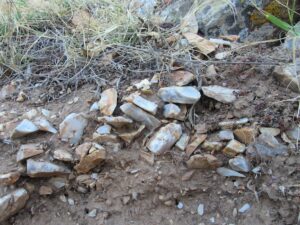
Stone tools discovered in situ at the excavation site of Stelida, on Naxos. From the Ancient Workshop of Naxos, Popular Archaeology, July 14, 2016. Courtesy Kate Leonard.
_____________________________
_____________________________
Going Forward
The discovery and telling of the Maltese islands ancient story is far from over. While the Neolithic megalithic wonders of the islands continue to fascinate and mystify, clearly the history, or to be more accurate, prehistory, of the islands’ human inhabitants extend much farther back in time than anyone had ever imagined. The recent discoveries in Latnija cave have opened a new window and a whole new battery of questions.
Popular Archaeology asked Scerri what she and her team have in mind going forward in their ongoing investigations.
Her answer provides a fitting summary for the Latnija Cave story:
“There are many outstanding questions regarding the Mesolithic in Malta, and many decades of research lie ahead. How did these hunter-gatherers survive on such a small and semi-arid island (Malta was one island in the early Holocene)? How often did they visit Malta? Were these seasonal visits or longer occupations? Where else did they live, and where else did they go? We hope to be able to answer these questions and many more with ongoing excavations.”
_____________________
*Key Characteristics of the Mesolithic Horizon
- Climate Shift: Occurring after the last Ice Age, rising temperatures and melting glaciers transformed the landscape into dense forests and marshlands.
- Microlithic Technology: Instead of large, heavy chipped-stone tools, humans crafted smaller, highly specialized bladelets called microliths. These were often slotted into wood or bone handles to create arrows, knives, and spears.
- Diet and Foraging: With large Pleistocene megafauna dying out, diets diversified to include smaller game (deer, wild birds), coastal resources (shellfish, fish), and gathered plant foods.
- Settlement Patterns: While largely semi-nomadic, communities began establishing more permanent or semi-permanent coastal and riverine settlements to exploit consistent food sources.
________________________
**Scerri, E.M.L., Blinkhorn, J., Groucutt, H.S. et al. Hunter-gatherer sea voyages extended to remotest Mediterranean islands. Nature 641, 137–143 (2025). https://doi.org/10.1038/s41586-025-08780-y
________________________
*** Eleanor Scerri, Discovering Europe’s Last Hunter-Gatherers, Springer Nature, Research Communities, April 9, 2025.
________________________
****Lower Paleolithic Hand Axes on Crete (~130,000–700,000 BP)
- The Island Reality: Crete has been completely isolated from the mainland by deep-water trenches for over five million years. It was never accessible via land bridges during glacial periods.
- The Finding: The Plakias Stone Age Project discovered Acheulean-style stone tools (including bifacial hand axes and cleavers) embedded in ancient marine terraces.
- Implication: Early hominins like Homo erectus or Homo heidelbergensis must have intentionally crossed a minimum of 25 kilometers of open sea to reach the island.
Neanderthal Seafaring in the Ionian Sea (~35,000–110,000 BP)
- The Island Reality: The southern Ionian islands (such as Cephalonia and Zakynthos) remained true oceanic islands even during periods of extreme sea-level drops.
- The Finding: Middle Paleolithic Mousterian stone toolkits—unequivocally manufactured by Neanderthals—were excavated across these isolated landmasses.
- Implication: Neanderthals possessed the cognitive capability and spatial reasoning required to construct watercraft and navigate active island straits.
Melian Obsidian at Franchthi Cave (~15,000 BP)
- The Island Reality: Melos is a volcanic island situated in the southwestern Aegean Sea, roughly 90 nautical miles away from the Greek mainland.
- The Finding: Upper Paleolithic strata within Franchthi Cave on the Greek mainland yielded black volcanic glass (obsidian). Chemical fingerprinting traced this material directly to Melos.
- Implication: Early Homo sapiens were operating coordinated, multi-island seasonal supply lines across the open Aegean Sea long before the invention of agriculture or sails.
_______________________
*****Experimental archaeology has suggested that prehistoric, non-sailing watercraft were fully capable of deep-ocean voyaging. Because the sail is a relatively modern invention—emerging roughly 5,000 years ago—human maritime expansion across places like the Mediterranean and the open Pacific relied entirely on muscle, current, and wind drift. Archaeologists use full-scale reconstructions of Paleolithic and Neolithic watercraft to test how early populations crossed open straits without sails.
Primary Vessel Types Tested
Experimental voyages focus on three main hull types used prior to the invention of the sail:
- Dugout Canoes (Logboats): Reconstructions carved entirely out of single logs using replica stone tools.
- Bamboo Rafts: Highly buoyant structures engineered from bound lengths of structural bamboo.
- Reed-Bundle Rafts: Vessels made of tightly wrapped papyrus, totora, or local reeds, functioning via displacement and material buoyancy.
Key Milestones in Non-Sailing Experimental Voyages
Key Breakthroughs & Findings
- Realities of Human Performance
- Advanced Navigation: Early voyages could not rely on passive drifting; success
- required sophisticated knowledge of tracking celestial bodies, reading wave reflections, and understanding seasonal changes.
- Paddle Dynamics: Reconstructions consistently reveal that single-bladed paddles, rather than fixed oars, require massive physical endurance and specialized synchronization to prevent the vessel from spinning in open ocean swells.
2. Hydrodynamics vs. Materials
- Dugout Dominance: Recent studies published in Science Advances demonstrate that dugouts possess the speed and structural hull speed required to punch through massive ocean currents, such as Japan’s Kuroshio Current.
- Raft Limitations: While buoyant, large bamboo and reed rafts create high water resistance. Experiments show they are exceptionally difficult to steer in high winds, making them less viable for targeted, intentional crossings against strong ocean currents.
3. Social and Technical Frameworks
- Community Labor: Reconstructing ancient vessels using Upper Paleolithic stone axes proves that boat construction required immense collective labor, forward planning, and specialized spatial reasoning
The “Human” Factor: Physical data from organizations like EXARC emphasize that the psychological endurance and cooperation of a multi-person paddling crew are just as vital to survival as the structural integrity of the vessel itself
______________________________