American Association for the Advancement of Science (AAAS)—Wood imprints and charred remains of spears, trays, tripods, and an unusually shaped club uncovered at the Middle Paleolithic site of Abric Romaní in Spain suggest that woodworking may have been a key part of Neanderthal technology that paralleled the elaboration of stone tools, but is seldom preserved in the archaeological record. Palmira Saladié and colleagues describe the evidence of woodworking recovered from 16 layers of the site, dated between 62,000 and 40,000 years ago*. Much of the evidence comes from wooden imprints preserved by travertine incrustation, where calcium carbonate surrounds a wooden artifact that slowly decays and leaves an impression in the rock – which can preserve details down to the cellular level in some cases. Among wood imprints, charred wood imprints, and charred wooden remains, Saladié et al. documented tools and weapons such as spears and pointed sticks, domestic objects including a wooden tray, structural objects such as a tripod, and a club-like tool that appears unique within the prehistoric record. “Though relatively small, this collection of artefacts is notable for the varied morphology and functionality of the items that comprise it, demonstrating a remarkable technological versatility and the diversified exploitation of wood as a raw material,” the authors write.
________________________
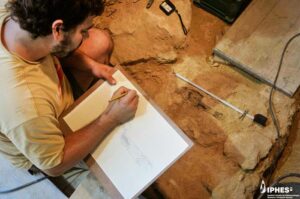
Drawing and recording work during the excavation of the wooden object at Abric Romaní. Credit: Gerard Campeny / IPHES-CERCA.
________________________
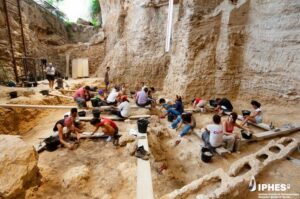
General view of the archaeological excavation at Abric Romaní, Capellades (Barcelona). Credit: Gerard Campeny / IPHES-CERCA
________________________
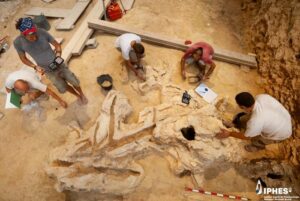
Drawing and recording work during the excavation of the wooden object from Abric Romaní interpreted as a wooden club. Credit: Gerard Campeny / IPHES-CERCA
________________________
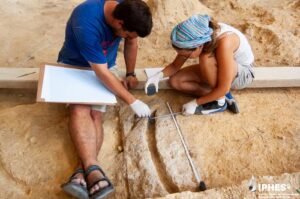
Drawing and recording work during the excavation of the wooden object from Abric Romaní interpreted as a digging stick. Credit: Gerard Campeny / IPHES-CERCA
________________________
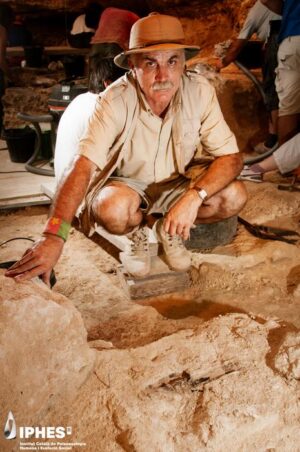
Prof. Dr. Eudald Carbonell with the wooden object from Abric Romaní interpreted as a wooden club. Credit: Gerard Campeny / IPHES-CERCA
________________________
Article Source: AAAS news release.
*Neanderthal woodworking at Abric Romaní: Insights into the role of wood in a Middle Palaeolithic domestic context, Science Advances, 7-Oct-2026. www.science.org/doi/10.1126/sciadv.aeh2287
Article Authors
- Palmira Saladie (Universitat Rovira i Virgili, Instititut Catala de Paleoecologia Humana i Evolucio Social, Museo Nacional de Ciencias Naturales)
- M. Gema Chacón (Universitat Rovira i Virgili, Instititut Catala de Paleoecologia Humana i Evolucio Social, Histoire Naturelle de l’Homme Prehistorique, Universitat de Barcelona)
- Ethel Allue (Universitat Rovira i Virgili, Instititut Catala de Paleoecologia Humana i Evolucio Social)
- Bruno Gómez de Soler (Universitat Rovira i Virgili, Instititut Catala de Paleoecologia Humana i Evolucio Social)
- Alex Solé (Instititut Catala de Paleoecologia Humana i Evolucio Social)
- Juan Marín-Hernando (Instititut Catala de Paleoecologia Humana i Evolucio Social, Department of Prehistory and Archaeology, Universidad Nacional de Educación a Distancia, UNED, Histoire Naturelle de l’Homme Prehistorique)
- Francesca Romagnoli (Universidad Autonoma de Madrid)
- Amelia Bargalló (Universitat Rovira i Virgili, Instititut Catala de Paleoecologia Humana i Evolucio Social, Universitat Rovira i Virgili Facultat de Lletres)
- Manuel Vaquero (Universitat Rovira i Virgili, Instititut Catala de Paleoecologia Humana i Evolucio Social)
- Maria Joana Gabucio (Universitat Rovira i Virgili, Instititut Catala de Paleoecologia Humana i Evolucio Social, Universitat Rovira i Virgili Facultat de Lletres)
- Paula Mateo-Lomba (Instititut Catala de Paleoecologia Humana i Evolucio Social, UMR5199 PACEA, Université de Bordeaux, MCC, CNRS)
- Marcos García Millán (Universitat Rovira i Virgili, Instititut Catala de Paleoecologia Humana i Evolucio Social)
- Antonio Pineda (Universitat Rovira i Virgili, Instititut Catala de Paleoecologia Humana i Evolucio Social)
- Mónica Fernández-Garcia (Instititut Catala de Paleoecologia Humana i Evolucio Social, University of Lancashire, Research Centre for Field Archaeology and Forensic Taphonomy, University of Lancashire)
- Gerard Campeny (Universitat Rovira i Virgili, Instititut Catala de Paleoecologia Humana i Evolucio Social)
- Lila Warnitz (Universitat Rovira i Virgili, Instititut Catala de Paleoecologia Humana i Evolucio Social)
- Amanda Merino-Pelaz (Universitat Rovira i Virgili, Instititut Catala de Paleoecologia Humana i Evolucio Social)
- Tomás Fernández-Iriarte (Universitat Rovira i Virgili, Instititut Catala de Paleoecologia Humana i Evolucio Social, ArqueoUIB Research Group, Departament de Ciències Històriques i Teoria de les Arts)
- Raül Bartrolí (Ajuntament de Capellades)
- Josep Vallverdu (Universitat Rovira i Virgili, Instititut Catala de Paleoecologia Humana i Evolucio Social, Museo Nacional de Ciencias Naturales)
- Eudald Carbonell (Instititut Catala de Paleoecologia Humana i Evolucio Social, Fundación Atapuerca)
___________________________
POPULAR ARCHAEOLOGY ON INSTAGRAM

___________________________
Advertisement