At Pompeii, a street corner can be as absorbing as a famous fresco. A shop opens onto the pavement; a doorway leads into a house; the road continues towards a public square. Even without a roof overhead or a crowd in the street, the relationship between these spaces is often easy to follow. People lived here, sold things to their neighbours and walked to the same places every day. That sense of familiarity is a good reason to visit Pompeii. It is also a reason to look further across Campania. Herculaneum preserves materials that rarely survive in ancient towns. Paestum takes the story back to Greek settlement in southern Italy. In Naples, objects removed from the excavations restore some of the colour and detail missing from the buildings. Each visit changes what you notice at the next.
Pompeii, beyond the eruption
The eruption of Vesuvius in AD 79 dominates Pompeii’s reputation. Yet a visit becomes much more interesting when the question shifts from how the city ended to how it worked. Begin in the Forum. Religious buildings, commercial premises and spaces for public business gathered around this square. Their proximity matters: activities that a modern visitor might separate into worship, shopping and politics belonged to the same urban centre. One of the most revealing buildings bears the name of Eumachia, a priestess of Venus. An inscription records her role in funding it in her own name and that of her son. The building’s precise function remains debated, but its prominent position and dedication give a named woman a visible place in the city’s public life. The statue of Eumachia found there is now in Naples’ archaeological museum.
Away from the Forum, follow the connections between houses and streets. Where was the entrance? What could someone passing outside see? How close were commercial spaces to domestic rooms? These questions give even an unremarkable stretch of pavement something to say. It helps to choose a few buildings and examine them properly. Trying to reach every famous house can leave little time to understand any of them.
What survives at Herculaneum
Herculaneum rewards close attention to materials. The volcanic flows that engulfed the town carbonised wooden objects and architectural elements, preserving evidence that normally disappears as wood decays. Excavations have recovered doors, stairs, partitions and furniture, as well as food remains, textiles and ropes. These finds allow archaeologists to ask unusually detailed questions about the construction and furnishing of Roman homes. A wooden partition tells us something that a stone wall cannot: how residents could divide an interior without rebuilding it. The survival was uneven. Much of the wood is carbonised, while exceptional finds include parts of a wooden ceiling retaining traces of colour and gilding. Such material requires painstaking conservation; its presence today should not be mistaken for an untouched house simply waiting to be entered. Herculaneum also preserves evidence of people through writing. Wax tablets, inscriptions and graffiti record aspects of legal, commercial and social life. Alongside the buildings and household objects, they help replace anonymous inhabitants with individuals whose names and affairs can sometimes be recovered. Give Herculaneum its own place in the journey. Treating it as a quick second stop after Pompeii risks overlooking the very details that make it worth visiting.
Paestum and the Greek cities of southern Italy
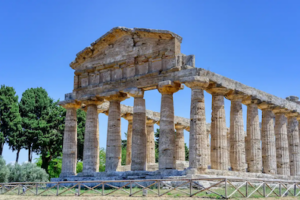
South of Salerno, Paestum widens the historical frame. Founded by Greek settlers as Poseidonia, the city subsequently passed through Lucanian and Roman phases. Its three great Doric temples survive within a much larger urban site. The columns are the obvious attraction, but the spaces between the monuments deserve attention too. Sanctuaries occupied the northern and southern parts of the city. Political and economic activities took place between them, while residential areas completed the urban plan. Walking through Paestum means moving through these different uses of space. The temples also provide a useful lesson in how archaeological interpretations change. The building traditionally called the Basilica was a temple associated with Hera, not the civic structure imagined by eighteenth-century scholars. The name Temple of Neptune is likewise conventional: its original dedication remains uncertain. The temple in the northern sanctuary is associated with Athena. Those distinctions make the visit more interesting than a sequence of architectural labels. They show how names can persist long after the explanations behind them have been revised. Beyond the sanctuaries, look for the Roman Forum and the residential remains. They help explain how later inhabitants adapted an existing city. Paestum’s history continued long after its most photographed temples were built.
Why the journey belongs in Naples too
The National Archaeological Museum of Naples, usually known as MANN, holds objects that once formed part of the places encountered on these visits. Seeing the excavations and the collections together helps reconnect a room with its decoration, or a public building with the person commemorated inside it. (3/4)
The Alexander Mosaic is a particularly striking example. It came from Pompeii’s House of the Faun and depicts Alexander the Great confronting Darius III of Persia. Its original setting was a grand reception space in a private house. Remembering that setting changes the question from how the mosaic was made to what its owner wanted visitors to see. Other mosaics depict fish, theatrical masks or birds drinking from a bowl. Their subjects bring the discussion back from rulers and battles to the choices people made about their surroundings. Rather than attempt every collection, follow a connection that interests you: decoration from Pompeian houses, for example, or the objects associated with a building you have already visited. Check the museum’s current room openings if a particular work is central to your plans.
Planning a trip with time to look
Pompeii, Herculaneum and the Naples museum make a coherent group, while Paestum deserves a separate day rather than a hurried addition. For the wider journey, Dolce Routes Campania guide brings together the region’s destinations, archaeological visits and suggested itineraries. Leave room between visits. After a morning among streets and houses, another extensive site can become a blur of walls. A museum visit on a different day gives the objects time to register; returning to the excavations afterwards may reveal details you previously passed without noticing. Carry the same question from place to place. Who paid for this building? How was this room used? Why did this object survive? Eumachia’s dedication, a wooden partition at Herculaneum and the changing names of Paestum’s temples offer very different answers. Together, they give a trip through Campania something more lasting than a list of monuments visited.
___________________________
Advertisement