All travelers to Rome – before going on to Florence, the cradle of the Renaissance, and thence to Venice and its streets of water:—the 21st century version of The Grand Tour—it would be wise to fit into the Italian sojourn an extra day or two to enjoy an overnight stay in a hilltop village that is enchanting and friendly beyond words.
Crowning a steep bank of a crater lake, a half hour by car to the southeast of Rome, Castel Gandolfo is a shy, elongated town of but a few streets that seem to begin from nowhere but all end in the charming main square, the Piazza della Liberta.
Famed in our time as the summer residence of the Popes, this peach-colored Papal retreat was known thirty centuries ago as Alba Longa, which claimed as its founder, Ascanius, son of the Trojan hero/refugee, Aeneas. Wreathed in legend from early on, this mountain settlement was destined to be the mother city of Rome.
__________________________
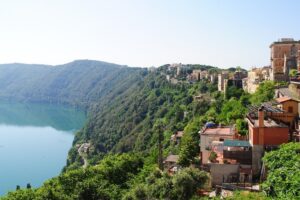
Castel Gandolfo and associated town/structures spreads in elongated fashion across the ridge overlooking Lake Alba, in the footprint of the ancient Alba Longa. Marek Mróz, CC BY 4.0, Wikimedia Commons
__________________________
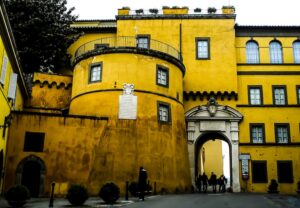
Castel Gandolfo. Heribert Pohl, CC BY-SA 2.0, Wikimedia Commons
__________________________
From Virgil and his epic poem, The Aeneid, we learn of the town’s origins and the reason for its peculiar name – Alba Longa. Latin for: The Long White (city). An oracle, the poet tells us, prophesied that Aeneas’ son would establish “a royal city of lasting fame, near the edge of a gentle flood.” and name it for the snow white sow and its thirty sucklings that he would come upon at his arrival there. Ascanius added the second word “Longa”, since the new city stretched in a lengthy narrow strip along the southwestern rim of the lake, to which he gave the name, Lacus Albanus (Lake Albano). All this took place in the twelfth century before Christ.
__________________________
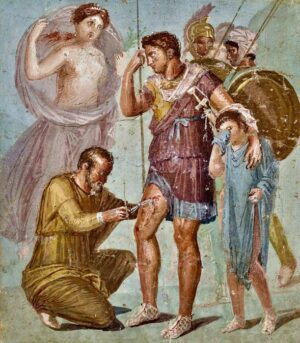
The boy Ascanius weeps and Venus hovers nearby as the physician Iapyx treats the wound of Aeneas (wall painting from Pompeii, 1st century AD). Marie-Lan Nguyen, Public Domain, Wikimedia Commons
__________________________
For the next four hundred years, Alba Longa served as the religious and political capital of the Latin Confederation, a loosely knit alliance of the region’s forty seven small city-states, linked by a common language, a primitive Latin. It was at the end of this span of time, according to a legend, that a descendant of Ascanius, a Vestal Virgin named Rhea Silvia, having been “visited” by the war god Mars, bore twin sons, Romulus and Remus. The former, Romulus, two decades later founded a modest colony of thatched huts on a hill called “Palatine”, near the banks of the Tiber river. Called Rome in honor of its founder and first king, this humble hamlet would, across the next thousand years or so, expand into a far-flung empire to which the whole world would pay homage. (Remus had intended to partner with his brother in building a new colony, but on the Aventine Hill instead. This resulted in a fierce quarrel and a breakup of their partnership.)
The third king, Tullus Hostilius, who – Roman lore informs us – reigned from 672-640 BC, waged a horrific war against the mother-city Alba Longa over rights to the fertile land that lay between the two states. The Roman troops demolished the Alban forces and devastated Alba Longa, sparing only the sacred temples. (One could consider this conflict to have been a civil war, since the descendants of the Albans were battling the then current Albans in their hilltop domain.)
Today many Classical scholars believe Alba Longa to have been nothing more than a myth, tying all Romans to a Trojan ancestry. Nonetheless, there are also those contemporary scholars who firmly believe in the actuality, the reality of ancient Alba Longa. Among the more prominent ones are Alexandre Grandazzi, Jacques Poucet, Stefania Quilici-Giglii, and Anna Pasquilini.
Grandazzi, a French prof and specialist of Archeology and Roman History, after years of extensive research, is convinced that Alba Longa was not mere fiction but rather an absolutely real city, citing ancient authors as well as archaeological and topographical evidence to support his claim.
Poucet examined closely the traditions that stemmed from an ancient, pre-Roman town and came to the conclusion that, like most legends, these also evolved from a kernel of truth, from a core of reality that over the ages was exaggerated and hyperbolized out of proportion by both the written word and by tradition. (I.e. word of mouth). Professor Poucet is the author of the highly acclaimed book, Les Origines de Rome.
Quilici Gigli, professor of Ancient Topography and Classical Studies at the University of Naples, did in situ research of the area around Lake Albano and came away insisting on the actual and factual existence of Alba Longa, and that it was indeed most likely the capital of Latin colonies throughout the old region of Latium (today’s Lazio).
Pasquilini put forth archeological evidence and cited the many other colleagues that cling to the belief in the real existence of Alba Longa, despite the admitted mythological aura surrounding it.
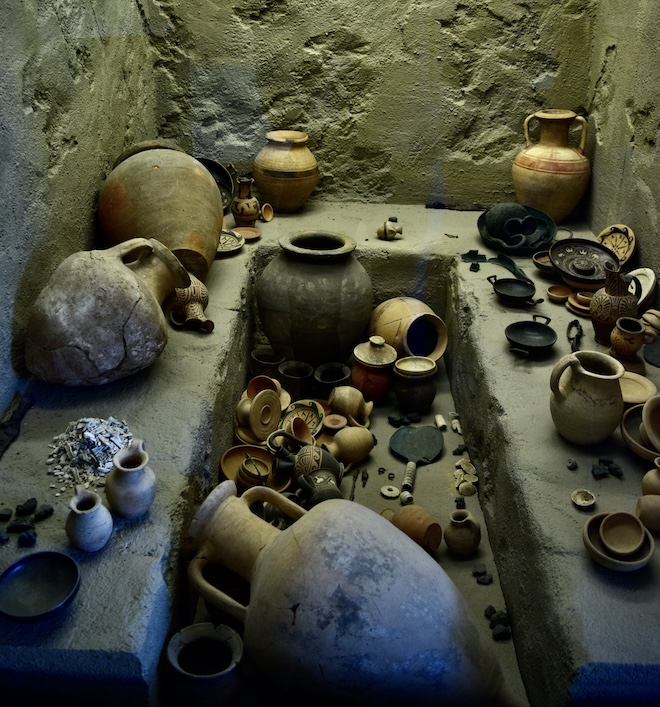
Then there is the Italian archaeologist Rodofo Lanciani (1845-1929), who discussed the sight where the city once stood. He also maintained that the town extended out in a long narrow strip “along the southwest ridge of Lake Albano.” As proof, he mentioned fossil graveyards in the region, along with the unearthing of many ancient, pre-Roman hut-shaped columbaria, containing funereal urns of ashes, on a road near the lake which was once a volcanic crater. The hut-shaped tombs, which he felt were probably likenesses of the type of housing in Alba Longa, Lanciani dated to four centuries before the legendary founding of Rome in 753 B.C.
Lanciani was persuaded by this, that Alba Longa had surely been a prominent thriving community and most likely the religious and political capital of the neighboring small city-states, and also the birthplace of Rhea’s twins who rebelled against their native town and took a multitude of fellow Albans with them to populate the new village they were planning, settling them on the Coelian Hill across the valley from the Palatine. Thus he considered the Albani immigrants to be the first true Romans
In addition to these modern Classicists, there were numerous Latin writers in antiquity who alluded to Alba Longa as a real place. Cato the Elder (234-149 B.C) in his history of Rome, “Origines,” suggested that Alba was a metropolis and mother city of the one founded by a native son, Romulus, whose lineage Cato traces all the way back to Aeneas, who established the city of Lavinium, named for and in honor of his wife, Lavinia, and to his son Ascanius, who built the city of Alba Longa in the twelfth century before the Christian era.
The great orator and writer, Cicero (105-43 B.C.), left us a written but unspoken defense of Titus Annius Milo, a prominent Roman politician and demagogue who served as a tribune for the plebians in 57 B.C. Milo was convicted of conspiracy in the assassination of Publius Clodius and driven into exile in the Gallic seaport of Massilia (today’s Marseille). Cicero accuses Clodius of destroying the shrines and sacred groves of the ancient city of Alba Longa. In his lengthy essay, De Republica, Cicero also refers to Alba as a strong and powerful city “for those times.”
………
The historian Livy (59 B.C. to A.D. 17), in his magnum opus “The History of Rome”, describes Alba as the “Mater Urbs” of Rome and tells of its location in the shadow of Mount Albanus:
His Ascanius fuerit certe natum Aenea…abundante Lavinii multitudine florentem iam erant opulentem urbem matri reliquit,novam ipse aliam sub Albano Monte condidit quae ab situ porrectae in dorso urbis Alba Longa appellata. Inter Laviniam et Albam coloniam deductam triginita ferme interfuere anni.
(This Ascaniuis was for sure the son of Aeneas. He left to his mother (Lavinia) the city of Lavinium which was a wealthy city with an overflowing population, and built another in the Alban Hills. It stretched out along the hillside and was called Alba Longa. Between the founding of Lavinium and that of Alba was a span of thirty years.)
Legends say that when Aeneas and his fellow refugees fled Troy and arrived by sea in Italy, a white sow leaped from the ship into the water and upon reaching land rumbled up the mountain and gave birth to thirty white sucklings, thus resulting in the naming of the mountain as Mons Albanus. For this reason, Ascanius came up with the name of Alba Longs, the Long White (City).
Also mentioning this city was the prolific biographer Plutarch. In his “Life of Romulus” he refers several times to “Alba”, a city he treats as a historical reality.
The poet Ovid writes about “illustrious Alba” and lists the Alban kings, starting, of course, with Ascanius. In his book Fasti, Ovid (43 B.C. – A.D. 17) tells the tale of a certain Alban this way:
Sed Proculus veniebat Iulius Alba, luna fulgebat nec facius usus erat..
“But Julius Proculus was coming from Alba. With the moon shining so bright a torch was of no use.”
Ovid also points out that the region of Latium (Lazio) and the city of Alba were given their names by Ascanius, “founder and first king of the city above the lake.”
The historian Dionysius (60-7 B.C) of Halicarnassus (modern day Bodrum in Turkey) made his way to Rome and spent the rest of his life there working on his book, “Roman Antiquities.” In the first volume he pens this line:
“After leaving Lavinium, Ascanius built a larger city, girded by lofty walls. This city he named, Alba”.
And the Roman author Dio Cassius (A.D. 165-235), in discussing the origins of Rome, also brings up the subject of Alba Longa and chronicles the royal families that ruled over it. He goes on to say that the Vestal Virgin, Rhea Silvia, came from there.
According to legend Romulus reigned over Rome for thirty-seven years, from 753 to 716 B.C. At his death he was apotheosized by his subjects and the Senate, and was thereafter worshiped as the god Quirinus. A temple was built and dedicated to him.
He was succeeded by the beloved pacifist Numa Pompilius whose long reign, 715 to 673 B.C., was devoted to the cause of peace and to the cults of Rome’s deities. He created the reverent sisterhood of the Vestal Virgins who conducted the sacred rites of Vesta, goddess of the hearth and home. His successor was the fiery king, Tullus Hostilius who wasted no time in living up to his name by waging war against the ctiy-state of Alba Longa (if later chroniclers are to be trusted). His powerful army leveled the capital of the Latin Confederation, sparing only its sacred temples. This conflict, one might say, was a civil war, with the Alban descendants of Rome’s army battling with the then current Alban people still living up in the hills, again over possession of the fertile campagna that lay between them. In the aftermath of the war Alba Longa faded into history (or into mythology, in the opinion of many modern scholars), Yet numerous Latin writers, as we have seen, sought to perpetuate the belief that the hilltop city indeed once existed.
The centuries, almost three millennia in fact, came and went, B.C. gave way to A.D., yet some of Rome’s later historians continued to write about the fabled city by the crater lake, especially when the tyrannical Emperor Domitian (A.D. 81-96), son of Emperor Vespasian and brother of the Emperor Titus, built over the venerable site a controversial sprawling (115 acres) sumptuous country vacation estate, to which he gave the name Villa Albana, overlooking the lake.
The highly respected writer Pliny the Younger saw the villa not as a peaceful retreat but as the headquarters of despotism, debauchery, and corruption, of reckless extravagance, of self-indulgence, of the shameful raiding of the state treasury while the lower classes of his subjects suffered – ill fed, ill housed, ill treated, ill governed. Pliny further characterized the luxurious villa of the paranoid ruthless ruler as a symbol of pure evil. Here Domitian made up his list of political enemies, scheduled them for execution, and then harassed their families. Here he even framed a Vestal Virgin, the chief priestess Cornelia, the mother-superior if you will, for violating her vows, and sentenced her to be buried alive. Pliny the Younger maintained that she was completely innocent. The same writer had his own titles for the property he disdained, calling it “The House of Terror,” and the “Arx Albana” (The Alban Fortress).
Pliny expresses disgust at the tyrant’s slothful behavior, at neglecting the affairs of state, at his whiling away hours each day practicing his archery, at his sadistic joy of snatching flies and stabbing them with a sharply honed stylus, at being illa immanissima belus (that monstrous beast), at Domitian’s suppression and banishment of philosophers, viewing them as hostile intellectuals and a threat to his absolute authority.
The satirist Juvenal (60 B.C. to A.D. 138) rants about Domitian’s persecution of Jews and Christians, of his frightening schizophrenia and fits of rage, of his sycophantic coterie of scared-to-death senators whom he considered his cabinet, often housing them at Villa Albana.
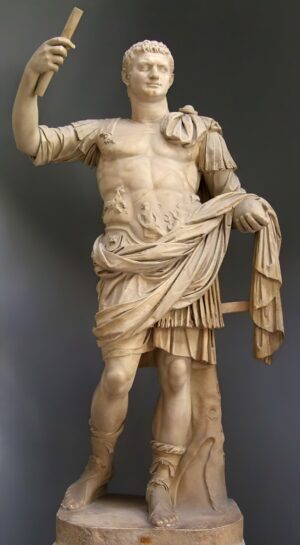
Statue of Domitian. Steerpike, CC BY-SA 3.0, Wikimedia Commons
The Roman historian Tacitus also weighs in on Domitian and his lofty village in the hills, on the site of the old, devastated town founded by Ascanius, also calling the property the “Alban Citadel” i.e. a stronghold whence Domitian plotted against his senatorial opporents, the aristocracy, and all others whom he perceived to be conspiring against him. An incurable paranoiac, he spent a considerable amount of time at Alba, where he felt more protected from his throng of foes than at the Imperial residence on the Palatine.
The biographer Suetonius also shows disdain for the beleaguered Domitian for seeing danger lurking everywhere, even up in Villa Albana. In Suetonius’ much acclaimed book, “The Lives of the Twelve Caesars,” the biographer says that it was there where the seething, insecure emperor hit on the novel idea of scorching his political enemies’ bodies to make them divulge “the whereabouts of other rebels still in hiding.” Domitian was not only cruel but short-tempered and depraved, the writer says.
The epigrammist Martial, however, parts company with Rome’s writing colony, composing very flattering verses about Domitian and his villa in Alba, often comparing him to the gods. He spoke reverently about the ruler as an avid patron of the arts, as a virtuous leader who governed in a kind and generous way, as the propagator of humanitarian deeds, as the vigorous defender of the Roman people. In private conversations Martial’s fellow authors spoke of his compliments for Domitian as self-serving and absurdly exaggerated. Martial also drew ridicule for his excessive praise for the villa up in Alba, calling it a majestic estate fit for the Roman divinities. He also expresses admiration for the elegant yachts on which the emperor would cruise up and down Lake Albano to while away the languid summer afternoons.
Professor and Classicist at Oxford, Robin Darwall Smith agrees with Martial and suggests that Domitian gets a “bad press” from most ancient writers, unfairly so, and sets about rehabilitating his political image.
……….
The tyrant would be appalled at what now occupies the site of his beloved “Albanum”, as he also called his hilltop hangout. In the twelfth century A.D., the whole area came into the ownership of the powerful Gandolfi family from Genoa. Otho Gandolfi, who then held the rank of senator in Rome, built a castle on the ruins of Villa Albana, along with small stone dwellings for the peasants who worked his surrounding fields, olive groves, and vineyards. The new town, which once again stretched in a narrow strip on the same site where Alba Longa once stood, took on the name of Castel Gandolfo, by which it is still known. The vast property afterwards passed into the hands of the wealthy and influential Savelli family and it was eventually sold to the Holy See. Pope Urban VIII in 1604, adopted the land as a Papal summer residence and had the architect Carlo Maderno design a palace to be raised over the remains of the castle.
A common spectacle in those High Renaissance times was a convoy of horse-drawn carriages swaying up the pine and poplar-lined mountain road, bringing red-robed Cardinals to conferences with their white-robed Pontiff.
Maderno’s Papal Villa was laid out on a beautiful tract of 120 acres, its lush gardens crossed by broad lanes lined with Ilex trees and curving graveled walks. He added a soothing sound track via the crystal murmur of many fountains. The palace itself was built around an immense rectangular courtyard which was to serve as an outdoor hall for audiences with the pope.
Huge throngs of pilgrims began to make the trek from Rome in order to see and be blessed by the Holy Father. This gave birth to a whole new local industry of inns, restaurants, and religious article shops. Suddenly, an active community once again stood on the location of old Alba Longa i.e. the southwestern hillside of Lake Albano. Aerial photographs show the town to be, mirabile dictu, a narrow community ala the original ancient “long white” city.
A church was now needed where the local faithful could worship. Also needed, was a town square where the inhabitants and visitors could gather for social life. Gian Lorenzo Bernini, whose architectural gems are to be seen all over Rome, tended to both needs, laying out a gracious, cobblestoned piazza, anchored on the north end, by the Papal Palace. Toward the other end he built the imposing Baroque church of San Tomasso, and punctuated the whole scene with a fine, central, perpetually flowing fountain.
During World War II, under orders from Pope Pius XII, the Papal Villa was put to use as a shelter for more than 15,000 Jews fleeing the Holocaust. On the night of February 10, 1944 the serenity of Castel Gandolfo was disrupted by blasts of bursting bombs from American planes. The bombardment was meant to be dropped on the nearby Nazi marshalling yards, where supplies kept pouring through for Hitler’s armies assaulting their way through southern Italy. Today all is serene again where the long, white city once stood.
How delightful it is to linger here awhile – to stroll the sunny Piazza della Liberta, to browse in the myriad little shops, to sit at outdoor tables under colorful umbrellas, to study the pastel tones of the sandstone buildings, to observe the handsome Swiss Guards in their red, yellow, and blue-striped uniforms, guarding the entrance to the Pontifical home. Then gaze from numerous vantage points – down at legendary Lake Albano, 500 feet below, its still waters reflecting the dark green of the surrounding hills and the warm blue of the sky. Small wonder is it that Ascaniius, the Roman Emperor, and the Popes of the last five centuries have all loved the area, its soft air and cooling breezes. Nota bene… do not forget to visit the Papal gardens which offer spectacular views of the ruins of Domitian’s lair.
__________________________
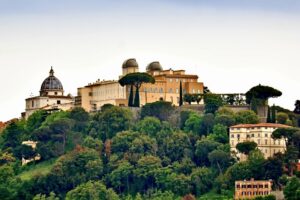
The pontifical palace in Catsel Gandolfo, with two domes of the Vatican Observatory on top. H. Raab, CC BY-SA 4.0, Wikimedia Commons
__________________________
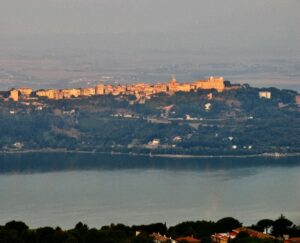
Sunrise view of Castel Gandolfo overlooking Lago di Albano. Sudika, CC BY-SA 3.0, Wikimedia Commons
__________________________
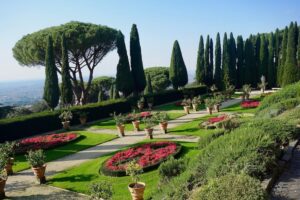
The Pontifical Gardens, Castel Gandolfo. Sonse, CC BY 2.0, Wikimedia Commons
__________________________
Cover Image, Top: Scene from early Roman myth. ArchaiOptix, CC BY-SA 4.0, Wikimedia Commons
__________________________
POPULAR ARCHAEOLOGY ON INSTAGRAM

__________________________