The moment I cross into the gallery, the eye meets a field in motion: color settling into paper while drifting outward, as lines gather and loosen at once, and the surface retains the afterlife of water as though it has only just withdrawn.
For a few seconds, I remain near the entrance.
The light is even, controlled, almost indifferent, and yet the paintings resist stillness within it. They register through duration, each image forming and releasing at once, and the instinct to take in an image gives way to something slower – a following, a tracing, a willingness to remain with what refuses to resolve into a single state.
I move forward.
Inside the galleries of the Penn Museum, the exhibit, Ancient Egypt in Watercolors: Paintings and Artifacts from Dra Abu el-Naga, unfolds through works created during excavations between 1921 and 1923 on the west bank of the Nile.
These paintings were created alongside excavations, as surfaces long enclosed emerged into open air and light again, with plaster revealing its separation and pigment already in gradual withdrawal.
They were painted on paper within that environment by Ahmed Yousef, working alongside the expedition led by Clarence Fisher.
“Before color photography, these paintings were essential records,” reflects University of Pennsylvania archaeologist and Egyptologist Josef Wegner. “They preserve details that are no longer visible today.”
In several cases, they now hold the only remaining record of scenes that have since disappeared entirely.
I read the line, then return to the paintings, and they begin to read differently.
What appears here belongs to what has already been lost.
___________________________

An overall view of the Penn Museum’s excavations at Coxe Expedition Dra el-Naga (Thebes) Egypt 1922-1923. “Through monies from the Coxe Fund, Clarence Fisher directed two seasons of work from 1921 to 1923 for the Museum. He concentrated mainly on the decorated tombs of Ramesside officials, but he worked as well in the Eighteenth Dynasty mortuary temple of Amenhotep I and his wife Ahmose-. Nefertari. Published in a preliminary report (see The Museum Journal, XV, 2, 28-49), the results of Fisher’s work still await full publication, although research on the excavation and the finds has continued over the years”. — From “The University Museum Expedition to Dra Abu El Naga.” Expedition Magazine 21, no. 2 (January, 1979): -. Accessed April 03, 2026. https://www.penn.museum/sites/expedition/the-university-museum-expedition-to-dra-abu-el-naga/
___________________________
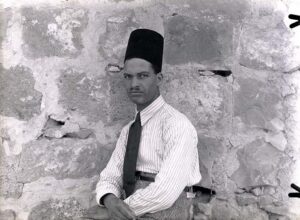
Egyptian artist Ahmed Yousef, whose century-old watercolor paintings of the interior wall decorations of the tomb excavations are now exhibited at the Penn Museum. Courtesy Penn Museum Archives
___________________________
Staying with the surface
I approach the first wall, shift slightly, step back, and then forward again, and with each change in position the images begin to respond, as distance, duration, and angle shape how they appear.
From afar, the compositions gather into order, as figures align within horizontal registers and gestures extend across the composition, forming sequences of offering and exchange.
Closer, that order gives way to variation.
A face dissolves into paper. An ornamental band continues, then disperses. A torso remains, while its lower half thins into the surrounding field.
The eye follows.
The actual tomb walls existed in this same condition: plaster lifting, pigment shifting, entire sections slipping away even as they came into view.
Watercolor meets this state directly, absorbing its instability and holding the image within that moment of change.
Scenes: offering, mourning, presence
Further along, the scenes separate into distinct registers.
In one, a group gathers around offerings, as figures unfold in sequence across the composition, with hands extending forward, objects presented, and bodies inclining toward one another, forming a cadence that feels ceremonial without excess.
Within that structure, interruptions appear.
A face softens into the surrounding space, and part of the offering table disperses into paper. The composition gathers through these breaks.
I move closer.
Brushwork becomes visible, strokes following the form while allowing pigment to settle unevenly. The image begins to read as contact.
A seated figure appears in another composition: posture composed, gesture contained, the arrangement settling into stillness while surrounding areas open into lighter tones.
Time lengthens here.
Nearby, a scene of mourning unfolds, as figures move in elongated gestures across the composition, and the arrangement develops into a sustained flow, allowing the action to extend beyond a single moment.
Even here, the image disperses slightly, as color thins and lines soften, and the composition remains coherent while becoming more permeable.
____________________________
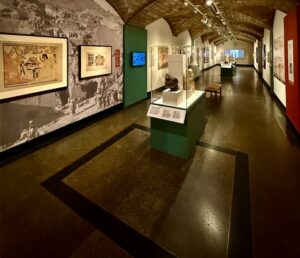
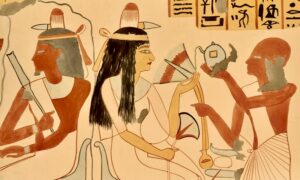
Above and below: Select views of the paintings and associated artifacts of the exhibit. “Last exhibited in Cairo during the 1920s, the watercolor paintings have been carefully preserved in the Penn Museum’s Archives for more than 100 years. They have never been on display in the United States. Ancient Egypt in Watercolors reveals the often under-appreciated, but critical function of art in archaeology. The 1,500 sq. ft. exhibition highlights elaborately decorated tomb chapels during the New Kingdom (approximately 1550 BCE-1070 BCE), a “golden age” that marked the height of Egypt’s power and wealth. Many affluent officials built their tombs at Dra Abu el-Naga—a key part of the larger Theban Necropolis. Their tomb paintings show scenes from everyday life and imagery depicting the journey to the netherworld—illuminating how much the ancient Egyptians valued family bonds, honoring their ancestors, and continuing one’s identity into the next life.
“The watercolors are copies of important tomb paintings of high officials and their families interred at Thebes and provide a rich record of the vitality of Egyptian funerary art of the New Kingdom,” says Penn Museum Egyptologist Dr. Josef Wegner, Lead Curator of Ancient Egypt in Watercolors. “Together with select artifacts on display for the first time, the exhibition reveals a society at the zenith of its power and creativity.” From Penn Museum press release, January 13, 2026. Photos by Anastasia Adeler
____________________________

____________________________
____________________________
____________________________

____________________________

____________________________

____________________________

____________________________
Meretseger, across states
I return to the paired depictions of the cobra-headed goddess Meretseger.
In the first, the figure comes into coherence, as the contour runs uninterrupted and color rests within its form, so that the structure reads as internally complete. In the second, that condition gives way to another. Sections open into paper. The line advances in intervals. Color disperses into a trace.
I move between them.
From one position, they stand apart. From another, they align.
Two conditions of the same image.
I stay longer than I expect.
Something in the way I look at them changes.
Excavation as presence
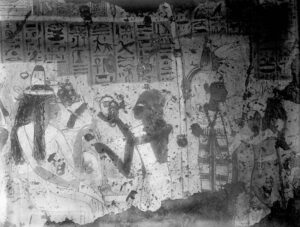
The exhibition opens into another layer through archival photographs, where walls appear in stages, fragments emerge, and figures move within the tomb, measuring, observing, recording as the space becomes visible.
With this, the paintings take on a different dimension.
Yousef worked inside these spaces, tracing painted surfaces as they came into view.
I imagine the conditions: uneven light, dust suspended in air, forms gradually appearing, and alongside that, the translation into watercolor takes shape, as a line shifts across the wall, proportion followed as it recedes, and color adjusts with light, with angle, with surface.
“These works are both copies and historical artifacts in their own right,” Wegner notes, “capturing a moment in the life of the tombs.”
Here, that moment becomes more precise.
___________________________
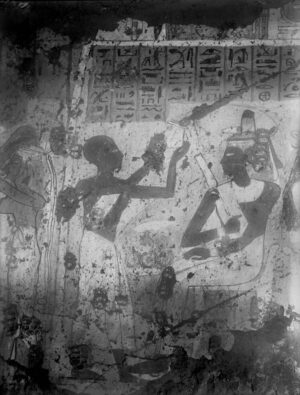
Above and below: As documented at the time of excavations, the Lower Cemetery, Tomb 36. Coxe Expedition Dra el-Naga, Thebes, Egypt 1922-1923. Courtesy Penn Museum Archives
___________________________
___________________________
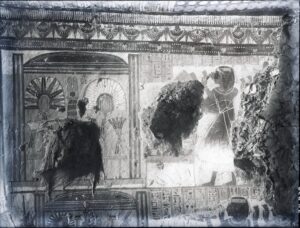
Tomb 286 shows original elaborate paintings and how they have encountered time-and-elements-related damage. Coxe Expedition Dra Abu el-Naga, Thebes, Egypt, 1922-1923. Courtesy Penn Museum Archives
___________________________
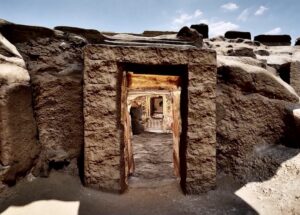
Above and below: Entering Tomb 286, Resting Place of the Scribe of the Table, Niay and his wife, Tabes. Photography and 3D models by David A. Anderson. Video screenshot. Courtesy Penn Museum
___________________________

___________________________
Water and stone
A dialogue takes shape between materials, as stone bears the weight of centuries, while pigment remains embedded within plaster, shaped by time and environment, and watercolor enters, where water moves through pigment and paper receives and releases.
The image passes into another condition.
What fades in stone appears again, differently.
From wall to paper, the same form appears under different conditions of time and material, and that difference becomes perceptible almost immediately.
The solidity of stone gives way to the fluidity of paper, and yet something persists across both.
Color
I move again toward areas where color gathers more densely, and as I remain with them, variation begins to emerge.
Reds deepen and ease outward, while blues anchor the composition before softening, and ochres move with a warmth that changes with attention.
Then the color opens.
At moments, it recedes enough for the paper to enter the image, so that perception moves between what remains defined and what begins to dissolve.
Hue itself begins to be interpreted as time.
Distance, proximity, return
At the center of the gallery, distance arranges what I see into order.
As I move closer, that order gives way to variation, and details come forward, while edges lose certainty and continuity reveals its internal fractures.
Stepping back again introduces another condition, where what has been seen up close remains active within the wider view.
Perception accumulates instead of resolving.
A different register
By the time I reach the final wall, the focus has already begun to change, and what first appeared as image begins to feel different – pigment, paper, and time coming together gradually, holding in place as I look.
I pause, and then move closer again, and with that movement the composition begins to reorganize, as each fragment holds its place while remaining in relation to the others, and each passage exists within its own span, so that the image no longer depends on completion to sustain itself.
What emerges here feels exact, as surfaces remain in transition and perception follows with greater precision, becoming capable of holding more than one state at once, while form extends across material, across time, across translation, and continues to exist through variation rather than reduction.
This is where the exhibition gains its force, as it refines perception and sharpens awareness, introducing a way of engaging in which variation stays visible and complexity retains its full presence.
I pause there a moment longer, and something comes into alignment – the image holds more than one state at once.
What stays is not the image alone, but the way it has been seen: active, precise, and open.
From that point on, form belongs to time.
__________________________
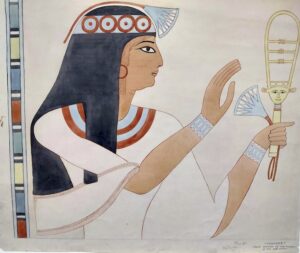
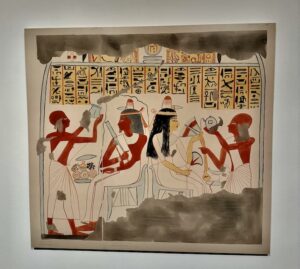
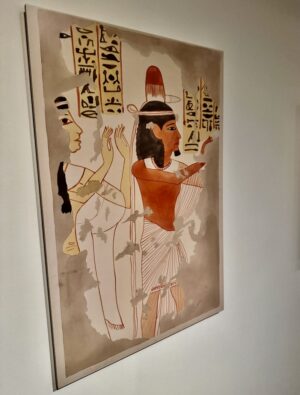
Above and below: Details of a selected sample of original water color paintings of the wall art as rendered by the artist, from inside the ancient Egyptian tombs. Images courtesy Penn Museum
__________________________
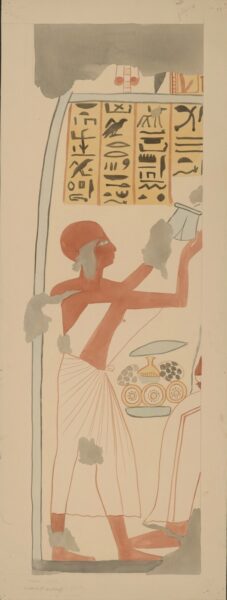
Cleaning a papyrus.
__________________________
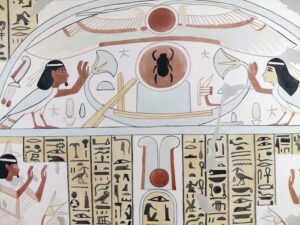
__________________________

The Theban Mountain
__________________________
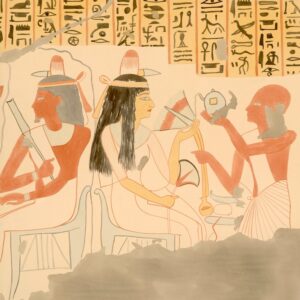
Doorkeeper of Amun(Temple), Irdjanen and his wife, Mutemipet, are shown being taken care of in the Afterlife.
__________________________
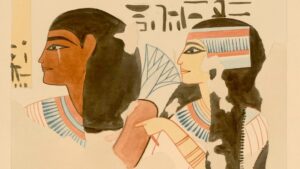
Husband and wife are together through eternity, as depicted in this painting inside Tomb 306.
__________________________
The Exhibit
Spotlighting century-old watercolor paintings by Egyptian artist Ahmed Yousef, Ancient Egypt in Watercolors: Paintings and Artifacts from Dra Abu el-Naga went on view at the Penn Museum starting February 28, 2026.
Ancient Egypt in Watercolors draws attention to one of the most important archaeological sites in Egypt excavated by the Penn Museum during the first half of the 20th century, as well as the prominence of the Museum’s Egyptian Collections of more than 50,000 artifacts—with nearly 3,000 objects from Dra Abu el-Naga. Of those, a selection of nearly 60 rarely-seen artifacts complement the paintings, including 3,500-year-old bread loaves, statuary of high officials and New Kingdom royalty, funerary stelae, shabti figurines (which ensured comfort for deceased individuals in the Afterlife), amulets, ostraca (informal notes), canopic jars, among others.
The eight-month exhibition will feature multimedia elements and two rotations of watercolor paintings: The first group will be on display through June while the second will be on view beginning July 1.
__________________________
Ancient Egypt in Watercolors will close in November—just ahead of the grand opening for the Penn Museum’s Egypt Galleries: Life and Afterlife on December 12, 2026. Following extensive conservation across nearly three decades, its centerpiece will be the 4,300-year-old Tomb Chapel of Kaipure—a high-ranking treasury official of Egypt’s Old Kingdom (ca. 2350 BCE). This architectural marvel, excavated more than a century ago at Saqqara, features a massive 5-ton “false door” with nearly 100 carved and painted limestone blocks. Visitors will be able to enter and move through the space to experience what it feels like to be inside an ancient tomb chapel.
Life and Afterlife represents the first phase of the Penn Museum’s bi-level, 14,000 sq. ft. Ancient Egypt and Nubia Galleries. The second phase is the Egypt and Nubia Galleries: Royalty and Religion—showcasing the monumental 3,000-year-old palace of Pharaoh Merenptah, whose towering 30-ft. columns will be displayed at their full height for the first time since their excavation more than 100 years ago. These galleries are scheduled for completion in 2029.
About the Penn Museum
The Penn Museum’s mission is to be a center for inquiry and the ongoing exploration of humanity for our University of Pennsylvania, regional, national, and global communities, following ethical standards and practices.
Through conducting research, stewarding collections, creating learning opportunities, sharing stories, and creating experiences that expand access to archaeology and anthropology, the Museum builds empathy and connections across diverse cultures
The Penn Museum is open Tuesday-Sunday, 10:00 am-5:00 pm. It is open until 8:00 pm on first Wednesdays of the month. The Café is open Tuesday-Thursday, 9:00 am-3:00 pm and Friday and Saturday, 10:00 am-3:00 pm. On Sundays, the Café is open 10:30 am-2:30 pm. For information, visit penn.museum, call 215.898.4000, or follow @PennMuseum on social media.
—Above edited text from the subject Penn Museum press release.
____________________________