Water is the silent force that has shaped civilizations. While grand monuments, temples, and palaces capture our imagination, the true lifeblood of societies often lies buried beneath our feet. Archaeological excavations across the globe have revealed that ancient cities were not only centers of politics, religion, and culture, but also marvels of engineering when it came to water management. Beneath the soil, crumbled ruins, and forgotten streets exist the arteries of history: aqueducts, sewers, cisterns, wells, and reservoirs.
Studying these hidden water systems has opened an entirely new dimension in archaeology. Far from being mundane infrastructure, they reveal how societies understood cleanliness, religion, public health, and even social hierarchy. Every excavation that uncovers ancient plumbing or water storage offers a window into daily life and the priorities of civilizations long gone.
From the advanced drainage of Mohenjo-Daro to the monumental aqueducts of Rome, and from sacred temple baths to ingenious underground cisterns, buried water systems remind us of the ingenuity of our ancestors. They challenge the assumption that technological sophistication is unique to modern societies and prove that human creativity in managing life’s essential resource is as old as civilization itself.
Urban Excavations – Discovering Water Systems in Mohenjo-Daro, Roman Cities, and Pompeii
One of the most remarkable aspects of archaeological water studies is how widespread and advanced these systems were across different civilizations, continents, and eras.
Mohenjo-Daro and the Indus Valley Civilization
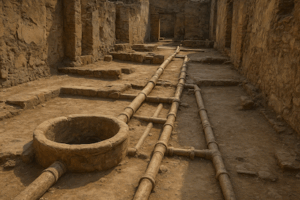
The Indus Valley Civilization, flourishing around 2500 BCE, is one of the earliest known urban cultures to showcase a sophisticated system of water management. Excavations at Mohenjo-Daro in present-day Pakistan revealed a city with meticulous planning. Streets were laid out in grid patterns, and alongside them ran covered drains that connected to larger sewage channels.
Each house often had its own private bathing area connected to these drains, suggesting that sanitation was not only a communal concern but also an individual right. Archaeologists uncovered brick-lined wells scattered throughout the city, demonstrating that access to water was carefully distributed. Unlike later civilizations where water distribution sometimes reflected social stratification, the Indus system hints at a surprisingly egalitarian urban planning philosophy.
The sheer scale of coordination needed to build and maintain such infrastructure indicates a highly organized civic administration. Mohenjo-Daro’s sewer system rivals some modern towns, proving that cleanliness and water accessibility were core values even 4,000 years ago.
___________________________

Mohenjo-Daro and the Indus Valley Civilization
___________________________
Rome: Aqueducts, Sewers, and Public Baths
The Roman Empire took water management to unprecedented heights. Rome itself was supplied by eleven aqueducts stretching across miles of countryside, carrying fresh water into the city through precisely engineered arches, tunnels, and channels. These aqueducts provided water not just for drinking, but for fountains, latrines, public baths, and even private homes of the wealthy.
The Cloaca Maxima, Rome’s grand sewer system, was initially constructed to drain marshland but later became a crucial channel for wastewater. It remains partially functional even today, a testament to Roman engineering. Excavations around the city reveal an impressive layering of infrastructure—sometimes new aqueducts and drains were built over older ones, creating a historical palimpsest of water technology.
Public baths, supplied by aqueducts and emptied through sewers, were central to Roman life. Archaeological digs at Pompeii and Herculaneum preserved bathhouses, fountains, and piping systems that show how integrated water was to urban leisure and social life. Water, therefore, was not just about survival but about status, culture, and identity.
__________________________

Rome Aqueducts, Sewers, and Public Bath
__________________________
Pompeii: Everyday Plumbing Frozen in Time
When Mount Vesuvius erupted in 79 CE, it buried Pompeii under volcanic ash, accidentally preserving an entire Roman city. Excavations there have revealed unparalleled details about household plumbing. Archaeologists discovered lead pipes (fistulae) supplying water directly into homes, sometimes adorned with inscriptions identifying the craftsman or the patron.
Pompeii’s fountains, street-side water taps, and elaborate bathhouses illustrate a society where water flowed into both public and private spaces with remarkable efficiency. However, the city also highlights disparities: while wealthier homes had direct water connections, poorer households depended on public fountains. This duality helps modern scholars understand how social class influenced access to resources.
________________________
Pompeii water system
________________________
Sacred & Ritual Uses – Plumbing in Temples, Baths, and Ceremonial Sites
Water is not only essential for life but also deeply symbolic. Archaeological discoveries show that ancient societies infused water systems with spiritual and ritual significance.
Mesopotamian and Egyptian Temples
In Mesopotamia, temple complexes often included sacred courtyards with channels designed to carry water for ritual purification. The association of water with divinity and cleansing was central to the region’s spiritual worldview. Similarly, Egyptian temples included sacred lakes where priests performed purification rituals before ceremonies. Excavations of temple ruins reveal carefully engineered basins and channels designed to hold and circulate water.
Greek and Roman Bathing as Ritual
Greek and Roman baths were not merely about hygiene—they were social, cultural, and sometimes spiritual experiences. Bathing involved a sequence of rooms with varying water temperatures, reflecting ideas of bodily purification. Archaeological remains of sanctuaries often include water systems designed for ritual cleansing, confirming that the line between practical plumbing and sacred symbolism was often blurred.
Hindu Stepwells and Ritual Bathing
In the Indian subcontinent, stepwells and bathing ghats show how water systems were intertwined with spirituality. Archaeological studies of sites like the Chand Baori stepwell reveal how architecture and water management combined to create both functional and sacred spaces. Ritual bathing in rivers, tanks, and temple wells highlights how access to water was considered essential for spiritual health.
Mesoamerican Ceremonial Water Systems
The Maya civilization constructed sophisticated water management systems, including underground reservoirs known as chultuns. Some of these were directly linked to sacred rituals. Archaeological findings suggest that water was not just stored but also sanctified, with offerings often deposited in reservoirs and cenotes (natural sinkholes). The famous Sacred Cenote at Chichen Itza contained artifacts and human remains, indicating its role as a ritual site.
Engineering Ingenuity – Tunnels, Cisterns, and Underground Reservoirs
The creativity of ancient engineers in channeling, storing, and preserving water continues to astonish archaeologists.
Qanats of Persia
One of the most ingenious systems is the qanat, developed in ancient Persia. These underground channels tapped into aquifers and gently sloped downhill, bringing water to the surface without pumps. Qanats extended for miles and were constructed with vertical shafts for ventilation and maintenance. Archaeological evidence shows they sustained cities, agriculture, and trade routes across arid landscapes for centuries.
Cisterns of Jerusalem and Istanbul
Excavations in Jerusalem reveal massive underground cisterns carved into bedrock, designed to store rainwater and supply the city during sieges. Similarly, the Byzantine city of Constantinople (modern-day Istanbul) boasted the monumental Basilica Cistern, supported by hundreds of stone columns. Built in the 6th century, this vast underground reservoir highlights how water engineering was essential to urban survival.
Nabatean Desert Mastery
The Nabateans, builders of Petra in Jordan, turned a desert into a thriving city through water ingenuity. Archaeologists have uncovered channels, dams, and cisterns that captured flash floods and redirected them into storage reservoirs. Their ability to control scarce water resources enabled them to flourish in one of the harshest environments on Earth.
Minoan Plumbing on Crete
On the island of Crete, the Minoan civilization constructed some of the earliest known pressurized water systems. Excavations at the Palace of Knossos revealed terracotta pipes capable of supplying water under pressure, allowing for fountains and flushing toilets. This combination of practicality and luxury shows that water engineering was central to their urban identity.
Preservation Issues – Protecting Delicate Water System Remains
While archaeological discoveries of water systems are breathtaking, they are also fragile. Protecting these remains is a constant challenge for archaeologists, conservators, and heritage organizations.
Natural Decay and Environmental Threats
Many ancient water systems were built of perishable materials such as wood, clay, or unbaked brick. Exposure to modern air, moisture, and pollution accelerates their decay once excavated. Underground structures such as cisterns are particularly vulnerable to collapse when not properly supported.
Urban Development Pressures
Modern urbanization often threatens archaeological sites. Expanding cities sometimes build directly over ancient remains, destroying valuable evidence. For instance, rapid development in regions of the Middle East and South Asia risks covering or damaging ancient water infrastructure before it can be studied.
Conservation Efforts
Archaeologists employ various methods to preserve delicate remains. Some sites are reburied after documentation to protect them from weathering, while others are reinforced and turned into public heritage attractions. Advances in 3D scanning and digital modeling allow researchers to record details without physically disturbing fragile structures. In cases where plumbing expertise is needed to understand water flow, collaborations with modern plomberie expert teams can bridge ancient techniques with contemporary knowledge.
How Buried Water Systems Redefine Our Understanding of Ancient Life
The study of buried water systems has redefined our perception of ancient civilizations. Far from being primitive, our ancestors displayed remarkable foresight, creativity, and technical skill in managing water.
The sewers of Mohenjo-Daro remind us that sanitation has been central to human well-being for millennia. The aqueducts of Rome showcase an empire’s ambition to harness natural resources on a monumental scale. The sacred reservoirs of the Maya and the ritual baths of Greece demonstrate water’s role beyond utility—as a medium of culture and spirituality.
Moreover, the ingenuity of ancient engineers in deserts, mountains, and islands proves that water management was often the key factor that allowed cities to rise, flourish, and endure. Today, these buried systems continue to influence modern urban planning, environmental sustainability, and even religious practices.
Preserving these fragile remains is not merely about saving stones and pipes—it is about protecting the legacy of human resilience and adaptation. As archaeologists continue to uncover hidden aqueducts, cisterns, and sewers beneath ancient cities, we are reminded that water is not only essential to survival but also deeply entwined with culture, faith, and identity.
In the end, what lies buried beneath tells us as much about humanity as what rises above. By studying ancient water systems, we do not just uncover plumbing—we rediscover the very foundations of civilization.