Da ogni coccio der Monte senti ancora la storia de
Testaccio de na vorta
(From every potsherd of the Hill you still hear the history of
Testaccio from long ago)
….Giuliano Malizia
Monte Testaccio, as it became known once Italian replaced Latin in the 1200’s, is not one of Rome’s fabled Seven Hills, even though it most assuredly is a hill, higher in fact than some of them. It is located in an area once enclosed by the very ancient Servian Wall.
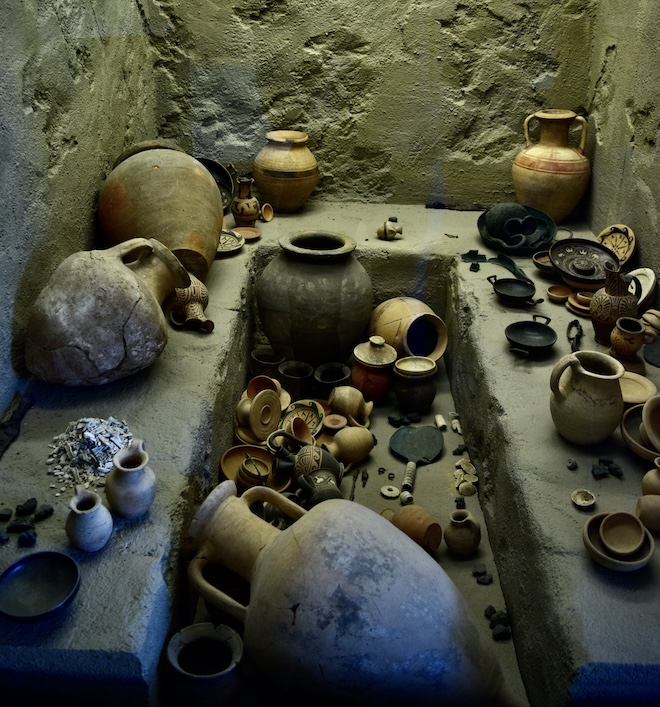
This elevation is unique, for it was created not by the hand of God but by the hands of men; not by Mother Nature but by Father Time. It is an artificial mini-mountain formed in the course of four or five centuries by heaps of broken earthenware vessels (amphorae), because of the site’s proximity to the wharves along the Tiber. These reddish-brown (terra cotta) jugs, sporting two handles, were quite large, often a meter tall with a capacity of 70 liters or more. Here in olden days were the unloading docks for provisions imported from the provinces and foreign lands, e.g. grain, fruit, and delicacies from Africa and the East; wine and olive oil from Spain and Gaul; linseed oil, salt, honey, and sauces from myriad other points on or near the Mediterranean. Almost everything of such nature arriving daily in the Capital – even dried vegetables – had been shipped in clay – or more precisely, in terra cotta (baked clay) containers rather than in tin or cardboard boxes or in wooden crates as in our modern era. Of course, some amphorae were broken during the shipping. And the porters of those days were no more careful than their modern counterparts. The harbor regulations required that all the fragments be thrown not into the river but into an empty field near its banks.
The imported goods would first reach the seaport of Ostia on the Tyrrhenian Sea and there be transferred from the large sailing vessels onto smaller craft for the last leg of the journey, up the river to the Statio Annona (the food pier) at the edge of the city. After the cargo was unloaded it would be carted to huge vats in the nearby horrea (warehouses) whose supervisors controlled the sorting out, the storage, and the distribution of grain, wine , olive oil and the rest of the imported goods. These contents – especially the liquids – would be then and there decanted into smaller, more portable jugs for retail purposes. After this, the longshoremen smashed even the intact empty amphorae and tossed the potsherds onto the steadily escalating pile. This was all done likely at the insistence of the waterfront commissioner who had officially designated the vast open field in back of the wharves as a dumping ground.
Evidently, amphorae and other such containers were so cheap and plentiful as to not be worth the effort of cleaning them and reshipping them empty. Furthermore, the wine, olive oil, and linseed oil would leave a residue that eventually turned rancid and impossible to clean, thereby rendering the massive jugs un-reusable. This was another reason for shattering them all with sledgehammers and discarding the jagged pieces onto the heap of shards.
This practice can be traced as far back as the second century before Christ. In 193 B.C. the censors, Lucius Emilius Lepidus and Lucius Emilius Paulus, ordered the construction of a new, state-of-the-art port with an enormous pier and unloading dock, 500 meters in length, which vastly improved the access to the river by means of several convenient staircases. This port was given the name Emporium, a term that English has adopted, meaning a trade mart. Ruins of this port can still be seen in the surrounding streets, the Via Bianca, Via Rubattino and Via Florio. The Emperor Trajan (A.D. 98-117) added several other fine structures which for the most part served the same functions. So then, one can say that it was between the second century B.C. and the second A.D. that the Monte Testaccio gradually took the size and shape we see in our time.
____________________________
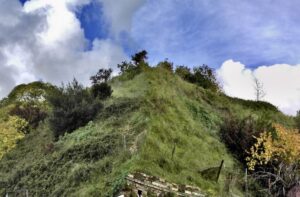
Monte Testaccio. Public Domain, Wikimedia Commons
____________________________

Tyler Bell, CC BY 2.0, Wikimedia Commons
____________________________
In antiquity, collectors, scavengers, and amateur archeologists exploring the hill would at times come upon shards with interesting information etched in or painted on them. From this information we can infer the extensive commerce between Rome and its provinces and other lands.
Epigraphs on some fortuitously flat pieces would still be legible, providing such info as contents, exporter, the province or country of origin, and even the year of shipping. This last would be indicated by one of two ways: A) The names of the incumbent co-consuls. Our republic is modeled on that of Rome, with some exceptions. In the United States the highest political office is the Presidency, with a single occupant and a four year term. The Roman version was the Consulship, held by two co-consuls, each with the power of veto over the other, for a one year term. Thus the year was indicated by a phrase such as “During the Consulship of Pompeius and Crassus” (which would have been 70 B.C. in our numerals.). Or: “During the Consulship of Piso and Glabrio” (67 B.C.) In the year 59 B.C., as we reckon time, the consuls were Julius Caesar and Calpurnius Bibulus. But Caesar so overshadowed his fellow commander-in-chief that wry Roman wits would refer to that year as “During the Consulship of Julius and Caesar.” Such a designation would be comparable to our: “During the Eisenhower administration” or “During the Carter term”. B) If one preferred to use numbers, he or she would express it: A.U.C..DCXX. (A.U.C. stood for Ab Urbe Condita (From the founding of the City) Tradition says that Romulus founded Rome in 753 B.C.; thus 620 years from that date would translate, for us, to 133 b.c.
By the first century A.D. a common daily scene down by the river was one of hefty Roman stevedores dragging bundles of potsherds up the uncertain, shifting slopes, since the summit was already too high for them to be tossed or flung up onto it.
In the reign of Hadrian (A.D. 117-138), the deposit had reached a height of 120 feet. A century later the homely rugged “crockery hill” had climbed to 165 feet, higher even than its neighbor, the beautiful, ultra chic Aventine, with its umbrella pine trees and cypresses, its ochre-shaded buildings, its romantic Park of the Orange Trees, its flower garden, the stately U.S. Embassy to the Holy See, and seven ancient churches.
As a result of the humble Mount Testaccio’s latest increase in elevation, prototypes of our modern cranes had to be invented to lift future disposals of shards into place on the hilltop. These terra cotta fragments were called testae, in Latin, eventually giving the hill its name; accio is an Italian pejorative suffix. For example libro=bookl, libraccio=an awful book. Ergo, testae=shards; testaccio=ugly shards. Modern archeologists estimate that the mount is made up of about 53,000,000 of these.
Around this time a clear path upward was made so that mule-drawn carts could also be used to convey loads of potsherds to the top where they would be spread out in a somewhat orderly fashion.
__________________________
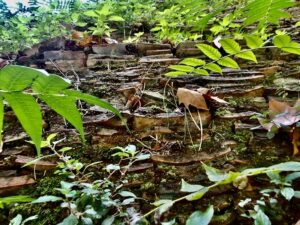
Layers of shards of amphoras settled at Testaccio hill in Rome. Flazaza, CC BY-SA 4.0, Wikimedia Commons
__________________________
The base of the hill was also expanding, reaching more than a kilometer (0.6 miles). The slopes of the hill were honeycombed with small caves, dug out by the ancient local gentry to provide cool storage space for their homemade wines. These caves were called grottini.
Rather surprisingly, there is little or no mention of the hill, or its name, by authors of the Renaissance era, with the possible exception of Cervantes – of “Don Quixote” fame – who in a later, short but charming novel has the protagonist rebutting his critics thus:
“What do you scamps want from me?
Annoying flies, filthy bedbugs, audacious flees?
Am I perhaps the Monte Testaccio of Rome
so that you feel free to hurl dirty, jagged
potsherds at me?”
Also contributing to the steady expansion of the hill was the fact that in this district of Rome there were numerous earthenware works which used the same rising dump-yard for discarding rejected materials. These factories’ products were apparently in demand throughout the Empire, for such items with potters’ stamps identical to those of materials produced here in the Capital, have fairly recently been unearthed in places such as Spain, France, England, and others.
Another factor? It would seem that a local ordinance required all citizens to take their no-longer wanted urns, jugs, and cooking pots to this same depository. Some scholars and historians of our day opine that Mount Testaccio also contains fragments of funereal urns from the long-ago demolished columbaria, which once lined the Via Ostiense, a short distance away.
__________________________
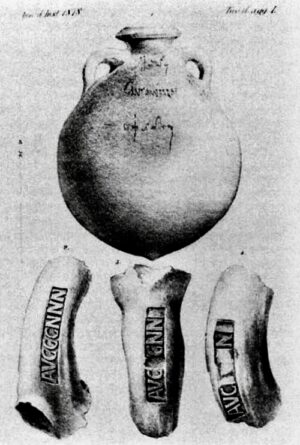
Roman tituli picti from amphorae found at Monte Testaccio, Rome. From H. Dressel, Ricerche sul Monte Testaccio, Annali dell’Instituto di Correspondenza Archeologica 1878, plate L. H. Dressel (1845—1920), Public Domain, Wikimedia Commons
__________________________
Another group of classicists suggests that also included in the vast collection are millions of stones from the considerable portion of the Esquiline Hill that was cut away to make level space for Trajan’s Forum. This part of the Esquiline, so they say, was also the source of much of the top soil laid over the many strata of shards, resulting in the growth of plant life, scattered here and there.
When one section of Mount Testaccio was observed by contemporary archaeologists to have an inordinate concentration of jug handles, it set them to speculating. The prevailing theory was that customs agents, on duty at the old docks, would knock off – with a wooden hammer – the two handles of an amphora to indicate that its contents were duty free. A marble slab found near the quays of the Tiber bears this ancient notice: “Quisquid usuarium invehitur ansarium non debet.” (Whatever is brought in of necessity – i.e. for the population – is not subject to the import levy. The metaphor for “levy” was ansarium,, from the same root as the word for jug handle … ansa.)
During the Middle Ages, those of Rome’s Christians who had made a pilgrimage to the Holy Land, saw in Monte Testaccio somewhat of a resemblance to Calvary and its Golgotha which inspired them to make it a setting for various religious observances. For instance, on Good Friday each year, the Pope himself would lead a solemn procession in a re-enactment of Christ’s agonizing walk on Jerusalem’s Via Dolorosa. This Stations of the Cross commemorative ritual would start out from the fourth-century church of Santa Maria in Cosmedin, just a few blocks away, and culminate in the placing of three large crosses atop Testaccio to simulate those of Christ and two thieves up on Golgotha, the dreary pockmarked mound just beyond the walls of Jerusalem. To this day, Testaccio remains surmounted by a tall iron cross as a reminder of Christ’s passion and death. Later in the Middle Ages the hill and surrounding grounds became a sort of public recreation site as well.
Throughout the pre-Lenten celebration of Carnevale annually, the area rang with the din of games, tournaments, contests, pageants, and picnics. Despite its homeliness, the Mount was dear to the artist colony of the Eternal City, above all to the French painter of the 1600’s, Nicola Poussin, known for his masterpieces: “The Rape of the Sabines” and “The Four Seasons.” It was the sweeping views out over the city that attracted the Frenchman and his confreres. This activity seems to have been the onset of the populating of the whole district, which took its name from the mini-mountain in its midst.
The modern quarter of Testaccio had arrived. Apartment buildings, with that peculiar burnt-orange color, began to sprout everywhere, shops opened for business, a magnificent church, with name Santa Maria Liberatrice, was erected to serve the fast growing population. In the 1800’s the Mattatoio (slaughterhouse) was built at the western base of Mount Testaccio. As a result of this facility, trattorias in the area, with their menus of steaks, chops, sweetbreads, and spicy meat-sauced pasta, began to draw eager patrons in droves. One of the choicest dishes back then was that which included the intestines, still full of milk, of newborn calves. The slaughterhouse has been abandoned for many years now, pre-empted by the construction of a super modern meat center on the outskirts of Rome. The closing of the Mattatoio completely canceled the industrial aspect of the Testaccio neighborhood, but the ristoranti and trattorie continued to multiply and attract mostly locals, for the district, until lately, was unknown and unpublicized and consequently overlooked by tourists. But word has been getting out, as guide books and magazines and newspapers increasingly and enthusiastically sing the praises of this mecca of bargain-priced tempting dishes of gnocchi bolognese, tortellini, tortelloni, canelloni, spaghetti alla carbonara or all’amatriciana etc. in this blue-collar part of Rome – gritty yet colorful; dense yet tranquil. Even the birds, especially in the area of the hill, seem to quiet their song.
There are three popular dining spots dug directly into the hill: Flavio al Velavevodetto, which has in the walls glass panels that allow diners to view the strata of terra cotta fragments; Checchino Dal 1887 with a wine cellar carved out of the layers of cocci; Ar Mont Testaccio, also located amid the shards deep inside this “hill of broken pottery”.
This enchanting little corner of Rome Eternal is bordered by the Tiber, Piazza dell’Emporio, Via Marmorata, the Gate of St. Paul, the Pyramid of Gaius Cestius, the avenue of Campo Boario, and the English Cemetery where repose the mortal remains of the poets Keats and Shelley, the artist Joseph Severn, and other luminaries of the English colony of the city. From the 1700s the Brits have been coming eagerly to Rome, their Baedeckers in hand, by the tens of thousands – some to visit, or some to stay.
From 1905 throughout the Twentieth century Testaccio was also popular with the local gentry and their guests for its open-air market, vending a myriad of wares, from fresh produce to the latest trendiest running footwear, and much in between. A few years ago, sadly, this large gem closed its stalls forever. But it was happily replaced by a brand-new attractive piazza ideal for strollers and sitters, and featuring lovely shade trees, comfortable benches, and a centerpiece splashing fountain with the name:…. La Fontana delle Anfore. (But of course.)
The Testaccini, as the locals refer to themselves, are warm and cordial and welcoming. One famous native Testaccino, the late Giovanni Malizia, mentioned and cited at the start of this essay, was an authority on the charms of Rome. He perhaps summed it all up most succinctly with verse,
In the Roman dialect:
“Da ogni coccio der Monte senti ancora la storia de Testaccio de na vorta…”
“From every potsherd of the Hill you still hear the history of Testaccio from back in the day…”
………………..
Note: One can visit the hill only in a guided tour, with a limit of 30 people, by calling the Turismo Roma office at 011-39-060608 or through their website. This should be done well in advance, for admission is extremely limited.
_____________________________