Hidden in the verdant hills of the Sierra Chapaneca in the beautiful state of Chiapas, in southern Mexico, is the ancient capital of the B’aak kingdom (b’aak = bone). For b’aak’s essence is the longest and most persistent proof of the seat of life, or identity through time, following the body’s soft tissues. The city’s ancient name is Lakamha’ in the Maya-Ch’ol language. Today, the town is called Santo Domingo de Palenque, 5.6 miles (9 km) from the ancient site; the Dominican Friar Pedro Lorenzo de la Nada named the town in 1567. The remains of impressive Maya temple-pyramids and palaces abound in Mesoamerica and amaze visitors with their monumental architecture. Few are as striking as Palenque. This UNESCO World Heritage site, set within a jungle-clad mountain range, is replete with springs, streams, and falls, overlooking the plains of Tabasco. It is also a site where recent discoveries, made possible by new technologies, help archaeologists write a new chapter of the ancient city’s history.
________________________
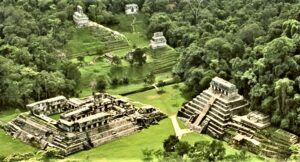
Central Palenque. @history.com
________________________
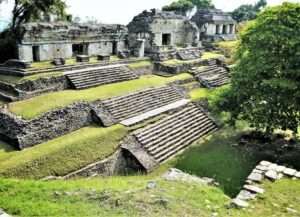
The 1998-2000 Palenque Mapping Project (PMP) under Mexico’s INAH-Instituto de Antropología e Historia (inah.gob.mx), and the Foundation for the Advancement of Mesoamerican Studies (famsi.org), recorded and mapped 1481 structures at Palenque. The PMP covered 0.850Mi2/2.2Km2 of the jungle-shrouded plateau. The area referred to as “Central Palenque,” open to visitors, accounts for about thirty buildings and structures. More remain shrouded in the dense tropical rainforest. During the Classic period, 250-950, the urban population may have peaked at 9,500 souls (Baluntè Phase, 750-850; Barnhart, 2001:94 years AD/CE). In the early morning, when nature awakes and the rainforest mist slowly lifts, the welcoming calls of howler monkeys and the songs of tropical birds greet visitors. As ancient times seem to dissolve into the present day, one wonders: who lived here?
_______________________
Palenque’s Palace. @georgefery.com
_______________________
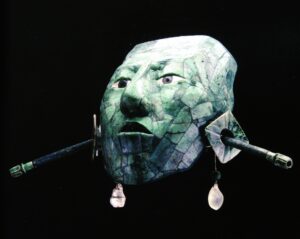
Palenque’s name means “stockade” in Spanish, a possible translation of the Maya-Ch’ol word otulún, for a fenced place. Its pre-Columbian name Lakamha’ translates as “big waters” and probably came from the 56 springs and nine small rivers that come out from the upper slopes of the Yemal K’uk’ Lakam Wiz, the “great mountain of the descending quetzal”, that overlooks the city. Water is a central theme in Maya and other cultures because it is seen as the mother of all life. The city has numerous springs and streams that fall through ravines and over great natural stair-steps, underlining its importance as a sacred place. From the end of the 5th to the mid-9th century, Lakamha was an important metropolis and a major regional player in politics, the arts, architecture, and trade. The 7th century saw the birth and death of one of the most significant mid-Classic Period Maya Lords, K’inich’ Janahab’ Pakal (603-683).
_______________________
K’inich’ Janahab’ Pakal, funerary mask. arqueologiamexicana.com
_______________________
His title, like that of lords before and after him, K’uhul B’aakal Ajaw, translates as “Sacred Lord of the B’aakal Kingdom,” which underlines the commanding secular-religious functions of Maya rulers. Pakal ruled for 68 years, from 615 to 683, making his reign one of the longest in Maya history. Pakal became king at 12, but his reign began on July 26, 615, when he was 23. During the interregnum, his mother, Sak K’uk’ Ahaw, governed as regent, not as lord of the realm. The reason she was not elevated to lordship may be because her husband, Kan Ix Mo’, Pakal’s father, was not from Palenque’s nobility, but from Ux Te’Kúh ’, as was his wife, Ix Tzak B’u Ahaw. The site was tentatively identified as El Retiro in Tabasco. El Retiro’s army helped protect Palenque’s kingdom’s western flank and the city where Pakal’s family took refuge when Palenque was burned twice in 599 and 611 by Calakmul proxies, the powerful K’an (serpent) kingdom of southwest Yucatán. Ix Tzak B’u Ahaw married Pakal in Palenque on March 26, 626, and had three sons: Kan Bahlam (635), Kan Joy Chitam (644), and Tiwohl Chan Mat (648). Ix Tzak B’u Ahaw died on November 13, 672. Her resting place is Temple XIII, referred to as the “Temple of the Red Queen” because of the large amount of cinnabar, a red pigment iron oxide, found in her sarcophagus.
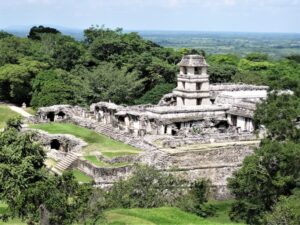
Palenque’s Palace, which is open to visitors, was the seat of power. Built on a massive, irregular quadrangle, it served as both a ceremonial and administrative building. Large stairways on four sides allowed access to the vaulted halls that ringed the quadrangle. The massive north stairway was ceremonial, while the south side was utilitarian. The whole complex consisted of a complex system of vaulted buildings, long halls, and three courtyards, along with underground rooms and corridors. All significant buildings in the city were covered with plaster and painted red, an impressive display of power to visitors, except for the throne room, the Sak Nuk Naah, or “White Main House”, today referred to as House E, which was then the only building painted white, synonymous with light and radiance.
In the middle of the Palace complex is a tower that, on its third floor, holds an altar built of limestone mixed with a large quantity of seashells from the Caribbean and the Pacific. The altar may have been dedicated to ceremonies linked to the Primordial Sea, a conjecture supported by marine fossils often found in the limestone of the mountain range.
On the Palace’s east side runs the Otolum River, its banks walled up as an aqueduct, a key part of the city’s essential and elaborate water management system. The man-made diversion of the Otolum’s waters to flow close to and parallel to the Palace’s east side allowed for water management, while the aqueduct reaffirmed the age-old control and domination of culture over nature. The palace served mainly as an administrative and ceremonial center for the ruler, nobles with bureaucratic roles, scribes, and high priests, as well as for formal state receptions of ambassadors and other important visitors.
The city’s history is tumultuous, with frequent wars and great and not-so-great ahau, or lords, at its head (ahau translates as “he of the powerful voice” and is gender neutral). Ix Yohl Ik’nal Ahau, daughter of K’inich Kan Bahlam 1st, was the only woman elevated to K’uhul B’aakal Ahau, or Sacred Lord of the B’aakal kingdom (her date of birth is unknown). Her reign (583–604) faced significant internal and external challenges. Regional antagonism grew from two enemies for different but complementary reasons. The first came from Tortuguero, a city in the northern plains of Tabasco, whose leaders claimed the title of K’uhul B’aakal Ahau. The title “ahau” holds significant spiritual connotations, and Palenque rightly claimed it as its historic right. A deep-seated enmity between Tortuguero and Palenque fed their antagonism for generations.
The second came from Calakmul, which fought Palenque through regional proxies over control of trade routes and the major Usumacinta River trade carrier. A Calakmul proxy, Toniná, was only 41 mi/66 km from Palenque, in today’s Ocosingo valley. Their hostility led to deadly wars that plagued Palenque until its collapse between 900 and 950. There may have been another reason for such lasting enmity with the K’an kingdom. Palenque traded and probably had political contacts with the mighty metropolis of central Mexico, Teotihuacán. This great city spread its influence far and wide, all the way south to Kaminal Juyú and Tikal in today’s Guatemala. Calakmul perceived Palenque as a Mexican proxy in the Maya heartland, which would explain such persistent and violent antagonism.
In 659, Pakal got his revenge against the K’an kingdom, as may be seen in the West Court of the Palace and House C. The six carved limestone monoliths show six sahals (government officials) taken in battles. They are shown bound and ready for execution, facing the carved steps across the courtyard. Glyphs on the steps recount Palenque’s defeat and burning twice, in 599 and 611.
________________________
Temple of the Inscriptions @georgefery.com
________________________
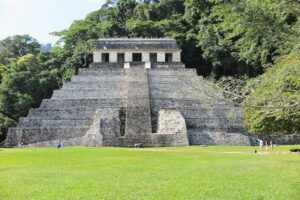
The Temple of the Inscriptions is Pakal’s final resting place and is considered the most remarkable sanctuary ever built in the Americas. Its name comes from three large hieroglyphic panels found on the walls of the sanctuary atop the pyramid. In the past, it was known as the “Temple of the Laws” because of the large limestone panels covered with 617 glyphs that narrate Pakal’s achievements and his place in eternity. The temple-pyramid had an exceptional “roof crest”, now lost to time. The temple also had a narrow man-made waterway running beneath its foundation, leading to an underground spring, perhaps the mythic gate to Xibalba, the underworld in Maya-K’ichè. In July 2016, a team from the National Institute of Anthropology and History (INAH) discovered a 3.3 ft/1 m square canal of dressed stones, believed to be 70ft/20 m long. Pakal’s sarcophagus was built directly over this underground canal that predates the construction of the crypt. Could the waterway be a structural feature that controls water flowing down from the hills behind the temple and channels water that would undermine the structure? Or is it a symbolic association with running water, the way chu’lel, the holy soul force of the universe, travels to the underworld? Further investigations will clarify this intriguing feature.
__________________________
Temple of the Inscriptions (Cutaway). @Philip Winton
__________________________
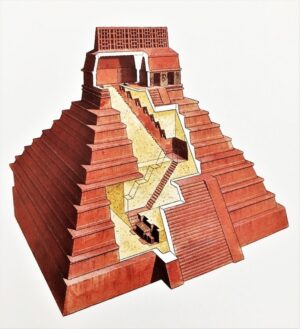
The crypt, now closed to the public for preservation, can only be accessed from the temple atop the pyramid. Cutaway drawings show the pyramid’s stairways from the temple at level nine down to the crypt, or Xibalba, the “place of fright”, the underworld. The “voyage” down the pyramid is integral to each step associated with death, the four cardinal points, and their symbolic colors in the Maya cross, the sacred Waqxaqib’B’atz calendar and colors: red/north, yellow/east, black/south, white/east, and its twenty angled corners with nawals, the spiritual energies or guardian spirits associated with each day in the 260-day Maya sacred calendar known as the Cholq’ij or Tzolk’in, believed to be the time of human gestation. In Maya beliefs, Pakal and his chu’lel’ spirit, or soul force, was first brought up the pyramid to the temple. After rituals and incantations, his body was carried down the three sets of stairs to the crypt, following the path of the Sun. At the threshold of the crypt, Pakal chu’lel transitioned from that of a divine king to a celestial ancestor.
__________________________
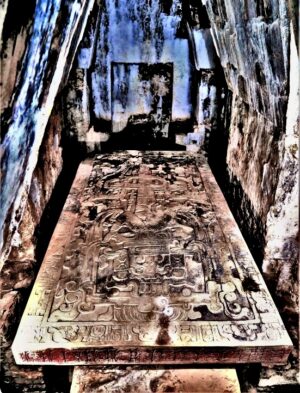
The Crypt @georgefery.com
__________________________
Pakal planned and designed the eight-level funerary pyramid, with the temple on top as the ninth level. The foundations were built, the sarcophagus was shaped, and its carved slab was ready about five years before Pakal died in 683. Then his son and heir, K’inich K’an Bahlam (635-702), completed the temple-pyramid and built a narrow stone conduit that fit each stair called the Tz’at Nakan, or “Serpent of the Wise Ones.” In 1949, renowned Mexican archaeologist Alberto Ruz Lhuillier (1906-1979) called it a psychoduct after discovering the stairwell and the crypt. The Tz’at Nakan, which espouses each step of the stairwell, connects the sarcophagus to the temple above, serving as the conduit through which Pakal and the priests were believed to communicate soul-to-soul. The feature also appears in similar structures, such as Temple XVIII and Temple XIII of the Red Queen, and suggests that the individual remained “socially alive” after death, with his/her life’s prerogatives being integral to the individual’s spiritual powers, thus affirming the inheritance of resources and the right to rule for descendants.
Nine life-size stucco figures are set on the walls of the crypt, then called the B’olon Eht Naah or “House of the Nine Companions.” Surrounding the sarcophagus are nine warriors – eight men and one woman – assumed to have been Pakal’s guardians. The woman is perhaps Ix Yohl Ik’nal Ahaw, daughter of Kan B’ahlam I, the only woman who ruled Palenque in her own right from 593 to 604. The companions’ task was to ward off malevolent forces when Pakal’s body was carried down the steps of the pyramid and into the crypt. The nine figures now stand guard for a god in eternity.
Five persons, the so-called “companions,” were sacrificed upon Pakal’s burial to attend and serve the soul’s ahau in the afterlife. This practice was customary among prominent individuals in ancient cultures of the Old and New Worlds. Researchers identified three of the “companions” as two males and one female in their late teens or early twenties (the other two could not be sexed because their remains had deteriorated). All were dismembered, and the remains were buried in a shallow stone cavity in front of the now-open massive limestone triangular door, which seals the entrance to the crypt in 690.
__________________________
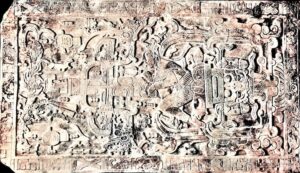
Pakal Tombstone @georgefery.com
__________________________
The sarcophagus’s 5-ton lid is unique in the New World archaeological record for its size and exquisite iconography. To understand the lid’s complex mythological significance, read it vertically from bottom (south) to top (north), not side to side as it is often shown. The crypt’s cramped quarters left no room for visitors, for it was intended that no one could ever see the sarcophagus and read its full imagery once the massive triangular door was sealed in 690. The message was there for its own sake to exist in the afterlife, never to be read by the living.
The iconography shows Pakal rising (not falling) from the depths of Xibalba, the “other” world, to be reborn as Hunal Ye, the Maize God, or an allegorical voyage from death to life. He is completing the journey on the sacbe, the “white road,” which began when his body left the Palace. His posture suggests he emerges from Xibalba, the underworld depicted at his back. At the same time, he looks up at Itzamna, the Great Cosmic Macaw (associated with the Milky Way, the Cosmic River). He is shown facing his destiny in the “other world” as a god heading north, away from the infernal east-west cycle of eternal return. Pakal is already half out of the mandibles of the mythological Sak B’aak Naah Chapat, the “White Bone Snake” whose mandibles were forced open by the gods, freeing him from the cycles of mortal life. He is reaching toward eternal life as Hunal Ye, the maize god, to ensure his people the sacred corn for their daily sustenance.
__________________________
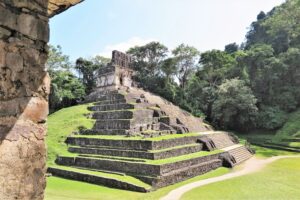
Temple of the Cross @georgefery.com
__________________________
At the heart of Palenque is the triadic Cross Group complex, made up of the Temple of the Cross-I, the Temple of the Foliated Cross-II, and the Temple of the Sun-III (detailed in a forthcoming article). The temples are accessible, but their sanctuaries are closed to the public to preserve them. The view of central Palenque from atop the Temple of the Cross is spectacular. The group is collectively referred to as Palenque’s Divine Triad, for the tripartite conception of the kingdom’s world space: I-transmission of power from ancestors and deities; II-control of the dual productive-destructive powers of nature for daily sustenance; and III-royal military power to defend and expand the kingdom.
Each temple is home to a god that Johan Henrich Berlin named God I, God II, and God III in 1963. They are the preeminent patron gods of Palenque, and the only place in the Maya world where they appear together. Maya mythology recounts their birth in K’an-Hub-Matawil, a few days apart. This birthplace is believed to be where existence, time, and space began. In each temple, there is a large, finely carved limestone panel that relates the story of Pakal’s son, K’inich’ K’an Bahlam’, and his accession to the throne in 684. He is shown transferring lordship powers to himself, witnessed by K’awiil (God K), the manikin scepter of royal power, together with a representation of his deceased father, along with dedications to the gods of the Divine Triad.
Palenque’s ballcourt size seems insignificant compared to those of other Classic Period cities and is centrally located on the Palace’s north side. It is among the smallest known, measuring 72 feet (22 meters) long by 33 feet (10 meters) wide. However, archaeologists indicate that, as in other ballcourts, they found no stone rings, though wooden markers may have existed, which are now lost to time. Ballcourts were among the most essential structures in Mesoamerica. In Peruvian cultures, circular arenas served similar purposes to those in Mesoamerica: ritual ceremonies, communal assemblies, or secular games. In Mesoamerica, they are generally I-shaped, with a central playing alley flanked by two parallel, sloping or vertical stone walls, with open or enclosed endzones. Stone platforms rose along the sides of the playing arena to accommodate large crowds of onlookers, priests, and nobility.
The Great Ball Court at Chichen Itza is the largest in Mesoamerica, measuring 545 feet (166 meters) long and 225 feet (69 meters) wide, with high vertical walls and two carved round stone rings depicting entwined serpents. Their diameters range from 33 to 39 inches (85 to 99 centimeters), with a slightly larger center hole to fit the rubber ball used in the game; they are placed midway on each wall, facing each other, and are about 23 feet (7 meters) above ground. Appearances may be deceiving, but size does not necessarily reflect a lesser function. In Palenque, the ball court is exceptional given the city’s secular and religious importance and its large population at the time. But what significance did ballcourts play in the lives of ancient Maya or other Mesoamerican polities? Ballcourts are among the most notable structures in Mesoamerican and other cultures for both ritual and secular games.
In the Maya sacred book, the Popol Vuh, we learn that the gods fashioned man’s substance from maize dough, which was also his daily sustenance. This duality underlines the traditional perception of two simultaneous worlds, visible and hidden at the core of traditional beliefs, mythology, rituals, and daily living in the Americas and beyond. The critical feature of Maya and other ancient Mesoamerican cities was the ballcourt, known as Tlaltchli in Nahuatl. Palenque, with one court, is not unique, and more courts may still lie in parts of the city still hidden under its tropical jungle canopy. Most ancient cities, however, had two or more ballcourts, such as El Tajín, which had 21, and Cantona, 27. Most cultures used games for both secular and ritual purposes; in Mesoamerica, they underlined the need to maintain peace and balance within and between polities, as well as between this world and the “other.” Essential to ritual games, and to a certain extent to secular games as well, was the need to keep in check latent antagonisms between factions within the same polity, as well as between polities, their respective policies, and beliefs. Games were the last peaceful attempt before resorting to conflict or war. Ballcourts, therefore, were primarily social instruments in the use and projection of power, whether secular or ritual. Secular games served the same communal and cultural purposes as those in our world today; they also helped maintain political balance of power within and between polities, as well as local social peace.
__________________________
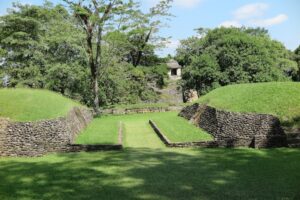
The Ball Court @georgefery.com
__________________________
In the North Group, a stucco frieze found at the base of the sub-structure in Temple V is evidence of contact with central Mexico. It shows a warrior whose adornments and dress leave no doubt about Early Period contact with Teotihuacán. Carved in relief, it depicts a goggled-eye warrior armed with a dart thrower, or atlatl, in his left hand. He is clearly Mexican and relates to Tlaloc, the Toltec god of rain, thunder, and war, probably of Teotihuacán origin. The Mexican warrior leaves no doubt about Palenque’s association with Tikal and, beyond that, with Teotihuacan, which was the reason for Calakmul’s persistent antagonism through its regional proxies such as Tonina, 63 miles (100 km) away from Palenque, for control of the economic watershed of the Usumacinta River basin and its affluents.
__________________________
The North Group. @georgefery.com
__________________________
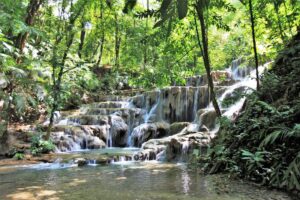
Palenque’s tropical environment provided abundant water and forest products, from fruit trees to soft and hard woods. Watered fields in the plains at the bottom of the mountain allowed for two crops of maize and other produce. Cacao trees were planted in private and shared gardens throughout the city, and still grow in the ruins today. Wildlife was plentiful, including jaguars, wild turkeys, monkeys, forest deer, and scarlet macaws. This exceptionally luxurious environment enhances the site’s elegance, and its multiple falls and pools offer a beautiful experience at the end of a day’s visit to this great Maya metropolis.
_________________________
The Queen’s Baths @georgefery.com
_________________________
References
Martin, N. Grube, 2000 – Chronicle of the Maya Kings and Queens
Julia Guernsey, 2006 – Ritual & Power in Stone
David & George Stuart, 2008 – Palenque, Eternal City of the Maya
David Stuart, 2011 – The Order of Days
Asociación Maya Uk’Ux’Be, 2009
- Cosmovisión Mayab’
- Historia Mayab’ Prácticas Mayas Antiguas
- de Garza, G. Bernal Romero, M. Cuevas García, 2012 – Palenque-Lakamha, Presencia Inmortal del Pasado Indígena
- Freidel, L. Schele, J. Parker, 1993 – Maya Cosmos
Linda Schele, Peter Mathews, 1998 – The Code of Kings
Geoffrey Braswell et al., 2003 – The Maya and Teotihuacan
Arthur Demarest, 2004 – Ancient Maya, Rise and Fall
- Eric Thompson, 1970 – Maya History and Religion
William L. Fash, 2001 – Scribes, Warriors and Kings
Michael D. Coe, 1992 – Breaking the Maya Code
Sylvanus Morley, George Brainerd, 1956 – The Ancient Maya
Cover Image, Top: Ferfive, CC BY 4.0, Wikimedia Commons
_____________________________