Dawn A. Saliba, as she looks on at Ggantija in the background.
 The island country of Malta, about 113 miles south of Sicily in the central Mediterranean Sea, is popularly known as a tourist hotspot, attracting both short-term travelers and an expanding expatriate community because of its warm climate and numerous recreational areas. It also boasts a long and complex history and prehistory, including seven iconic prehistoric sanctuaries built between 3800 BC and 2500 BC. They are numbered among the oldest freestanding stone structures on Earth. Older than both Stonehenge and the Egyptian Pyramids, these UNESCO World Heritage Sites showcase an extraordinary architectural feat achieved by a Neolithic civilization working entirely without metal tools.
But behind the story of these priceless treasures is another story—one that speaks of endangerment, destruction and cultural loss.
Popular Archaeology interviewed Dawn Adrienne Saliba, Ph.D., an archaeologist based in Malta. Along with her academic work, she is known as an activist, championing the cause for protecting and preserving the current remains of Malta’s prehistoric heritage, and those yet to be unearthed.
What follows is the substance of that interview.
__________________________
What is your background and education as it relates to what you are currently doing? You have extensively studied the Hal Saflieni Hypogeum on Malta. How do you interpret the significance, purpose and use of this ancient site? What other archaeological matters are you involved with in Malta?
My background is very multi-disciplinary, yet it all revolves around a central theme: theatre. I have a Ph.D. from SUNY Binghamton where I utilized a cultural-historicist approach to Early Modern Drama, but I also have an MFA in musical theatre writing obtained at New York University’s Tisch School of the Arts—and most of my adult life was spent writing, directing, and performing for the stage. However, I recently completed an MPhil in Archaeology from the University of Malta, which concentrates on evidence of liminality and proto-theatricality from Malta’s Late Neolithic civilization.
It happened like this: In 2013, as I was finishing up the Ph.D., I took a trip to Malta just to meet family and explore the region. When I visited the Hypogeum of Ħal Saflieni (as a tourist), my heart stopped as I beheld one chamber which seemed clearly purposefully-shaped as a theatre. After the tour, I researched the academic literature to see what had been written about it in terms of its performative dimensions, and no one had really tackled the subject: so I vowed to move to Malta and study it myself!
Nearly a decade later, my study is complete—it was an incredible journey. Essentially, the study shows how Ħal Saflieni is one of the world’s earliest extant purposefully-built theatre spaces. It precedes the Theatre of Dionysius (often cited as the world’s earliest theatre) by millennia, and the Hypogeum deserves its own place in the annals of theatre history.
Heritage Malta granted me permission to conduct phenomenological studies within the space, through a process I call “performance fieldwork.” Inspired by David Lewis-Williams’ work in Paleolithic caves, I utilized a multi-evidential stranding methodology that synthesized empirical observations of the area’s architectonic dimensions (spatial measurements, participant-access points, sightlines, soundwave distribution, etc.) with phenomenological study. Drawing on my theatrical background and working with a team of academic colleagues also experienced in performance (music, dance, acting, and recitation), we performed in various sections of the Hypogeum, also recording our observations and experiences as participants and observers. This enabled us to draw conclusions as to how the Hypogeum’s architecture likely affected past performative movements and audience reception.
However, what consumes most of my work today is, unfortunately, advocating against the destruction of several archaeological sites here in Malta, some of which are quite important.
My advocacy started one month after I moved to the country in 2017, when I found out that a site that had held the foundations of one of Malta’s earliest Roman buildings was going to be destroyed for a car showroom. Aghast, I founded the collective, MALTA-ARCH along with some like-minded colleagues and passionate activists and fought for the area’s protection. We only succeeded in saving a fraction of it; although they abandoned the showroom idea, they created a raised building that preserves some of the Roman remains below. But, tragically, many other nearby remains were destroyed to build a supermarket right next to another supermarket in a small town that, at the time, possessed 17 other supermarkets.
And that’s how it goes in Malta.
Sadly, since then the situation has just gotten progressively worse. Today, there are *three development proposals within the buffer zone of the UNESCO heritage site, Ġgantija Temple—one of Malta’s most iconic cultural treasures, as well as one of the most important Neolithic sites in the world! Ġgantija is situated on a plateau near two other areas: the Santa Verna Temple and the Xagħra Circle hypogeum. Recent developments near these sites have already destroyed important archaeological landscapes, and more are in the pipeline.
______________________________

Above and below: Views of the Hal Saflieni hypogeum. Above Public Domain
______________________________

Credit: Hamelin de Guettelet, CC BY-SA 3.0, Wikimedia Commons
______________________________
What is the significance of the Ġgantija, Xagħra Circle, and Santa Verna megalithic complexes? What do they say about the ancient culture that once thrived on Gozo?
As I stated, Ġgantija is one of the most important archaeological sites in the world; it’s been protected by UNESCO since1980. As UNESCO writes, the site is important because of its “originality, complexity and striking massive proportions [and the] considerable technical skill required in their construction.”
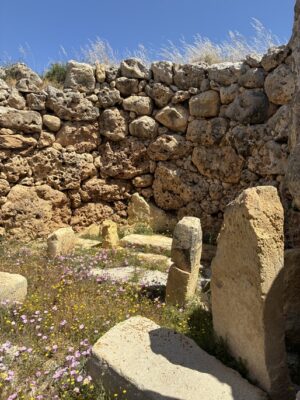
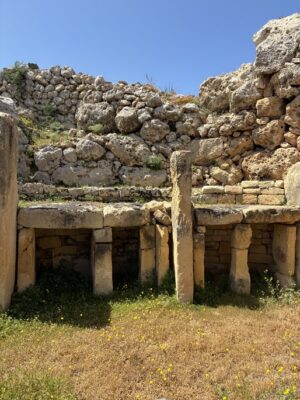
Ġgantija was built on a massive scale, with enormous megaliths nearly 10ft (3m) tall and walls extending up to 23ft (7m). It is of stunning beauty and reveals some of the world’s earliest free-standing monumental stone architecture, famously predating Stonehenge and the Egyptian pyramids by at least a millennium (the earliest temple was built somewhere between 3800 – 3600 BCE). Its massive megaliths testify to the extraordinary complex society of Neolithic Malta, revealing a community that was able to mobilize architects, artisans, and laborers in the creation of a communal and, quite likely, sacred ritual space that was linked to a larger network of communities across the islands of both Gozo and Malta that shared a similar culture.
Similar to other temples on Malta’s main island, Ġgantija was situated within a larger monumental landscape that was utilized for over a thousand years. Near Ġgantija are two other coeval structures: the Santa Verna Temple and the Xagħra Circle hypogeum, both of which have also yielded revelatory information.
The Xagħra Circle hypogeum, especially, was a game-changer in providing new information regarding this prehistoric society. Although most of its main monuments were destroyed in the 19th century, many of the burials were excavated in the 1990s, providing us with the first comprehensive scientific examination of such a Neolithic area in Malta. This study revealed previously unknown elements of funerary ritual, including the disarticulation and sorting of bones, the staining of bones with red ochre, and the movement of bones across the site.
The least famous and protected of the megalithic complexes, Santa Verna, is nonetheless just as important. GPR surveys and excavations from the 2014 FRAGSUS study reveal it once had been a 5-apse structure (likely temple) with unique features, including a hidden pit-like structure made of polygonal stone tiles and a mosaic cobblestone path. But the real value is in the landscape around it. Lead Archaeologist Caroline Malone emphasizes that Santa Verna’s archaeology extends far beyond the megaliths; untouched paleosols are still extant, preserving ancient soils, bones, seeds, pottery, lithics, and environmental material. The site’s landscape (which we’re fighting to protect) is still relatively undeveloped and it also provides a means for the visitor to have valuable phenomenological experiences that give windows into the prehistoric past.
____________________________
Above and below: Ggantija. Above, credit Bs0u10e01, CC BY-SA 4.0, Wikimedia Commons
____________________________
____________________________
____________________________
What are the specific issues related to Ġgantija, Xagħra Circle, and Santa Verna in terms of conservation and preservation?
The entire plateau, where all three sites are located, is being threatened. Worse—structures within Ġgantija’s protected buffer zone are being approved or considered for development: Ġgantija Heights, a 22-apartment development directly east of the temple that the Gozo Regional Council warned would cause “permanent harm” and another 27-apartment complex with an underground parking garage just west of the temple and steps away from the Xagħra Circle.
Even worse, there is a development being planned over a recently discovered extension of the Circle, which has not received any significant protection, despite its classification as a “Class A site.” Indeed, the only protection the human remains were given was simply a tarp thrown over them held in place by some rocks six years ago—no signs or fences were ever installed. Now, the tarp is weathered and torn and the human remains may have disappeared. Absolutely disgraceful.
Then there is the ongoing issue of Ta’ Lablab, a few minutes’ walk from Santa Verna. This area had a beautiful cave system situated right near a Ġgantija-Phase burial pit that had contained human remains, including a line of seven skulls, mostly children’s, interred in a unique way, shedding new light on funerary ritual. However, this pit was partially destroyed by a bulldozer and the entire site would have been destroyed had it not been for the efforts of a local resident who alerted the police, press, and took the matter to court. We also launched extensive awareness-raising events and objection campaigns about this area, resulting in the temporary salvation of 1/3 of the site—however, not the area with the burial pit of caves. At the moment, the caves are already partially demolished and developers are still trying to acquire permission to develop upon the remaining third.
What are the implications for the rest of the cultural treasures/resources on Malta and Gozo as a result of the Santa Verna and Ggantija stories?
Nothing here is fully protected. Forces of corruption, cronyism, ignorance, and greed are already destroying some of our most environmentally and archaeologically precious areas.
What would you suggest as a solution or set of solutions for addressing culturally significant sites across Malta and Gozo?
The current Maltese government is intent on dismantling our cultural-heritage protective mechanisms, so, sadly, no help can be found there, though massive protests and court cases led by NGOs do sometimes succeed. But for every one site that gets rescued, it seems a dozen more are destroyed.
There is almost no hope with this current government—in the case of Ta’ Lablab we have almost exhausted every outlet: the courtroom, objection-letter campaigns, Planning Authority presentations, the Environment and Protection Review Tribunal, the national Ombudsman, Parliamentary petitions—all agencies have been bent to serve the will of an authoritative leader who governs unilaterally—despite massive violations of existing cultural heritage protection laws and massive, incessant protests by NGOs and private citizens.
The government simply does not care.
And when a nation-state goes rogue, violating its own laws and conventions, where is there accountability?
What is needed now is efficacious international pressure: a coordinated network of archaeologists, heritage lawyers, UNESCO and ICOMOS officials, European cultural-heritage bodies, investigative journalists, and civil-society organizations capable of documenting violations, publicizing them internationally, and forcing not just Malta, but all regions to answer for violations of cultural-heritage treaties and agreements they have signed, including the Valletta Convention. UNESCO, especially, needs to step in.
The archaeology community can help, because international scholars can do what local citizens often cannot: lend authority, visibility, and pressure to demand that Malta’s prehistoric landscapes be treated not as disposable real estate, but as something that belongs to the history of the entire world.
What are your future plans/goals for your work and mission as they relate to the cultural treasures of Malta and Gozo?
I would very much like to not have to spend all of my time advocating for the protection of sites that should never have been threatened in the first place.
I believe there are potentially future exciting and important implications to my phenomenological performance experimentation in other archaeological sites here in Malta and elsewhere. Archaeologists sometimes miss the human dimension as the pendulum has shifted towards exclusively publishing empirical data. There’s nothing wrong with that, but it isn’t the complete picture—and incorporating phenomenological performance experimentation is just one more multidisciplinary approach that can also illuminate the past.
However, since the likelihood is that these fights aren’t going to end any time soon, my main objective is to use the arts as a means of empowering protest and community-building. In the past five years, we have held four protests that bring together not only politicians and NGO representatives, but also poets, musicians, dancers, film, and visual artists. I am a firm believer in the power of the arts to instigate personal and societal change. When common (or uncommon, as the case may be) citizens use destruction as a means towards creation, it is an act of empowerment—and even if we cannot save our precious sites, we can at least document their erasure and bring to life something new.
_____________________________
POPULAR ARCHAEOLOGY ON INSTAGRAM

______________________