An archive written around a missing voice
In Ankara, Rome wrote itself into Galatia in two imperial languages. On the walls of the Temple of Augustus and Rome, the Res Gestae survives in Latin and Greek: the emperor’s own account of his deeds copied onto stone in the provincial capital. It is one of the great accidents of textual survival. The original inscription in Rome disappeared; the Anatolian copy endured.
Now place that monumental abundance beside the older language of the country around it.
Celtic-speaking people had been living in central Anatolia since the third century BC. Their descendants were not a footnote passing through someone else’s landscape. They became part of the political geography of the region, associated especially with Ancyra, Pessinus and Tavium; they fought, ruled, traded, served Rome, used Greek, became Christians, and left names that still look recognizably Celtic. Late Antique writers could still speak of a Galatian language centuries after the migration.
And yet there is no Galatian equivalent of the Monumentum Ancyranum. No native paragraph. No legal text. No letter home. No securely preserved continuous sentence that lets us hear an ordinary speaker arrange words in Galatian.
That absence is not a void where anything can be imagined. It is an archaeological problem.
Reconstructing Galatia therefore requires an unusual discipline: build outward from places, objects, names, inscriptions and ancient testimony, but never allow a strong reconstruction to impersonate a surviving text. The question is not whether the Galatians existed or whether their speech was Celtic. The question is what kind of history can be recovered when a people survive much better in archaeology than their language survives in writing.
Three centers, not a Celtic island
The Galatian migration into Anatolia belongs to the turmoil of the early Hellenistic world. Celtic-speaking groups moved through the Balkans and crossed into Asia Minor around 278–277 BC. Ancient accounts connect their entry with the Bithynian king Nicomedes I and the military politics of the region. Over time, three principal Galatian groupings become conventional in the sources: the Tectosages, Tolistobogii and Trocmi.
It is tempting to imagine them arriving as an intact European culture and preserving themselves in an Anatolian enclosure. The landscape refuses that picture.
Ancyra—modern Ankara—had a history before the Galatians and a much larger one after them. Pessinus was a major sanctuary and market centre associated with the Mother of the Gods. Tavium in the east occupied another long-lived Anatolian site. Gordion, already ancient when the Celts arrived, remained part of the regional network. Archaeological surveys around Ancyra and other central Anatolian sites have identified fortifications, settlement patterns and Hellenistic material that help put Galatian political life back onto the ground.
Even Strabo’s geography, written in the Roman period, is more useful when read as a political landscape than as an ethnic map. He associates the Tectosages with Ancyra, the Tolistobogii with territory toward Bithynia and Phrygia, and the Trocmi farther east. Modern scholarship often summarizes the mature regional pattern as Tectosages–Ancyra, Tolistobogii–Pessinus, Trocmi–Tavium. But these centres were never sealed ethnic laboratories. They were places where older Anatolian traditions, Hellenistic power, Galatian institutions and eventually Roman provincial administration accumulated.
That accumulation is the point. Galatian language survival does not require cultural isolation. If anything, the archaeology makes isolation the least interesting explanation.
_____________________________
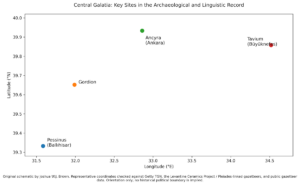
Figure 1 — Central Galatia: Key Sites in the Archaeological and Linguistic Record. Credit: Original schematic prepared for this article by Joshua W.J. Brown. No third-party base map or copyrighted cartographic artwork is reproduced. Representative point data were checked against Getty TGN for Pessinus; the Levantine Ceramics Project / Pleiades-linked records for Gordion and Tavium; and public gazetteer data for Ankara/Ancyra. The figure is explicitly a site-orientation schematic and does not claim a historical political boundary.
Rights/permission: Original figure; author-controlled publication use. Underlying gazetteer facts are cited as data sources rather than reproduced cartographic works.
_____________________________
Archaeology first
For a vanished language, archaeology cannot tell us what a verb sounded like. It can do something just as important: tell us what kind of world the speakers inhabited.
Around Ancyra, research on Hellenistic and Roman-period settlement has treated forts not as disconnected ruins but as a system embedded in topography and routes. Pessinus gives us a religious and commercial centre whose importance reaches far beyond a single ethnic community. Tavium, surveyed around modern Büyüknefes, preserves another eastern node in the Galatian landscape. Gordion complicates the story again because a famous Phrygian centre did not cease to exist when a new population arrived.
The material picture is therefore one of reuse, layering and contact. That matters linguistically. A language spoken in this environment would have lived beside Greek for centuries and inside changing political institutions. It could lose functions without losing speakers. Greek might dominate inscription, administration, long-distance commerce, public cult or Christian theology while Galatian remained useful in kinship, locality, work, memory or ordinary speech.
We cannot prove those exact domains. The evidence is too thin. But the archaeological setting makes one assumption untenable: that Greek public visibility means Galatian private extinction.
This is where the Monumentum Ancyranum becomes more than a Roman monument. It is almost a diagram of archival inequality. The city gives us Augustus in two written languages at monumental scale. The language Jerome later says the Galatians still possessed survives mostly as names recorded in other people’s alphabets. The stones do not tell us everything that was being spoken around them.
Names are linguistic artifacts
What survives of Galatian is overwhelmingly fragmentary: personal names, tribal names, place names, divine names, glosses, forms carried through Greek and Latin writers, and external statements about the language. That sounds meagre until we ask what a name can actually preserve.
A personal name can carry recurring Celtic elements. A Greek spelling can preserve how a foreign sound was heard or approximated. A compound can show productive word formation. A cluster of related forms can be tested against Gaulish and reconstructed Common Celtic. Names such as Deiotaros and Brogimaros are not decorative evidence. They are linguistic artefacts.
Brogimaros is especially useful because it illustrates the layered archive. A name identified as Celtic appears in the Greek part of an inscriptional environment where Phrygian and Greek also coexist. The object does not give us a Galatian sentence. It gives us a Galatian name operating inside multilingual Anatolia. That is historically richer than pretending that only one language could belong to one site.
The famous political term Drunemeton, transmitted by Strabo for the Galatian council meeting-place, works similarly. Its second element is recognizably Celtic *nemeton*, a sacred place or grove; the whole name has long been read in Celtic terms. Again, the value is not that one word miraculously reconstructs a constitution in Galatian. The value is that a Celtic lexical fossil survives inside a Greek geographical account of a political institution.
Joseph F. Eska’s phrase “salvage grammar” is exact because the work is not free invention. It is extraction under damage. The corpus has to be treated like an excavated site: provenance first, association second, reconstruction after that.
Jerome’s line across Europe
The strongest late checkpoint arrives not from archaeology but from a scholar writing in AD 387.
Jerome, commenting on Paul’s Letter to the Galatians, remarks that the Galatians used Greek like the rest of the East but also had “a language of their own, almost the same as the Treveri.” The Treveri were associated with the region around Trier on the Moselle.
The comparison is startling because it puts two places beside one another that had no business sounding alike after six centuries of separate history. By Jerome’s lifetime, Galatia had passed through Hellenistic kingdoms, Roman provincial government and Christianization. Ancyra was not a Celtic refuge outside the imperial world. Yet Jerome still distinguishes a local language from Greek and compares it with speech far to the west.
The safe reading is also the strongest one. Jerome does not prove that every person in Galatia still spoke Galatian. He does not give population figures, a grammar, a recording, a dialect map or one native sentence. Nor should “almost the same as the Treveri” be modernized into a claim that fourth-century Galatian was simply unchanged Gaulish. Jerome himself allows that languages change under contact and across regions.
What he gives us is narrower: a late-fourth-century witness who understands the Galatians to have a language of their own in addition to Greek, and who hears—or knows of—a meaningful similarity with the speech of Trier.
That is enough to destroy the neat replacement story. Greek could become overwhelmingly visible without instantly erasing every other language spoken under it.
The sixth-century temptation
A later source offers the most seductive extension of the chronology. Cyril of Scythopolis, writing in the sixth century, tells a hagiographic story involving a man from Galatia named Procopius who speaks *Galatisti*—“in Galatian.” Read straightforwardly, the word carries Galatian speech into the age of Justinian.
It is also exactly the kind of evidence that should make a reconstruction slow down.
The passage is hagiography, not linguistic documentation. It supplies no specimen of the speech. Scholars have cautioned that the isolated reference may not be strong enough to bear an uncomplicated claim of an eight-century continuous language tradition all by itself. The appropriate response is not to delete the source or worship it. It is to weight it.
Jerome is a strong checkpoint because he explicitly contrasts Greek with the Galatians’ own language and gives a western comparison. Cyril is a later but more fragile checkpoint because the language label occurs inside a literary episode without linguistic material. Both belong in the record; they do not belong in the same confidence column.
That distinction is the method in miniature.
Reconstruction needs provenance
Suppose we decide to “rebuild Galatian.” The first few steps are legitimate and exciting. We assemble the names. We collect every spelling variant. We compare them with Gaulish and other Celtic evidence. We reconstruct probable sound correspondences. Then the blanks begin.
We need a pronoun that is not preserved. A verb ending. A standard spelling. A word for an object no Galatian source names. Comparative Celtic can often offer a plausible answer. Soon there is a clean paradigm and a complete sentence. The language looks recovered.
It may also have crossed, invisibly, from archaeology into design.
The solution is not to prohibit reconstruction. It is to label it. My own working model uses four provenance classes. A is directly attested Galatian material. B is material analytically recoverable from attested Galatian evidence: a segmented name element, for example. C is comparative reconstruction—forms predicted from Gaulish, Proto-Celtic and regular historical relationships but not themselves attested in Galatian. N is a deliberate modern creation or standardization required if people want to build a usable Neo-Galatian.
A transparent revival can contain all four. What it cannot do is print them in the same evidentiary costume and then call the result ancient.
This is where archaeology offers a useful ethic to historical linguistics. An archaeologist records context because an object without context can become almost anything. A language reconstruction needs the same discipline. Every word should be able to answer: Where did you come from? What is actually attested? What has been inferred? What has been borrowed comparatively? What did we create because the ancient record went silent?
That is not pedantry. It is what allows ambitious reconstruction without counterfeit certainty.
_________________________
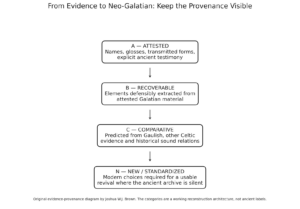
Figure 2 — From Evidence to Neo-Galatian: Keep the Provenance Visible. Credit: Original evidence-provenance diagram by Joshua W.J. Brown. The A/B/C/N architecture distinguishes directly attested material, analytically recoverable material, comparative reconstruction, and modern creation/standardization. The categories are a working reconstruction architecture developed for the Galatian project; they are not ancient labels and are not presented as a quotation from another author.
Rights/permission: Original figure; author-controlled publication use.
_________________________
The language the archive did not deserve to keep
Galatian presents a severe version of a familiar historical problem. Institutions preserve what institutions use.
Greek had schools, administration, inscriptions, literature, theology and scripture. Latin had government, law and imperial power. Those languages generated durable archives. A minority spoken language could remain alive in domains that produced little stone or manuscript evidence and still become almost acoustically invisible after its speakers disappeared.
The surviving record therefore creates a false soundscape. We hear Greek stone. We hear Latin rule. We hear Christian manuscripts. Galatian enters mostly as names inside Greek or Latin writing and as remarks made by outsiders.
That does not mean the language was socially marginal every moment it existed. It means archival visibility and historical existence are different variables.
The archaeology of central Anatolia makes that distinction tangible. Ancyra, Pessinus, Tavium, Gordion and the surrounding settlements show a landscape where political and cultural identities were layered rather than sequentially erased. Jerome gives us a late witness that the linguistic landscape was layered too. Cyril may extend it. The onomastic corpus gives us fragments from which Celtic ancestry and structure can be tested. None of those sources alone is enough. Together they make a recoverable history.
But the most responsible reconstruction ends with blanks.
We cannot ask a fourth-century Galatian what language he used with his mother, whether his children answered in Greek, how he cursed when a tool broke, or what a joke sounded like in Ancyra. We cannot recover a continuous native paragraph by force of will.
What we can recover is the architecture of the problem: a Celtic language transplanted into Anatolia, reshaped inside a multilingual world, still recognizable many centuries later, then preserved so unevenly that its existence outlived its sentences.
The silence at the end is not a failure of the project.
It is part of the evidence.
__________________________
EDITORIAL SOURCE NOTE
• Strabo, Geography 12.5.1–3, for the Galatian tribal-political geography, Ancyra, Pessinus, Tavium and the Galatian council tradition.
• Jerome, Commentary on Galatians, Book II (on Gal. 2:3), composed in the late fourth century, for the contrast between Greek and a Galatian language compared with that of the Treveri.
• Joseph F. Eska, “A salvage grammar of Galatian,” Zeitschrift für celtische Philologie 60.1 (2013): 51–64.
• Philip Freeman, The Galatian Language: A Comprehensive Survey of the Language of the Ancient Celts in Greco-Roman Asia Minor (Edwin Mellen Press, 2001).
• Stephen Mitchell, Anatolia: Land, Men, and Gods in Asia Minor, Vol. I: The Celts in Anatolia and the Impact of Roman Rule (Oxford University Press, 1993).
• Derya Ulusoy, Archaeology of the Galatians at Ancyra from the Hellenistic Period through the Roman Era (Middle East Technical University, 2006), for settlement/fort-system synthesis around Ancyra.
• Karl Strobel, “Galatia and Pisidia,” in A Companion to the Archaeology of the Roman Empire (2024), for the Roman-period regional centres and provincial urban framework.
• Wojciech Sowa, “Linguistic and Cross-Cultural Relations in and around Galatia (3rd Century BC–3rd Century AD),” in Galatian Victories and Other Studies into the Agency and Identity of the Galatians in the Hellenistic and Early Roman Periods.
• David Stifter, Old Celtic linguistic materials and discussion of the late Galatian testimony, including the caution required around Cyril of Scythopolis.
________________________
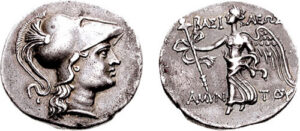
Cover Image, Top: AR tetradrachm of king Amyntas of Galatia, 36-25 BC. Public Domain, Wikimedia Commons
________________________
Advertisement