American Association for the Advancement of Science (AAAS)—Hunter-gatherers in southern Africa laced their stone arrow tips with poison roughly 60,000 years ago, a new study finds. The discovery pushes back the timeline for poison weapon use – a cognitively complex hunting strategy – from the mid-Holocene to the Late Pleistocene. Hunting with poison was a gamechanger for hunter-gatherers, making it easier to kill prey animals. The emergence of the practice also represents a defining moment in the human journey; People had to keep a mental encyclopedia of poisonous plants they could use, and they also had to anticipate animals’ behavior as they slowly weakened. Until now, the earliest evidence for poison weapons dated to the mid-Holocene. Here, Sven Isaksson and colleagues have uncovered traces of plant-based poison on 5 of 10 quartz arrow tips in Umhlatuzana Rock Shelter in KwaZulu-Natal, South Africa. The tips came from a stratigraphic layer dated to 60,000 years ago. Analysis revealed alkaloid residue (buphandrine and epibuphanisine) from indigenous members of the Amaryllidaceae family of flowering plants. Hunter-gatherers most likely made this poison from the milky bulb extract of Boophone disticha (locally called poison bulb), Isaksson et al. suggest, because records from the 1700s refer to the plant’s use in historic arrow poisons. Notably, this poison does not work immediately; Late Pleistocene hunter-gatherers must have understood its delayed effects and used that knowledge to enhance their persistence hunting. “Because poison is not a physical force, but functions chemically, the hunters must also have relied on advanced planning, abstraction and causal reasoning,” the authors write.
__________________________

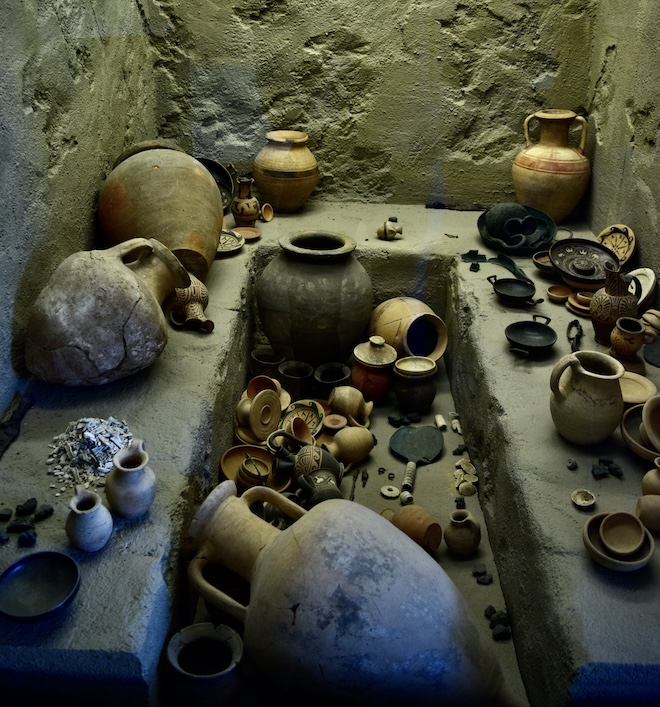
Umhlatuzana Rock Shelter backed microlith. Credit Isaksson et al., Sci. Adv. 12, eadz3281
__________________________
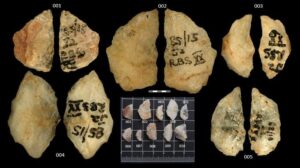
Closeup of the five quartz backed microliths from Umhlatuzana Rock Shelter with buphandrin, epibuphanisine alkaloid toxins (001-005 [artefact numbers = sample numbers] scale = 5 mm). The inset shows all ten archaeological artefacts analysed, all curated at the KwaZulu-Natal Museum in Pietermaritzburg. Credit Isaksson et al., Sci. Adv. 12, eadz3281
Article Source: AAAS news release.
*Direct Evidence for Poison Use on Microlithic Arrowheads in Southern Africa at 60 000 years ago, Science Advances, 7-Jan-2026. www.science.org/doi/10.1126/sciadv.adz3281