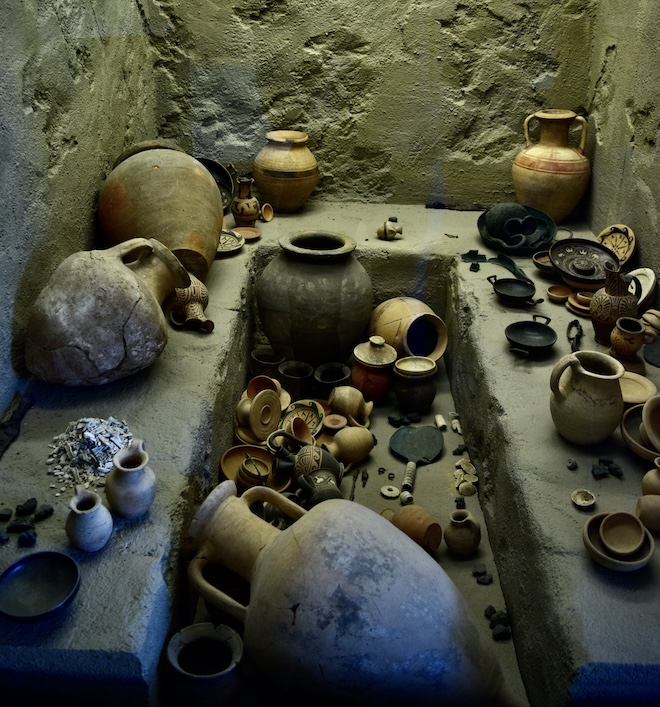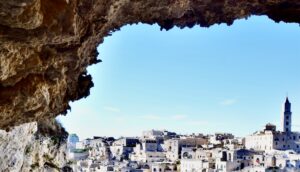
The Italian word, ‘sassi’, takes on double meaning as one walks through this place. By definition it means ‘stones’. Here, in this ancient town known to Italy and the world as Matera, it defines an ancient, rock-cut urban center whose zones are famously known as the Sassi. The Sassi features, in its essence, a landscape assemblage of ancient cave dwellings boasting human habitation dating back likely to Paleolithic times. Very little remains to attest to the Paleolithic human presence, but there is enough evidence suggesting a significant Neolithic occupation, the foundation for a history of continuous habitation extending back to at least the eighth millennium BC. This ranks it among the world’s oldest continuously occupied settlements, and certainly the oldest in Italy.
For those appreciating the aesthetic ambience of ancient structures, it is wondrous to behold. As a writer of things archaeological, I spent three days here.
Three days that left me with as much questioning wonder as answers.
The Gravina
Matera is as much about its geography and geology as it is about its ancient and medieval architecture and historic culture. Emerging from my vehicle, the uniformly tan, rock-cut soft limestone structures of the medieval town rose closely contiguous to me on the slope, almost as if to touch me, while a steep, rocky, cavernous ravine spread out before me to my left.
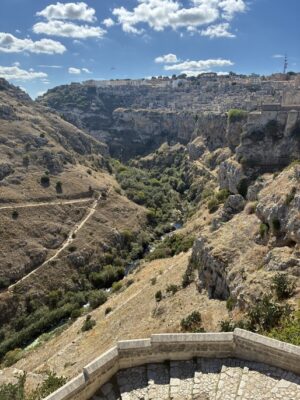
This dramatic ravine immediately drew me in. I walked toward it to perceive its vertical expanse below, to the river far below. Bushy vegetation interspersed with trees hugged and adorned the river in a narrow, slightly meandering swath, dominated on either side by the natural cliff wall formed through hundreds of thousands of years of water-cut erosion. Far and high on the opposite cliff face I could see scores of naturally carved caves — protective rock cavities that once, deep into the past, harbored groups or families of human occupants. Today they remained vacant and devoid of obvious evidence of any human presence, though they still provide natural visual reminders of an ancient accommodating environment.
___________________________

___________________________

___________________________
This was the Gravina di Matera. I dedicated one day to hiking and exploring this compelling landscape. The trail began at the edge of the city, introducing me to a very steep, roughly cut stone stairway leading to the first natural rest stop for trail walkers. I made my way slowly down this, the ‘city’ side of the Gravina, making periodic stops to shoot photos as I approached the river at its base. My destination, the Neolithic caves, from this point appearing as distant, small, irregular black holes punctuating the high rocky cliff face far above on the opposite side of the ravine, compelled me forward.
___________________________

___________________________
___________________________
The hike downward was moderately precarious, with no handrails for support on either side, despite the necessity of straddling a trail edge that, with one unintended slip, could lead me plummeting to certain injury, if not death. I encountered couples and a few small families with children along the way, people hailing from Italy, Germany, the UK, the U.S., and other countries — some of the children robustly scampering the trail with no regard for the unguarded edge just inches away from their feet.
Reaching the bottom of the Gravina, it became a gentle, level hike beside the river’s flowing water and picturesque greenery, a significant stretch that would accommodate a relaxing and scenic stroll for anyone. In time, the terrain inclined with a rocky outcrop that met the suspension bridge, the only way to easily traverse across the bed of the ravine to reach the other side. It was a one-minute crossing at an easy walking pace.
____________________________

____________________________

____________________________
With the city-side cliff now behind me, I began to make my way up the opposite side of the ravine, my sights set squarely on the summit above me. The climb was rigorous. A slight injury of my right ankle from a careless fall the day before weakened my gate and made me considerably more careful than I otherwise would have been, so each step was slow and deliberate, but deliberately forward. I stopped, more than once, to rest, hydrate, and shoot more images of the, now distant, ancient city crowning the summit across the ravine from me. Its panorama became more breathtaking as I progressed upward on the trail, affording numerous new photo opportunities.
The reward for my efforts came less than an hour after the beginning of my ascent. A final push put me onto a natural rock terrace featuring an amazing assemblage of 3 caves, one large and two much smaller. Before exploring the caves, I stopped and relaxed to enjoy the high, panoramic view of the Gravina below me, and the ancient city spread across the summit on the opposite side of the Gravina. It was easy to see why the ancients settled and built there. With a strategic view of the region around them, set atop subterranean water resources and in a defensible position from any would-be attackers, it was ideal.
______________________________

The view of Matera as I ascended toward the caves above me.
______________________________
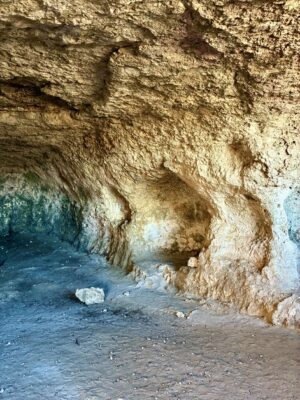
I peered in from the exterior edge of the largest cave. It was shallow enough to see the back wall, and well-lit by the natural light streaming in from outside, so it was easy to see that it was empty of any surprises in terms of animals and large insects. Walking in, the surface beneath me was impacted soil, with a few large stones nature or previous animal and human activity had scattered about, breaking visual monotony. The lines and undulations of the walls of the cave were fascinating to look at, carved by the erosive power of nature. There was enough space here to accommodate a small family, or one or two individuals who preferred a spacious abode. I thought about what may have transpired in this space over the millennia. These caves were likely visited, not only by animals, but by Paleolithic and Neolithic humans, as well. I didn’t know the history of any scientific exploration or excavation of this cave, but I was surmising that not enough investigation has been made of this place to know the history for certain. I imagined, with some funding and other resources, a good survey with possible ensuing excavation could reveal a human prehistoric presence dating back into Pleistocene times. Certainly the geology would support the suggestion that this cave, with the river below as a fresh water source, could have existed for the benefit of archaic Homo sapiens or even Neanderthals. Research and studies have shown that what is today known as Italy was a land occupied by early humans hundreds of thousands of years ago. Investigations have only touched the surface for evidence still likely buried across this ancient land. Scarcity of money and time are the biggest obstacles to expanding our knowledge.
______________________________

______________________________

______________________________

______________________________
______________________________

______________________________

Above and below: the view from the interior back wall of the cave, looking back at Matera.
______________________________

______________________________
I did not venture into the smaller caves. My impression was already complete.
Gathering my backpack and camera, I began my descent back to the river far below, the suspension bridge, and what turned out to be a moderately grueling ascent to return to my original starting point on the edge of the city.
I was not alone. I encountered scores of individuals, and even a few small families along the way — visitors from all over the world, young and old.
______________________________
Article Supplement
A Prehistoric Land
We know that what is currently called Italy was occupied by early humans, or hominins, as much as 850,000 years ago. Evidence for this has been discovered at the site of Monte Poggiolo, where thousands of Paleolithic artifacts were recovered. A fossil of the genus Homo (Neanderthal) was discovered in 1993 in a cave near the city of Altamura, Italy. Though well preserved, it was covered in calcite. Dating of the calcite indicated it was between 128,000 and 187,000 years old. Other Neanderthal fossils dating to about 50,000 years ago were discovered at 20 other sites, including Grotta Guattari at San Felice Circeo, on the Tyrrhenian Sea south of Rome; the grotta di Fumane (in the province of Verona) and the Breuil grotto, in San Felice.
___________________________
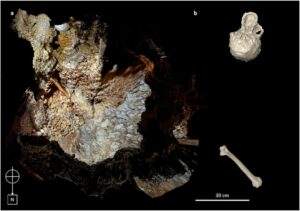
Three-dimensional model by photogrammetry of the back chamber of Altamura cave as seen from above. Part of the ceiling has been digitally removed to show the inside. The red rectangle indicates the position of the cranium and the right humerus, zoomed in b) model of the back of the cranium (above) and a digital model of right humerus (below) showing the relative positions of the two specimens. Costantino Buzi, Marco Boggioni, Andrea Borsato, Giovanni Boschian, Damiano Marchi, Jacopo Moggi-Cecchi, Antonio Profico, Alessandro Riga, Marco Samadelli, Giorgio Manzi, CC BY 4.0, Wikimedia Commons
___________________________

Altamura skeleton as seen when discovered within the cave. Costantino Buzi, Marco Boggioni, Andrea Borsato, Giovanni Boschian, Damiano Marchi, Jacopo Moggi-Cecchi, Antonio Profico, Alessandro Riga, Marco Samadelli, Giorgio Manzi, CC BY 4.0, Wikimedia Commons
___________________________
Homo sapiens sapiens, or modern human, remains have also been found, the earliest dated to about 48,000 years ago in Riparo Mochi. Homo sapiens fossil teeth were unearthed in 1964 at the Grotta del Cavallo, dated to between 43,000 and 45,000 years ago. The Villabruna rock shelters in the Veneto region of Italy yielded modern human remains dated to about 14,000 years ago. In 2011 a complete human skeleton, Amsicora, was discovered at Pistoccu in Marina di Arbus and dated to 8500 years ago. And Italy’s Val Camonica features a series of rock engravings (petroglyphs) dated from 8,000 BC to 1,000 BC with scenes depicting the daily life of prehistoric humans, abstract symbols and animals.
The Neolithic period (6000 BC — 3000 BC) saw the transition from the nomadic lifestyle of hunting/gathering to settled agriculture in Italy as evidenced at sites like Lagozza in Lombardy, Passo di Convo in the region of Puglia, and here in Matera.
Research and investigations continue to uncover evidence that Italy is an ancient land that hosted migrating and settling populations long before the recognized elements and trappings of urbanized civilization.
______________________________
A City of Caves and Churches
With my hiking journey now complete, a can of chilled Fanta never tasted so good and refreshing as the one I acquired at the very strategically located outdoor café overlooking the Gravina near the entrance gate of the trail. It was an establishment the owners surely knew, I thought to myself, would be a business winner when they made their plans to create it.
Leaving the café, it was only a short walk back to my room at the Sant’Angelo resort. My room was, quite literally, a cave. Not only a luxury resort, Sant’Angelo is best known for its rooms carved directly from the natural stone, with some of the rooms adapted from already existing caves. The light tan stone of my cave room bestowed a feeling of light, and with the artificial light of the lamps and the sun filtering through my windows, it hardly felt like the dark, closed-in ambience typical of most caves. It was, in fact, like living within a work of sculpture.
___________________________

The Sant’Angelo resort. Front entrance.
___________________________
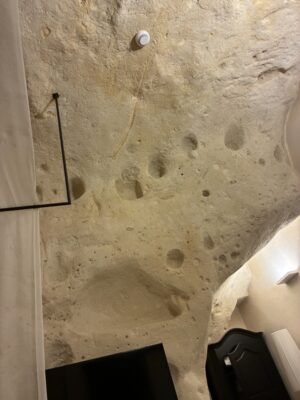
The cavernous bright of my room.
___________________________
Like Sant’Angelo, Matera is a habitation characterized by caves — spaces created by nature where people historically lived their daily lives, and other, much larger caves where people worshipped. It is how old Matera derived its famous name, Sassi (stones) di Matera, a maze-like urban system of spaces carved by nature and human settlers into the calcarenitic rock. Here, Byzantine and Benedictine monks transformed the many caves on the landscape into churches, embellishing their interiors with stunning frescoes and other decorated religious spaces, now part of the Park of the Rupestrian Churches.
___________________________

Above and below: the Sassi di Matera.
___________________________

___________________________
I ventured into one of those churches. It was, in contrast to the churches I have entered before, an endearingly intimate space. It was the feeling, not only the structure and interior decor and objects, that gave this place its unique impression. It was as much personal as it was ecclesiastical. It was but one example of the powerful religious culture that permeated this ancient city. Aside from the historic structures, restaurants, shops and resorts that gave the city its draw for tourists, there appeared to be more Christianity per square foot here than any other place on earth, excepting the Vatican.
___________________________

Above and below: interior view of Rock Church of Sant’Agostino al Casalnuovo, 13th – 17th century.
___________________________

___________________________
Underlying all of this, the city’s inhabitants, over thousands of years, created an extensive subterranean network of cisterns and underground structures for water management and other uses, such as animal stables and cellars. I entered one of these, perhaps the most magnificent, subterranean structure to get a feel for the genius of their water management practices. Known as the Palombaro Lungo, it was built in 1832. With massive pillars carved from the rock and a vault height of more than fifteen meters, it has been described as a water cathedral, navigable by boats. It is a testament to the genius of historic engineering in stone and water management that has given this city its remarkable character.
The Promise of the Gravina
My journey through the Gravina had to be unfortunately cut short due to my personal injury. Still, these few caves offered me a taste of the scores of caves that punctuated the walls of this magnificent ravine. With future archaeological investigation, new stories of Matera’s prehistory will be written. And perhaps, as is the case at other sites of prehistoric Italy, new evidence will be uncovered shedding light on the early journeys of hominins — humans of deep time — enlightening our understanding of human evolution and early human migration in this critically prehistorically important region of the European continent.
I made a mental note to return to this place. There were many more caves to explore. And much more to see in a city where visible spaces belie the works that lie behind and beneath them.