Is Tutankhamun’s Tomb the Entrance to a Hidden Royal Burial?
By Menna Tallah Salah Eldin
With the inauguration of the Grand Egyptian Museum, global attention has once again turned toward Ancient Egypt. Alongside international fascination, a renewed local pride has emerged, accompanied by calls for the repatriation of iconic artifacts removed from Egypt under questionable circumstances—most notably the famous bust of Queen Nefertiti, now displayed in Berlin.
While much of the world searches for Nefertiti’s image abroad, this article poses a different question: where is Nefertiti herself?
Through historical context, architectural analysis, funerary precedents, and direct field observations in the Valley of the Kings, this writer proposes a coherent hypothesis: that the tomb known today as KV62—conventionally attributed to Tutankhamun—may originally have been designed as Queen Nefertiti’s royal tomb, with Tutankhamun later buried within it under exceptional circumstances.
Who Was Nefertiti?
Queen Nefertiti—whose name means “The Beautiful One Has Come”—was the Great Royal Wife of Amenhotep IV, better known as Akhenaten, a pharaoh of Egypt’s Eighteenth Dynasty. Far from a ceremonial consort, Nefertiti ruled as Akhenaten’s political and ideological partner, appearing in reliefs performing royal rituals traditionally reserved for kings.
She bore six daughters and played a central role in Akhenaten’s religious revolution, which elevated the sun disk Aten above all other deities.
The Mystery of Nefertiti’s Disappearance
Nefertiti vanished abruptly from historical records toward the later years of Akhenaten’s reign. Scholars have proposed numerous explanations: exile, death, a change of royal name, or even a brief reign as a female pharaoh.
This article adopts a more pragmatic hypothesis: Nefertiti withdrew from public rule after Akhenaten’s death, transferring authority to Tutankhamun—her son-in-law—and living the remainder of her life away from political power in order to stabilize relations with the priesthood and restore religious balance.
Such withdrawal would naturally explain the absence of her name from later inscriptions without implying disgrace or erasure.
How Old Was Nefertiti at Death?
If Nefertiti withdrew from power around age 35 and lived through most of Tutankhamun’s reign, her age at death would likely have been approximately 44 years, placing her well within the age range of royal burials prepared long in advance.
Why Tutankhamun’s Tomb Raises So Many Questions
KV62 is anomalous. Despite Tutankhamun ruling for nearly ten years—a period sufficient to complete a substantial royal tomb—his burial chamber is notably small and architecturally inconsistent with other Eighteenth Dynasty kings.
The steep descent into the tomb suggests an originally ambitious design, yet the interior abruptly narrows, implying that KV62 may represent only a portion of a much larger original plan, or that it was adapted from a tomb intended for someone else of higher status.
______________________________

The author at the entrance of Tomb KV62 (Tutankhamun), documenting on-site observations during field inspection.
______________________________
Nefertiti and the Original Tomb Design
Akhenaten and Nefertiti ruled jointly for 17 years. It was customary for Egyptian rulers to begin constructing their tombs at the start of their reigns. While Akhenaten chose Amarna as his burial site, political and religious tension may have prompted Nefertiti to commission her tomb in the traditional royal necropolis: the Valley of the Kings.
At that early stage, since Akhenaten and Nefertiti ruled during the middle of Egypt’s Eighteenth Dynasty, few kings had yet been buried there, and no queens possessed independent royal tombs. Nefertiti may therefore represent the first queen for whom such a tomb was planned—following the precedent of Hatshepsut, who shared a tomb with her father.
The link between Akhenaten’s royal tomb and the Tutankhamun Tomb
Although Akhenaten’s royal tomb at Amarna was conceived as a large, multi-chambered complex intended for the king and possibly members of the royal family, there is no direct archaeological or textual evidence indicating that Queen Nefertiti was ever buried there. While side chambers within the Amarna tomb have been interpreted by some scholars as potentially reserved for royal relatives, none bear inscriptions, iconography, or burial equipment explicitly naming Nefertiti. Her absence from the tomb’s dedicatory texts is particularly striking given her prominence during Akhenaten’s reign.
In contrast, the scale disparity between Akhenaten’s royal tomb and the tomb of Tutankhamun in the Valley of the Kings is significant. Akhenaten’s tomb extends deep into the cliffs of the Royal Wadi at Amarna and was clearly designed as part of a large, long-term funerary project, whereas Tutankhamun’s tomb (KV62) is remarkably small and architecturally constrained for a king who ruled nearly a decade. This contrast raises the possibility that KV62 does not represent a complete, standalone royal tomb, but rather a repurposed or truncated section of a larger, pre-existing funerary plan—potentially one originally prepared for a figure of higher status, such as Queen Nefertiti. The absence of any indication that Nefertiti was buried alongside Akhenaten at Amarna further strengthens the argument that her intended burial place may instead lie within the Theban necropolis, concealed within an unfinished or later-adapted royal monument.
How Does Tutankhamun’s Tomb Fit into This Narrative?
Following Akhenaten’s death, Egypt faced instability: religious reversal, weakened central authority, and labor shortages. Tutankhamun ascended the throne as a child and died unexpectedly.
Under such conditions, constructing a new royal tomb was impractical. The most viable solution was to inter Tutankhamun within an already prepared royal tomb—Nefertiti’s—by modifying its entrance and adding a subsidiary burial space.
Precedents for Shared Royal Tombs
Shared burials were not unusual in the Valley of the Kings:
- Thutmose I and Hatshepsut (KV20): The tomb was modified decades later to accommodate Hatshepsut, with corridors reworked and decoration altered.
- Ramesses V and Ramesses VI (KV9): Ramesses VI reused the tomb, erasing his predecessor’s cartouches and redecorating walls.
These cases establish reuse, modification, and architectural compromise as accepted royal practices.
How Does Multiple Burial Affect Tomb Design?
- Redistribution of chambers
- Addition of side annexes
- Alteration or removal of earlier inscriptions
- Variations in artistic style within the same tomb
All of these features are observable in Tutankhamun’s tomb.
Architectural Clues from Field Observation
Direct observation in the Valley of the Kings reveals:
- All tombs feature carved reliefs—except KV62, whose walls are painted rather than carved.
- Ramesses III (KV11): Construction was redirected to the east to avoid an existing tomb, demonstrating how architectural obstacles shaped royal burials.
- Most royal tombs descend deeply into the mountain, while KV9 (Ramesses V & VI) is unusually shallow yet fully completed.
- KV9 lies directly north of KV62, while KV62 descends far deeper.
This spatial relationship suggests that, similar to what happened in KV11 where the construction was redirected to avoid the existing tomb, KV9’s shallow design may have resulted from encountering an underground obstacle and the proximity of KV9 north of KV62, combined with the greater depth of KV62, supporting the hypothesis that KV9 was constructed above an earlier tomb, avoiding it.
In other words, KV9 may have been built over the original tomb of Nefertiti and Tutankhamun, with the northern wall serving as a structural boundary.
_____________________________

Hypothetical cross-sectional illustration showing KV62 beneath KV9, with a proposed extension beyond the northern wall.
_____________________________
The North Wall of KV62
In 2015, British Egyptologist Nicholas Reeves proposed that the north wall of the main burial chamber of KV62 conceals a sealed doorway leading to a hidden chamber—potentially Nefertiti’s burial.
Ground-penetrating radar surveys conducted by Japanese, American, and Italian teams between 2015–2018 produced conflicting results, prompting Egyptian authorities to suspend further investigation.
Why the Northern Wall Opposite the Descent Corridor Deserves Investigation from an architectural perspective
There are moments when physical presence reveals what documents and data cannot. Entering a space allows patterns, inconsistencies, and structural logic to emerge instinctively—not as intuition alone, but as informed spatial reasoning shaped by observation and experience. It’s as if the place speaks in its own language and reveals secrets and you just have to listen carefully to know the hidden secrets.
When observing the northern wall facing the descent corridor in KV62, it raised significant questions. In royal tomb design, corridors typically continue along a main axis toward the burial chamber, with subsidiary chambers branching off laterally. The presence of a solid wall directly opposing the descent corridor interrupts this expected spatial logic. Such an architectural anomaly suggests the possibility of a blocked continuation of the original axis, rather than a terminal wall by design. This deviation from standard tomb planning warrants focused investigation, as it may indicate an intentionally sealed passage rather than a structural endpoint.
Based on the above, from the observation of the tomb, this writer agrees with Reeves proposal that there may be a hidden burial room, but it differs regarding the place of the hidden passage for the burial room.
_________________________________

Inside KV62, photographed by the author during fieldwork.
_________________________________
Why Radar May Have Failed
Howard Carter documented that upon entering KV62 in 1922, he initially mistook the massive wooden shrine for a wall. If a similar shrine and other artifacts exist behind the north wall, radar signals would likely be distorted—explaining inconsistent readings.
_________________________________
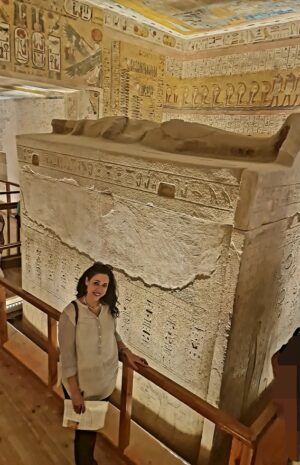
The author inside the tomb of Ramesses IV, standing beside the massive granite sarcophagus lid. The scale of the lid illustrates how such large stone elements—if present in a hidden chamber—could significantly interfere with radar-based void detection.
_________________________________
An Alternative Proposal for better results: Metal Detection
Rather than searching for voids, this writer proposes non-invasive metal detection.
If we are to expect a complete royal burial behind the wall, then a complete royal burial would normally contain:
- A gold funerary mask
- Gilded coffins or shrines
- Dense concentrations of precious metals
So, advanced electromagnetic or magnetometric scanning could detect such materials without breaching the wall, providing a clearer indicator than radar.
Conclusion
This article does not claim discovery. Instead, it presents a structured hypothesis grounded in:
- Historical chronology
- Architectural precedent
- Funerary practice
- Field observation
- Scientific plausibility
Where the question remains open—but legitimate:
Does the Tutankhamun tomb cover up the visible entrance to the real tomb of the great Queen Nefertiti?
And more importantly:
Does Nefertiti’s complete burial still lie hidden behind the northern wall?
_____________________________
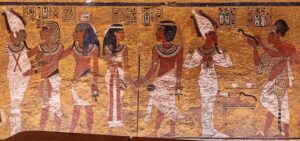
The north wall within the tomb. Diego Delso, delso.photo, License CC BY-SA 4.0, Wikimedia Commons
_____________________________
References & Sources
- Reeves, Nicholas. The Burial of Nefertiti? (2015)
- Carter, Howard. The Tomb of Tutankhamun (1923)
- Wilkinson, Richard H. The Complete Valley of the Kings
- Ministry of Tourism and Antiquities (Egypt), radar survey reports 2015–2018
- KV20, KV62, KV9 architectural plans (Theban Mapping Project)
- Wilkinson, Richard H. The Complete Valley of the Kings
- Valley of the Kings architectural surveys
- Personal field observation, Valley of the Kings (2025)
- Dodson, Aidan. Amarna Sunrise
- Arnold, Dieter. Building in Egypt
_____________________________
 The author, Menna Tallah Salah Eldin, is an independent Egyptian researcher based in Egypt, with a focus on ancient Egyptian civilization.
Read the full premium article, The Lost Tomb of Queen Nefertiti, for much more.
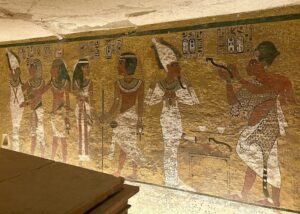
Cover Image, Top Left: Interior view of the tomb showing the north wall. ولاء, CC BY-SA 4.0, Wikimedia Commons