Following is an interview conducted by the author of Dr. Kathleen Sheppard, Professor of History at Missouri S&T in Rolla, Missouri, and the Director of the Center for Science, Technology and Society. Her research focuses on the history of women in the professions, specifically Egyptology in the so-called Golden Age (1885-1925).
Where does the story of European Egyptology begin? When do women enter?
It begins pretty early, with the Greeks and Romans in 300s BCE, but in the modern era it begins with the French entering Ottoman Egypt in 1798. Women enter the picture pretty early, in terms of being consumers of Egyptian history in their home countries, but they start arriving in the 1820s and 30s with husbands, brothers, or sons. On their own in the 1860s. After that, they never leave and become experts just like the men do.
“In January 1864, Lady Duff Gordon – Lucie—woke each morning to the sunrise peeking over Luxor Temple’s ancient columns.” Your book, Women in the Valley of the Kings, takes us to another time and place; we’re brought to the adventure right away. Can you tell us about this fascinating woman and her Letters from Egypt?
Lucie Duff Gordon had tuberculosis in the mid-1850s and had to leave England by about 1860. She ended up in Egypt in 1862 and almost never left it. In order to pay for her life in Egypt—she had to leave her family in England—she published the letters she wrote home. They’re full of social and political commentary as well as detailed discussions of her life in Egypt. People, especially potential travelers and women, made the book a best-seller. She died in 1869 from tuberculosis.
____________________________
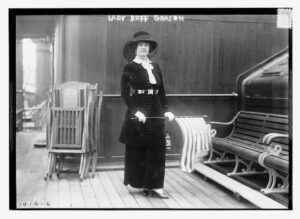
Lady Duff Gordon. Bain News Service, publisher, Public Domain, Wikimedia Commons
____________________________
Was Amelia Edwards inspired by Lady Duff Gordon’s book? Can you tell us why she’s called the Godmother of Egyptology?
Amelia Edwards went to Egypt in 1873, partly to see where Lucie Duff Gordon had lived in Luxor, at the French House. Edwards was a traveler anyway, but reading Duff Gordon’s letters had inspired her to go to Egypt herself. And she fell in love with it. She is called Godmother of Egyptology because she founded—and funded—some of the first academic Egyptology happening in Britain. Her work founded the Egypt Exploration Fund (now Society) and her money founded the first chair of Egyptology at a UK university—the Edwards Chair of Egyptology at UCL.
Can you give us some of the highlights of Marianne Brocklehurst — and what was her connection to Amelia Edwards?
Brocklehurst was a wealthy woman, partnered with Mary Booth, and the two of them traveled up the Nile in 1873-74 with Amelia Edwards. When Brocklehurst and Booth came home to Bolton, with hundreds of artifacts they purchased, they began to work on a museum in Macclesfield, UK. Booth and Brocklehurst went to Egypt a few more times together as well.
You wrote about Brocklehurst’s Temple of Mut in Asher (1899). Can you tell us a little about Amun and Mut and the temple?
It was Maggie Benson who wrote the Temple of Mut in Asher with her partner Janet Gourlay. Amun and Mut were the chief god and goddess of the region near Luxor in the New Kingdom, so their temple complex at Karnak is important as a worship site. Mut was a cat-headed goddess, sometimes appearing as a lion or a woman in a red dress.
___________________________

Relief from Temple of Mut. LBM1948, CC BY-SA 4.0, Wikimedia Commons
___________________________
To continue our journey: in 1894, Maggie Benson headed up the Nile for the first time. Was she searching for the cure — and searching for ancient Egypt as well? Can you tell us some of the highlights?
Benson was looking to ease her breathing and her rheumatism. She had not been searching for anything other than that. But her time in Egypt made her think she wanted to learn more, and her brother Fred encouraged her to excavate. So she found the Temple of Mut, wanting to dig up the cat-headed statues she could sort of see.
Can you add Janet Gourlay (Nettie), who was close to Maggie Benson?
Nettie had trained with Flinders Petrie at University College, London, so when she met Maggie in 1895, they were a perfect pair. The two worked together for two seasons and were partners until Nettie died in 1912.
If I recall — Emma Andrews and her partner Theodore Davis (who lived in a mansion with a garden designed by Olmsted) funded major excavations of Percy Newberry? And did Emma and Theodore also work on excavations and other aspects of the study of Egypt?
They first were tourists in Egypt, from 1889-1900. In 1900 they started funding Newberry, who already had permission to excavate. They began working with Howard Carter in 1901/02. But in 1902, they became private sponsors for archaeologists working in the Valley of the Kings. They did this until 1915, when they gave up their concession.
___________________________

Pathway to Valley of the Kings. CC0 1.0 Universal, Wikimedia Commons
___________________________
Ah, Howard Carter – didn’t he work for one of the famous Egyptologists just mentioned?
When Carter arrived in Egypt at the age of 17, he worked for Flinders Petrie as a draftsman/artist.
___________________________

Theodore Montgomery Davis. Public Domain, Wikimedia Commons
___________________________
Speaking of towering figures, Margaret Murray. What did she do and teach? Why is she so important?
Margaret Murray was the first university-trained woman in British Egyptology. She was trained at University College London, by Flinders Petrie. She in turn trained many of the women who came after her, in this book. Her career, lasting from 1894 until her death in 1963, was long and distinguished. She published dozens of books and articles. She developed the first 2-year university training program for Egyptologists, and ran it for 2 decades, training dozens of famous Egyptologists.
She was instrumental in deciding what Egyptologists in Britain should know, and then teaching them that. I would argue she is the foundation of 20th century British Egyptology.
______________________________

Margaret Murray, Public Domain, Wikimeda Commons
______________________________
An incredible life. Can you also tell us about “Building the Dream Team?” Did Kate Griffith and Emily Paterson administrate the Egypt Excavation Fund and what were their accomplishments?
Emily Paterson was the first secretary of the Egypt Exploration Fund under Amelia Edwards. She worked closely with Kate Bradbury in the earliest days of the fund, and after Edwards’ death made most of the administrative decisions. They kept up correspondence with archaeologists in the field, made sure bills were paid, distributed artifacts to museums, and so much more.
Are these women and others often overlooked since they’re not men and they’re not out in the field making big headlines?
Even though their names are on almost every piece of correspondence at the Fund for over 20 years, they are overlooked in favor of field work.
Didn’t Kate Griffith accompany Amelia Edwards on that incredibly influential and exhausting tour?
She did. It was because of Kate, I argue, that Amelia could go on the trip at all. Amelia Edwards gave over 100 lectures between November 4, 1889 and March 30, 1890 throughout the United States. She spoke to audiences that numbered in the thousands, keeping them all rapt with attention about the study of ancient Egypt.
She left behind her a legacy of interest and, most of all, funding throughout the areas she visited. Many of the Egypt Exploration Fund US branches were in existence until the middle of the 20th century, expanding the reach of the interested general public in Egyptology in the US.
____________________________

Amelia Edwards. B.O. Flower (ed.), Public Domain, Wikimedia Commons
____________________________

From A Thousand Miles Up the Nile by Amelia Edwards. Pearson, G., CC BY-SA 2.5, Wikimedia Commons
____________________________
There are of course still in-person conferences and lectures. But with Zoom and other digital technologies, some of the living power of lectures has drained away. Do you mourn this process, this change?
There are still plenty of opportunities for live lectures in towns and cities across the US and Europe, likely all over the place. People just need to take advantage of them. Sometimes I think people are spoiled for choice, but that can also be exhausting. We live in a world where there is just a bit too much.
In Women in the Valley of the Kings, you beautifully describe how Myrtle Broome wrote to her parents from Egypt. What were some of the things she did and wrote about?
Broome wrote about everything. She wrote about work, and growing carrots, and making gloves, and their servants, and driving their car across the desert. And thank goodness she did! Her letters are better than many diaries I’ve read, in terms of the useful historical content. She was very close to her parents.
Was Myrtle connected to UCL and also Flinders Petrie? Can you comment on the last two?
Broome was in the first group of students that joined Margaret Murray’s 2-year training program. So, I would say she was more trained by Murray than Petrie. And Murray helped her hone her art skills to be better at copying art on tomb and temple walls. Murray had perfected that skill herself in her two years in the field (1902-04). She worked in the field with Petrie at one or two sites, but most of her time was with Calverley at Abydos.
There are others in that chapter who knew and worked with Myrtle Broome, such as Olga Tufnell, Amice Calverley and others. I recall that they were involved in very important excavations in Abydos and other places – can you highlight some of that?
Olga Tufnell and Broome worked together at Tell el Ajjul, copying art that was rapidly deteriorating in the tombs there. She became a very well-known archaeologist working in Palestine. Broome worked primarily with Calverley at Abydos from 1929-1937 where they copied the art in the Temple of Seti I at Abydos. They were extremely talented artists. John D. Rockefeller Jr gave the equivalent of over $1 million in today’s money to the project, but only if Calverley stayed as director.
I fondly recall the beautiful way you describe Caroline Ransom Williams walking into the youngish Metropolitan Museum of Art in 1910 – as well as the picture of her on a ladder at Medinet Habut. Can you tell us about her? And can you tell us about her connection to James Breasted?
Ransom was from Toledo, and given an above average education for a girl at the time. She attended the University of Chicago, beginning in 1898, finishing her Master’s degree in 1900, and her PhD under James Breasted and Frank Tarbell in 1905. She immediately went to Bryn Mawr but got tired of administrative duties keeping her from her research work, so she moved to New York in 1910 to work at the Metropolitan Museum of Art. Albert Lythgoe brought her on as Assistant Curator. She was there until 1916, when she left, got married, but continued working in several positions for the rest of her life. I like to think if she were a man, we would know a whole lot more about her. About all of these women.
____________________________

Great Hall – Metropolitan Museum of Art. Daderot, CC0 1.0 Universal, Wikimedia Commons
____________________________

Mastaba Tomb of Perneb at the Metropolitan Museum of Art. CC0 1.0 Universal, Wikimedia Commons
____________________________
In the Epilogue, you wrote that “they deserve a reckoning, these women in the Valley of the Kings.” They were amazing and courageous trail blazers, weren’t they?
Yes! I think so. The reckoning they deserve is that they existed at all and were able to do the things they did do in the situations they were put in. They inspire me all of the time.
____________________________
Kathleen Sheppard is currently Professor of History at Missouri S&T in Rolla, Missouri, and the Director of the Center for Science, Technology and Society. Her research focuses on the history of women in the professions, specifically Egyptology in the so-called Golden Age (1885-1925). She has written several journal and magazine articles, book chapters, and books about these issues. Her most recent work, Women in the Valley of the Kings: The Untold Story of Women Egyptologists in the Gilded Age (2024), is a story that brings all of the themes of women in Egyptology at the turn of the century together in one carefully woven narrative. Following the lives and careers of over a dozen women, Sheppard tells the story of Egyptology in a whole new light: the work that women did in the field. They got dirty, they dug, they had adventures. They also formed the foundations of institutions in Western Egyptology: the very institutions that allowed the discipline to survive and thrive.
Among other positions in professional societies, Sheppard is a Trustee of the Egypt Exploration Society. She sits on the board of the Missouri Chapter of the American Research Center in Egypt (ARCE), is the ARCE Chapter Council VP.