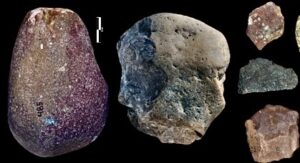
Rising to nearly 6,000 feet above sea level, Mount Homa dominates a Kenyan landscape that features sediments as old as the Miocene epoch — a geologic time period that ended more than 5 million years ago. This mountain’s real name, however, is Got Uma or God Marahuma, meaning “famous mountain,” bestowed by the Luo fishing people who have inhabited the surrounding region for centuries. Considered an inactive volcano, Got Uma, or Mount Homa, defines its namesake Peninsula, which extends into Africa’s massive Lake Victoria and helps to define the lake’s Winam Gulf, which laps the peninsula’s shoreline from the north. Though the peninsula, like anywhere else, has a regional and local natural and cultural history that extends back thousands of years, its most recent claim to fame lies in ancient sediments featuring a rich array of fossils that have drawn paleontologists, geologists, archaeologists, and many other scientists to explore and study a remarkable mosaic of prehistory. It is a mosaic that has also included evidence of a hominin presence — deep-time human relatives that have long become extinct.
Archaeologist Tom Plummer, Professor of Anthropology at Queens College, City University of New York, has been conducting field research on the Homa Peninsula since the 1990’s. Among other things, a record of significant fossil finds of Theropithecus oswaldi monkeys drew him and others to the area, as fossils of these monkeys have historically been frequently found near fossil evidence of hominins. Together with Richard Potts, who directs the Human Origins Program at the Smithsonian’s National Museum of Natural History, along with a team of other scientists and universities, he has uncovered robust evidence for hominin activity as far back as over 2 million years ago at key locations across this landscape.
One of the first “eureka moments” of these discoveries emerged at a place on the northwestern shore of the peninsula.
________________________________
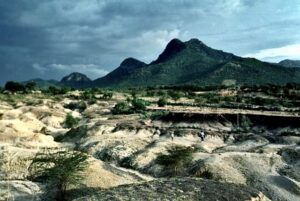
View of Mount Homa and surrounding landscape where investigations have taken place. Chip Clark (Smithsonian Institution), Public Domain
________________________________
Toolmaking and Butchery at Kanjera South
Early on, Plummer and a team of scientist specialists and excavators began investigating a site designated as Kanjera South, located near the margins of what was, at one time, an ancient lake. Digging methodically through fossil-bearing silts and fine sands, they penetrated several meters of sediment. In the process, they encountered stone artifacts and associated fauna, all revealed within three major beds. (A “bed” being a layer with a defined sequence of related or associated geologic events and fossil occurrences, such as what were initially described in excavations at Olduvai Gorge.) One 169-square meter excavation area alone yielded about 3,700 animal fossils and 2,900 artifacts in a sequence measured 1 meter in depth. Stone artifacts found during the excavation represented, according to Plummer, “one of the largest collections of Oldowan artifacts”* found to date, from anywhere in the world. The first Oldowan stone tools were discovered by archaeologist Louis Leakey in the 1930s at Olduvai Gorge. This very early technology usually consisted of simple cores, choppers, scrapers, awls and burins made of quartz, quartzite, basalt, obsidian, flint and chert. Early humans produced them by striking a core stone on the edge with a hammerstone to produce a conchoidal fracture with sharp edges and flakes that could be used for a variety of functions, such as cutting meat. Unmodified pieces, called manuports — stones transported from other locations — have also been found at some sites. Though the quantity and concentration of the Kanjera South finds at this location was significant, it was not altogether precedent-setting, because the Oldowan stone tool industry is considered, Plummer saya, “the oldest geographically widespread and long-lasting technology.”
_______________________________
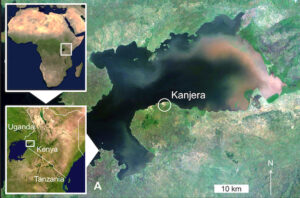
Location of Kanjera along the modern shoreline of Lake Victoria, East Africa. Joseph V. Ferraro, Thomas W. Plummer, Briana L. Pobiner, James S. Oliver, Laura C. Bishop, David R. Braun, Peter W. Ditchfield, John W. Seaman III, Katie M. Binetti, John W. Seaman Jr, Fritz Hertel, Richard Potts, Creative Commons Attribution 4.0 International, Wikimedia Commons
_______________________________
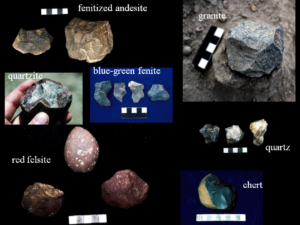
Artifacts made from a representative sample of raw materials from Kanjera. Photo credit: Tom Plummer. See The Hard Stuff of Culture: Oldowan Archaeology at Kanjera South, Kenya, by Tom Plummer, Popular Archaeology, May 30, 2016.
_______________________________
But there was more.
Notable from their analysis of the Oldowan artifacts, Plummer and colleagues observed that they had been fashioned from a great variety of raw material sources, including not only local sources of carbonate, limestone, iolite, nephelinite, and fenitized stone, but also from non-local, more remote sources for the quartzite, rhyolite, granite, basalt, and schistose stone. This led to an interesting implication. As stated by Plummer in a 2012 article published in Popular Archaeology Magazine:
“What we found is that approximately 30% of the artifacts recovered from Kanjera were made from rocks that were transported to the site from conglomerates at least 10-13 km away (Braun et al., 2008)…The finding that there are not nearly enough cores to account for all of the flakes at the site further hints that the artifact sample at Kanjera was part of a larger transport system. It appears that cores were being carried by hominins, for use to dispense flakes…”*
In this sense, the Kanjera site is unusual compared to other Oldowan sites in East Africa and elsewhere.
“The fact that hominins were investing energy in the transport of hard raw materials, and more efficiently reducing them, suggests that artifact manufacture was of great importance in their day-to-day lives,” wrote Plummer in The Hard Stuff of Culture.*
But why?
Analysis of the faunal remains at the site has given some clues. The site investigators recorded a comparatively significant number of associated bones of small antelopes about the size of or slightly larger than today’s Grants Gazelles. Bone type representation accumulated at the location suggested complete carcasses were brought to the site. Moreover, use-wear analysis of the associated artifacts, as well as damage analysis of the bones, indicated intentional cut-marks using the stone tools.
“Damage to the fossils indicates that hominins were using stone tools to slice meat off of bones, and to break bones open for their fatty marrow,” wrote Plummer.* Carnivore toothmarks were also found on the bones but most of those marks were made after the cut marks, suggesting carnivore scavenging after the hominins had completed processing the carcasses.
“The overall pattern of hominin access to the complete carcasses of small antelopes may be the signal of hominin hunting,” suggests Plummer. “If so, this would be the oldest evidence of hunting to date in the archaeological record.”[statement made based on fossil and artifact discoveries made as documented in the record by 2015]*
Moreover, use-wear analysis of the artifacts also suggested that these hominins were not limited to a carnivorous diet. They were processing a variety of plant tissues, including tubers and wood.
A new window on early hominin behavior was beginning to emerge.
____________________________
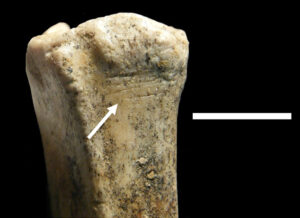
A small bovid metatarsal, bearing cut marks; from bed KS-2 of Kanjera, an archaeological and paleoanthropological site on the southern shores of the Winam Gulf of Lake Victoria, Homa Bay County, Kenya (scale: 1 cm). Joseph V. Ferraro, Thomas W. Plummer, Briana L. Pobiner, James S. Oliver, Laura C. Bishop, David R. Braun, Peter W. Ditchfield, John W. Seaman III, Katie M. Binetti, John W. Seaman Jr, Fritz Hertel, Richard Potts. Creative Commons Attribution 4.0 International, Wikimedia Commons
____________________________
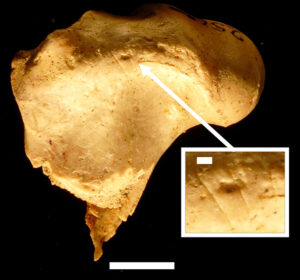
A small bovid femur with numerous cut marks. From bed KS-2 of Kanjera. Joseph V. Ferraro, Thomas W. Plummer, Briana L. Pobiner, James S. Oliver, Laura C. Bishop, David R. Braun, Peter W. Ditchfield, John W. Seaman III, Katie M. Binetti, John W. Seaman Jr, Fritz Hertel, Richard Potts. Creative Commons Attribution 4.0 International, Wikimedia Commons
____________________________
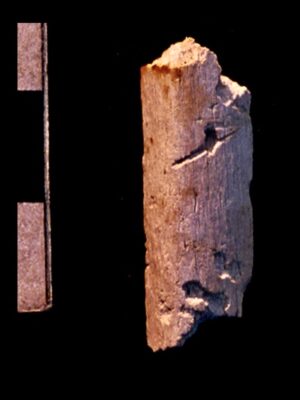
A shaft fragment from an ungulate leg bone showing a single, deep stone tool cutmark and carnivore toothmarks. One toothmark overlays the cutmark, indicating that the hominins had stripped meat off the bone prior to carnivore gnawing. Photo credit: Tom Plummer. See The Hard Stuff of Culture: Oldowan Archaeology at Kanjera South, Kenya, by Tom Plummer, Popular Archaeology, May 30, 2016.
____________________________
Retiming the Horizon at Nyayanga
While the discoveries and implications of Kanjera South were remarkable enough, Plummer and his colleagues soon found that there was much more to add to the story when they turned their attention to other sites west and south of Kanjera. Those efforts included a site known as Nyayanga (named after a nearby beach), located in the foothills of Mount Homa, a few hundred meters from the Lake Victoria shoreline.
It came on a personal referral. “Peter Onyango, one of the excavators working with us [at Kanjera South], told us that there were tools and fossils like we were finding at Kanjera near his home at a place called Nyayanga,” said Plummer. “So he showed us the place, and we began to research the exposures there.”
Plummer knew he faced a few given complications with the site location. “Because the area is densely populated with people and livestock, trampling can damage and disperse bones and stone tools as they erode out of the outcrop,” he explained. “Also, heavy rain during the wet season(s) can rapidly erode sediments of interest and wash away important fossils and artifacts.”
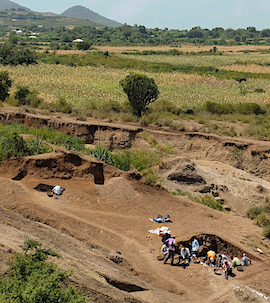
With these challenges, excavations began in earnest in 2015. Digging in 1 meter squares, they recorded and mapped all objects and fossils measuring greater than 2 centimeters with a laser theodolite. “All of the artifacts from the most ancient sediments at Nyayanga (Nyayanga Beds 1-4) were Oldowan tools,” said Plummer. The team recovered a total of 330 identifiable Oldowan artifacts, 195 from the surface and 135 in situ within the stratigraphic context. Although the assemblage was generally similar to those found at other locations, this one was distinctly characterized with a high frequency (20.6 %) of cores and a comparatively larger percentage of artifacts showing signs of percussive activity. The tools were manufactured from a variety of different raw materials, including quartz, quartzite and rhyolite.
A total of 1,776 bones were recovered and recorded, combined from two excavations (excavations 3 and 5). A large percentage of the bone remains were attributed to hippopotamids (hippos) at 57.1% and 61.9 %, respectively. Most significantly, Plummer’s team detected clear evidence of butchery among these large fauna. At least two hippos were recovered from excavation 3, the bones of one individual hippo associated with as many as 42 stone tools, including several in direct physical contact with the bones. One rib fragment featured a clear cut-mark with characteristics typically made by a stone tool, and three stone flakes exhibited use-wear patterns identifiable to butchery activity. In excavation 5, another array of bones attributable to a single individual hippo were recovered in association with 14 stone tool artifacts. Faunal remains of other animals were also found showing clear damage attributable to stone tools. Evidence pointed to hominin consumption of both meat and bone marrow.
But stone tool use was not confined to butchery activity at the site. “Our team’s analyses of stone tool butchery marks on fossils, and microscopic wear formed on stone tools used to cut and pound things, indicate that a diverse array of plant and animal foods was acquired and processed by the Nyayanga toolmakers,” says Plummer. The hominins who occupied the site, in other words, did not subsist entirely on megafauna. They had a diverse diet.
Moreover, analysis of soil carbonates, tooth enamel isotopes, and taxon in the area indicated that these hominins subsisted in a grassy woodland consisting of warm-season grasses along a stream channel and fresh-water springs within an overall savannah-like environment, a setting not unlike those found at other Oldowan sites such as Ledi-Geraru and Mille-Logya in Ethiopia. Such a habitat would have provided the hominins at this location with a diverse range of potable water, animal and plant food sources, and shelter.
What stood out most from the finds at Nyayanga, however, revolved around three eye-brow raising discoveries — the date range of the finds, the hominin fossil evidence, and the location of the finds…
____________________________
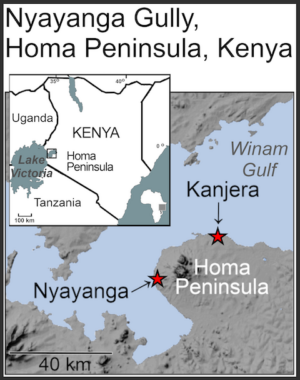
Nyayanga site in July prior to excavation. Tan and reddish- brown sediments are Late Pliocene deposits where Oldowan tools and fossils were later excavated. T.W. Plummer, Homa Peninsula Paleoanthropology Project. (lower right inset) Index map showing location of Nyayanga Oldowan site on the Homa Peninsula. J.S. Oliver, Homa Peninsula Paleoanthropology Project
____________________________
Nyayanga site being excavated in July 2016. J.S. Oliver, Homa Peninsula Paleoanthropology Project
____________________________
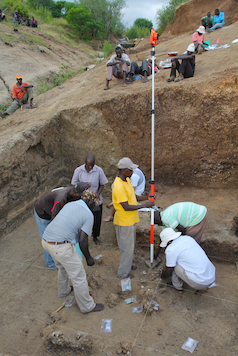
Members of the excavation team plotting and recording the positions of fossils and artifacts in July 2017 at the Nyayanga site, including the Paranthropus molar and fossils from a hippo skeleton. T.W. Plummer, Homa Peninsula Paleoanthropology Project
____________________________
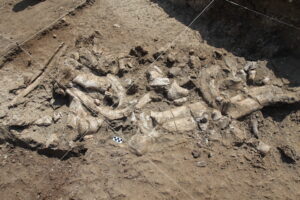
Fossil hippo skeleton and associated Oldowan artifacts at the Nyayanga site in July 2016. T.W. Plummer, Homa Peninsula Paleoanthropology Project
____________________________
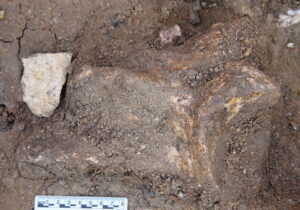
Oldowan flake lying directly on a hippo shoulder blade fossil at the Nyayanga site. T.W. Plummer, Homa Peninsula Paleoanthropology Project
____________________________
The Earliest Oldowan
As would be done in any investigation of this kind, Plummer and his team employed specialists as well as outside labs and testing centers to date the sediments and artifacts related to the excavations. Samples for magnetostratigraphic testing were sent to Andy Herries of La Trobe University, Australia, and other samples for apatite crystal testing were sent to Youjuan Li for their analysis at the Chinese Academy of Sciences in Beijing. Combining these efforts with analysis of the fossil fauna data from the sediments and comparing it with already known fauna well established in the fossil record, they were able to date the Nyayanga finds — and most significant to this investigation, the Oldowan artifacts — to between 2.58 and 3 million years old.
The results were remarkable. It meant that the artifacts found at Nyayanga could have been as much as 400,000 years older than the oldest known Oldowan artifacts discovered within the Afar Triangle area of Ethiopia that date to 2.6 million years ago.
Oldowan is older than anyone had ever thought. Moreover, these artifacts could have predated the currently known earliest horizon theorized for the emergence of the Homo genus, the hominins thought by scientists to have been the first toolmakers and that led to the advent of Homo sapiens, our own species.
____________________________
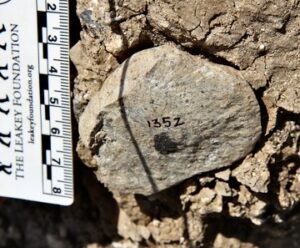
Oldowan flake at Nyayanga site in 2017. T.W. Plummer, Homa Peninsula Paleoanthropology Project
____________________________

Oldowan core exposed from erosion at Nyayanga in 2015. T.W. Plummer, Homa Peninsula Paleoanthropology Project
____________________________
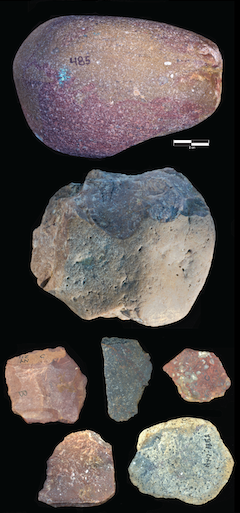
Examples of an Oldowan percussive tool, core and flakes from Nyayanga. T.W. Plummer, J.S. Oliver, and E. M. Finestone, Homa Peninsula Paleoanthropology Project
____________________________
Paranthropus — Toolmaking Cousins?
With the exception of only a few sites in the world, fossil evidence for hominins — the primates that define the evolutionary bush of human ancestry — has been, compared to other paleontological finds, relatively scarce. Thus, it was exciting for the team when they recovered two hominin fossils, a left upper molar from surface collection, and a left lower molar in direct association with the remains of a hippo that showed signs of having been butchered. The molars were identified as belonging to two individuals classified in the Paranthropus genus — an extinct hominin suggested by many scientists as being an early “sister” genus to Homo.
The possible implications of these finds were game-changing for understanding early manufacture and use of stone tools. “There are multiple species of hominins living on the landscape of Africa between 3 and 2 million years ago,” explains Plummer. “It’s widely been assumed that the oldest stone tools were made by our lineage, the genus Homo, fossils of which go back to 2.8 million years. Instead of fossils of Homo, we found teeth of a human relative called Paranthropus at Nyayanga, including at a hippo butchery site. The association of these Nyayanga tools with Paranthropus may reopen the case as to who made the oldest Oldowan tools. Perhaps not only Homo, but other kinds of hominins were processing food with Oldowan technology.”
_______________________________

Paranthropus molars recovered from the Nyayanga site. Left upper molar (top) was found on the surface of the site, and the left lower molar (bottom) was excavated. S.E. Bailey, Homa Peninsula Paleoanthropology Project
_______________________________
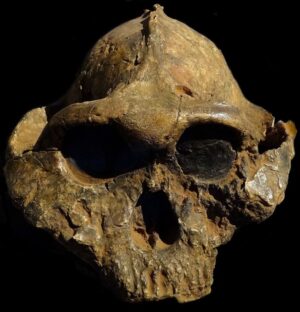
The skull of Paranthropus boisei, known as KNM ER 406, photographed at the Nairobi National Museum. Bjørn Christian Tørrissen, Creative Commons Attribution-Share Alike 3.0 Unported, Wikimedia Commons
_______________________________

Paranthropus boisei – forensic facial reconstruction. Draw made by Cicero Moraes and 3D scanning of the skull by Dr. Moacir Elias Santos. Creative Commons Attribution-Share Alike 4.0 International, Wikimedia Commons
_______________________________
The Expanding Range
For decades, the earliest occurrences of Oldowan technology were thought to be confined to East Africa, with evidence found at sites such as Gona in Ethiopia, where they were dated to about 2.6 million years ago. Enter the 2006 and 2009 discoveries made at Aïn Boucherit in Algeria, northern Africa, where a team excavated Oldowan artifacts dated to at least 2.4 million years ago. This date is considerably later than that assigned to the Nyayanga finds, but it suggested a broader geographic spread for the technology.
Thus, a new picture was emerging, and Nyayanga did much to contribute. Plummer continues: “For decades it has been thought that the Oldowan emerged approximately 2.6 million years ago in a small region in Ethiopia and then gradually spread across Africa. Our discovery of sites that are between 3 and 2.6 million years old at Nyayanga, southwestern Kenya, expand the geographic range of the earliest Oldowan by 1,300 kilometers, demonstrating that this technology was more widespread at its inception than previously recognized.”
Plummer recognizes the essentiality of connecting the inception, functions and impact of stone tools and toolmaking to our understanding of human evolution. “Humans (Homo sapiens) are odd primates,” Plummer explains. “We have unusually big brains, extensively share nutrient dense foods, form large social networks, and can survive in a wide array of environments. While some species of nonhuman primates produce technologies that assist in foraging, humans are uniquely dependent on technology for survival. But the evolutionary origins of this reliance on technology for survival is shrouded in mystery…Investigating what Oldowan tools were used for, and how important they were for the survival of the hominins (human relatives) that made them, are important issues for understanding human evolution and the origins of human technological dependency.”
However, Oldowan was not the first industry on the stage of hominin tool invention. Remarkable finds near Lake Turkana in Kenya have raised new questions…
Before Oldowan
Just west of Lake Turkana in northwestern Kenya, the rocky, arid terrain of the desert badlands, like a southern New Mexico landscape, can wear a hiker down very quickly. For Sammy Lokorodi, a local Turkana tribesman who is a resident of the region, this is a familiar and livable landscape. He is also, among other things, a fossil and artifact hunter. As an integral part of scientific field expeditions, he has been specially trained by experience to see and excavate fossils and artifacts that likely could be millions of years old, teasing them from a surrounding matrix of desert rock and soil.
But one day in 2011, while working as a member of the field team for the West Turkana Archaeological Project (WTAP), he found himself front-and-center in a discovery that would raise new questions with far-reaching implications about the human evolutionary past.
“Our project has been working in this region of northern Kenya for 20 years, and, in 2011, we made a plan to survey for early stone tools in very old sediments,” said Dr. Sonia Harmand, a French archaeologist and co-director of the WTAP project field team. “So on the morning of July 9,” she continued, “we were on the way to a particular survey zone, where Meave Leakey and her team found a hominin skull back in 1999.”
While driving in a dry riverbed, Harmand and her party came to a point where it branched off to the left and to the right. They chose the left branch. In time they could see, however, that they were off course. They were lost—but, as she and her colleagues soon discovered, they were lost in a very fortuitous way.
“Something was really unique about this place,” she said. “We could tell that this zone had a lot of hidden areas just waiting to be explored. So for an hour before teatime, while trying to head back to the main channel, we surveyed around and spotted a few strange rocks on the surface. We surveyed around a bit more intensely, and that’s when Sammy Lokorodi, one of our Turkana team members, called us over to the site where we found these oldest stone tools.”
_______________________________
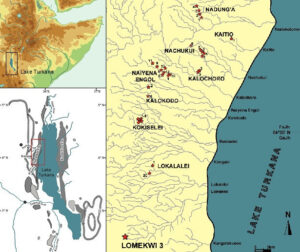
The mapped location of the Lomekwi site, west of Lake Turkana. Courtesy West Turkana Archaeological Project. As illustrated in Straddling the Evolutionary Divide, Popular Archaeology, June 11, 2015.
_______________________________
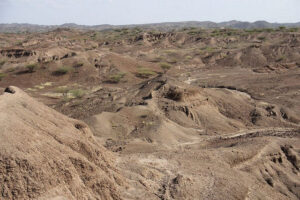
The Lomekwi site area is not unlike an American Southwest landscape. Courtesy MKW and West Turkana Archaeological Project. As shown in Straddling the Evolutionary Divide, Popular Archaeology, June 11, 2015.
_______________________________
A New Stone Tool Industry
“Oldest stone tools” turned out to be the operative phrase. What they found, over two field seasons spanning 2011 and 2012, was an assemblage of simple stone tools that exhibited a combination of characteristics unlike any they had ever seen before. In some ways, they resembled the simplest stone tool industry best known to date—that of the Oldowan. In other ways, however, these newly found artifacts differed. By experimenting with the same stone material to replicate what they had found, the researchers concluded that these objects were something altogether distinct from that of the Oldowan. The “lithics (cores and flakes) are significantly larger in length, width, and thickness” than the Oldowan-type tools discovered at many other sites in eastern Africa, noted Harmand and her colleagues. “The dimensions and the percussive-related features visible on the artifacts suggest the hominins were combining core reduction and battering activities and may have used artifacts variously: as anvils, cores to produce flakes, and/or as pounding tools. The use of individual objects for several distinctive tasks reflects a degree of technological diversity both much older than previously acknowledged and different from the generally uni-purpose stone tools used by primates [such as using stones exclusively to crack open nuts].” The arm and hand motion employed in the production of the tools were somewhat less sophisticated than that employed in producing Oldowan tools, the researchers observed. “The “knappers’ understanding of stone fracture mechanics and grammars of action is clearly less developed than that reflected in early Oldowan assemblages…the assemblage could represent a technological stage between a hypothetical pounding-oriented stone tool use by an earlier hominin and the flaking-oriented knapping behavior of later, Oldowan toolmakers.”**
In other words, what Harmand and her colleagues were looking at was an entirely new stone tool industry, previously unknown to the science. And though simpler or more “primitive” than that of the Oldowan, these were clearly not made or used by chimpanzees or some other primate. The “artifacts indicate that their makers’ hand motor control must have been substantial and thus that reorganization and/or expansion of several regions of the cerebral cortex (for example, somatosensory, visual, pre-motor and motor cortex), cerebellum, and of the spinal tract could have occurred,” stated Harmand and colleagues in the research report related to the discovery.**
By the end of the 2012 season, the artifact assemblage totaled 149 lithic objects in all, including “83 cores, 35 flakes (whole and broken), seven passive elements or potential anvils, seven percussors (whole, broken or potential), three worked cobbles, two split cobbles, and 12 artifacts grouped as indeterminate fragments or pieces lacking diagnostic attributes.”** They assigned them to a new lithic tool industry, the “Lomekwian,” named after the hill site where they were initially found, Lomekwi 3, or LOM3.
How were these stone tools used?
“This is the key question everyone is still trying to answer,” says Harmand. “Early members of our lineage surely first began making tools to solve a problem, but what problem that was remains unclear. Maybe they needed sharp flakes to cut or otherwise process new food resources, whether animal or vegetal. Maybe they were using the cores to pound open nuts or bones. In any case, this development was important because it represents the ability to modify our environment, to imagine tools that aren’t naturally there and make them from available raw materials, and use those tools to solve problems and better survive.”
_________________________________

Sonia Harmand excavating a stone tool find. Credit MKW and West Turkana Archaeological Project. As shown in Straddling the Evolutionary Divide, Popular Archaeology, June 11, 2015.
_________________________________
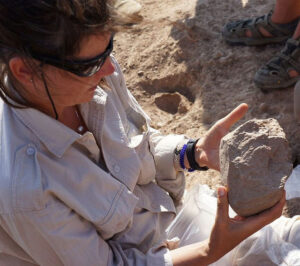
Sonia Harmand examines a stone tool, just unearthed. To the untrained eye, it looks like any stone, but to the scientists who know how and where to look, it bears the unmistakable signs of having been intentionally worked by hand in antiquity. Credit MKW and West Turkana Archaeological Project. As shown in Straddling the Evolutionary Divide, Popular Archaeology, June 11, 2015.
_________________________________
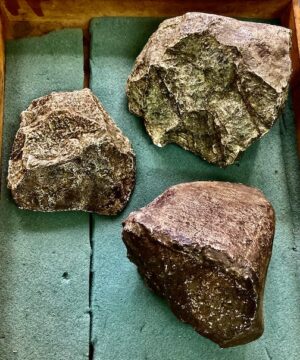
Lomekwi stone tool casts as displayed at the National Museum of Kenya in Nairobi.
_________________________________
Though the finds were tantalizing by themselves, none of them would be more significant without their context in time. The team called on Christopher Lepre, who was at the Department of Earth and Planetary Sciences, Rutgers University, to take a look at the contextual sediments of the finds. Arriving one week after the initial discovery, he collected samples of sediments from a series of different depths associated with the artifacts. Returning to the Lamont-Doherty Earth Observatory lab at Columbia University, he worked closely with Dennis Kent to cut the samples into sugar-cube-sized blocks and place them into a magnetometer. This measured the polarity of key grains of minerals within the sediment known as hematite and magnetite, a record of the time periods in the past when the Earth’s magnetic field reversed itself. “We essentially have a magnetic tape recorder that records the magnetic field … the music of the [earth’s] outer core,” said Kent. Comparing their measurements with the already-known chronology of those changes going back millions of years, they were able to determine the dating of the artifacts.
The results: These stone tools were between 3.33 and 3.11 million years old. That made them the oldest stone tools ever found.
Moreover, scientists were able to develop a picture of the environment in which the toolmakers must have lived. They did this by studying carbon isotopes in the sediments, conducting forty-seven isotopic analyses on eleven paleosol samples using a Micromass Optima mass spectrometer. They also examined the animal fossils recovered at the site. What they found was surprising: These tools were fashioned in a partially wooded, shrubby environment — not a dry savannah. It belied the broadly accepted evolutionary paradigm that toolmaking emerged, at least in part, due to adaptation by early humans to the spread of the dry, savannah grassland environment, analogs of which can still be seen today in the modern east African landscape.
The implications of these findings were enormous. It meant that there was a group of hominins living in a partly wooded, shrubby land who made simple stone tools before the Oldowan, the earliest examples of which are now dated to between 2.58 and 3.0 million years ago at Nyayanga.
The Lomekwian Toolmakers
So who were the Lomekwian toolmakers?
“It is unclear at the moment who the most likely maker of the tools was,” said Jason Lewis of Rutgers University, a lead researcher and lead author of the study on the Lomekwi finds. “We can be fairly certain it was a member of our lineage and not a fossil great ape, as modern apes have never been seen knapping stone tools in the wild. Which of the members of our lineage it was, however, remains to be determined. The most likely possibilities include Kenyanthropus platyops (the fossils of which are from just a few hundred meters from the LOM3 site), Australopithecus afarensis [the species best known through the famous Lucy discovery], or an as-yet undiscovered early member of the genus Homo.”
Kenyanthropus platyops fossils which were first discovered in 1999 by Justus Erusas, a member of the expeditionary team led by Meave Leakey, is considered by many scholars to be a hominin species that lived 3.2 – 3.5 million years ago in the Lake Turkana region. It is not yet certain whether Kenyanthropus belongs with the Homo genus or the Australopithecus genus, but its discovery has added to the growing consensus that there may indeed have been multiple species, and perhaps even multiple genera, of hominins living at roughly the same time. Early humans and their proto-human cousins may have, together, been a diverse lot.
____________________________
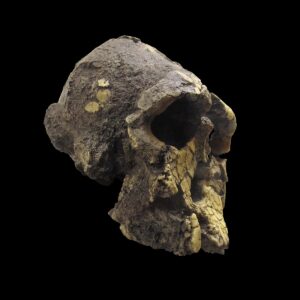
Fossil skull of Kenyanthropus platyops. Cantonal Museum of Geology in Lausanne, Switzerland. Creative Commons Attribution-ShareAlike 3.0 France, Wikimedia Commons
____________________________
Moreover, there is already arguable evidence that tool production and use was taking place even before LOM3. In 2009, a team of researchers at the site of Dikika in Ethiopia discovered 3.39 million-year-old animal bones featuring slash marks and other cut marks, evidence of intentional de-fleshing. It is considered the earliest possible evidence of hominins consuming meat and marrow. Although no tools were found at the site, it was clear that the marks were made by either sharp-edged stones or more finely crafted stone tools. Who were the possible hominins responsible for the Dikika cut marks? Fossil remains of Australopithecus afarensis are (as of this writing) the only hominin fossils found in the area of Dikika dated to the same time period.
In any case, even if/when any additional hominin fossils are discovered at or near the LOM3 site, certainty about the identification of the toolmakers may continue to be elusive. As Lewis states, “it is extremely rare to be able to pinpoint what fossil species made which stone tools through most of prehistory, unless there was only one hominin species living at the time, or until we find a fossil skeleton still holding a stone tool in its hand.”
Most important of all, the LOM3 findings may require a re-thinking of what constitutes the “evolutionary divide” between Homo, the genus that gave rise to us—Homo sapiens—and proto-human precursors such as the australopithecines.
“The idea was that our lineage alone took the cognitive leap of hitting stones together to strike off sharp flakes and that this was the foundation of our evolutionary success,” said Lewis. “This discovery challenges the idea that the main characters that make us human, such as making stone tools, eating more meat, maybe using language, etc., all evolved at once in a punctuated way, near the origins of the genus Homo. If the makers of the LOM3 tools were australopiths or some other non-Homo species, then that tells us some of these main traits were important for our lineage’s survival before the origins of Homo. If they were made by an even earlier and as-yet-unknown member of the genus Homo, that’s a different but equally interesting story, in which our genus evolved half a million years before and in response to completely different natural selective pressures than we currently think.”
__________________________________
*Plummer, Thomas, The Hard Stuff of Culture: Oldowan Archaeology and Kanjera South, Kenya, Popular Archaeology Magazine, 30 May 2016.
**Harmand, Sonia, et al., 3.3-million-year-old stone tools from Lomekwi 3, West Turkana, Kenya, Nature, Vol. 521, 21 May 2015.
Quotations related to the Nyayanga finds were sourced from interview questions posed by Popular Archaeology to Dr. Thomas Plummer.
Quotations related to the Lomekwi finds were sourced from interview questions posed by Popular Archaeology to Jason Lewis and Sonia Harmand of the West Turkana Archaeological Project, Turkana Basin Institute, and from subject press releases by the project participating institutions.
___________________________